
- First in Europe: Finland's Helsinki University Hospital (HUS) has launched Europe's first in-hospital Boron Neutron Capture Therapy (BNCT) facility using the
nuBeam®accelerator-based neutron source. - Patient Impact: BNCT treatment typically requires just 1-2 sessions, compared to weeks or months of traditional radiation therapy.
- Global Context: Japan has already treated hundreds of patients with BNCT, and China and South Korea are advancing their own clinical trials.
Experts view this milestone as a significant advancement in cancer treatment, offering a highly targeted and efficient therapy with reduced side effects, though further trials are needed to establish its broader efficacy across different cancer types.
Finland Unveils Europe's First In-Hospital Cancer-Killing Neutron Beam
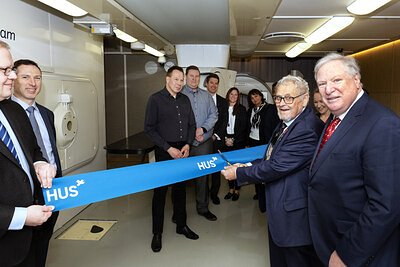
HELSINKI, FINLAND – February 12, 2026 – A decade of international collaboration culminated today in Helsinki as officials and scientists celebrated the formal opening of Europe's first in-hospital Boron Neutron Capture Therapy (BNCT) facility. Located at the Helsinki University Hospital (HUS), the center represents a monumental leap forward in cancer treatment, moving a highly precise and powerful therapy from the confines of nuclear research reactors into a clinical setting, making it vastly more accessible to patients.
The ribbon-cutting ceremony, attended by Finnish Minister of Social Affairs Kaisa Juuso, HUS CEO Matti Bergendahl, and Neutron Therapeutics co-founder Bill Buckley, marked a milestone for a facility that has already been quietly changing lives. Since May of 2025, the center has been treating patients as part of a clinical trial, offering new hope for those with difficult-to-treat cancers. "With BNCT we saw an opportunity to use our technology to help people with cancer," Mr. Buckley remarked at the event. "I'm very proud of what we've been able to accomplish here together with HUS."
The Patient Promise: Targeted Destruction in Two Sessions
At its core, BNCT is a two-step, cell-level precision strike against cancer. Unlike conventional radiation or chemotherapy that can cause significant collateral damage to healthy tissue, BNCT is designed for unmatched accuracy. First, a patient receives an infusion of a compound containing a stable boron isotope, boronophenylalanine (BPA). This compound is selectively absorbed by rapidly dividing cancer cells, effectively marking the tumors for destruction.
In the second step, the patient is exposed to a low-energy neutron beam. The neutrons themselves are harmless to the body, but when they are "captured" by the boron atoms concentrated inside the tumor cells, they trigger a powerful, localized nuclear reaction. This reaction releases alpha particles that have a destructive range of less than a single cell's diameter. The result is the annihilation of the cancer cell from within, while adjacent healthy cells remain virtually untouched.
For patients, the benefits are profound. The entire treatment course is typically completed in just one or two sessions, a stark contrast to the weeks or months of daily treatments required for traditional radiation therapy. This dramatically reduces the physical and emotional burden on patients and their families. The biologically targeted nature of the therapy also promises to minimize the debilitating side effects often associated with systemic cancer treatments, potentially leading to a significantly improved quality of life during and after treatment.
From Reactor to Accelerator: A Technological Revolution
The celebration in Helsinki is not just about a new therapy, but about the technology that makes it possible. For decades, BNCT has been a promising but niche field, tethered to the handful of research nuclear reactors capable of producing the necessary neutron beams. This limited its application to a small number of patients and research centers.
The new HUS facility shatters that limitation by using the nuBeam® suite, a compact, accelerator-based neutron source developed by the Boston-based company Neutron Therapeutics. This system, designed specifically for in-hospital use, replaces the need for a nuclear reactor entirely. It can be installed within a hospital's existing infrastructure, bringing the treatment directly to the cancer center. This shift is a game-changer for safety, public perception, and, most importantly, accessibility.
According to Neutron Therapeutics, the nuBeam® system also delivers the highest neutron flux of any available BNCT technology and provides a superior quality beam that adheres to stringent guidelines set by the International Atomic Energy Agency (IAEA). The higher flux allows for shorter treatment times, potentially enabling a single machine to treat thousands of patients per year, making it an efficient solution for healthcare systems.
Finland at the Forefront of a Global Race
While the HUS facility is a first for Europe, it joins a growing global movement to harness the power of BNCT. Japan has been the world's leader in this field, having already granted regulatory approval and health insurance coverage for accelerator-based BNCT for treating recurrent head and neck cancers in 2020. Japanese medical centers have treated hundreds of patients, providing a wealth of data on the therapy's safety and efficacy.
Meanwhile, a quiet but intense race is underway across Asia. In China, multiple accelerator-based systems are now in clinical study phases, and the country recently began Phase I trials for its own domestically developed boron drug. South Korea is also making significant strides, with clinical trials for recurrent brain tumors underway using its own advanced accelerator technology.
Helsinki University Hospital's role in this global narrative is that of a seasoned pioneer. The hospital began its journey with BNCT in 1992, treating over 200 patients using a local research reactor. This deep-seated expertise, built over decades, made HUS the ideal partner for Neutron Therapeutics to bring the next generation of BNCT to Europe. This long-term vision and commitment underscore Finland's position as a hub for medical innovation.
The Path Forward: Trials, Challenges, and Hope
The immediate focus at the HUS BNCT facility is the completion of its initial ten-patient clinical trial. The study is aimed at demonstrating the safety and efficacy of the nuBeam® system for patients with locally recurrent, inoperable head and neck cancer—a group with historically poor prognoses. To date, nine of the ten patients have completed their treatment, and the medical community eagerly awaits the published results.
Despite the immense promise, experts caution that the road to widespread adoption has hurdles. The success of BNCT is critically dependent on the effectiveness of the boron delivery agent. While the currently used compound, BPA, works well, researchers worldwide are in a fervent search for "third-generation" boron drugs that can target tumors with even greater specificity and be retained longer, further enhancing the treatment's effectiveness while minimizing uptake in healthy tissue.
Furthermore, broader, randomized controlled trials will be necessary to firmly establish BNCT's place in the oncology toolkit for various types of cancer. HUS plans to be at the center of this research, with ambitions to launch new trials for other solid tumors and explore combination therapies with other cancer drugs. As the first accelerator-based facility in the Western world begins to gather crucial clinical data, it paves the way for a potential expansion of this transformative therapy across Europe and into the United States, offering a powerful new weapon in the fight against cancer.