
- 1 billion people worldwide affected by Obstructive Sleep Apnea (OSA)
- Class II FDA clearance granted to ProSomnus's RPMO₂ OSA Device
- ARMS of 2.94% for SpO₂ accuracy across skin pigmentations
Experts view the FDA-cleared ProSomnus RPMO₂ OSA Device as a transformative advancement in sleep apnea care, enabling continuous, data-driven management and addressing longstanding challenges in treatment adherence and accuracy.
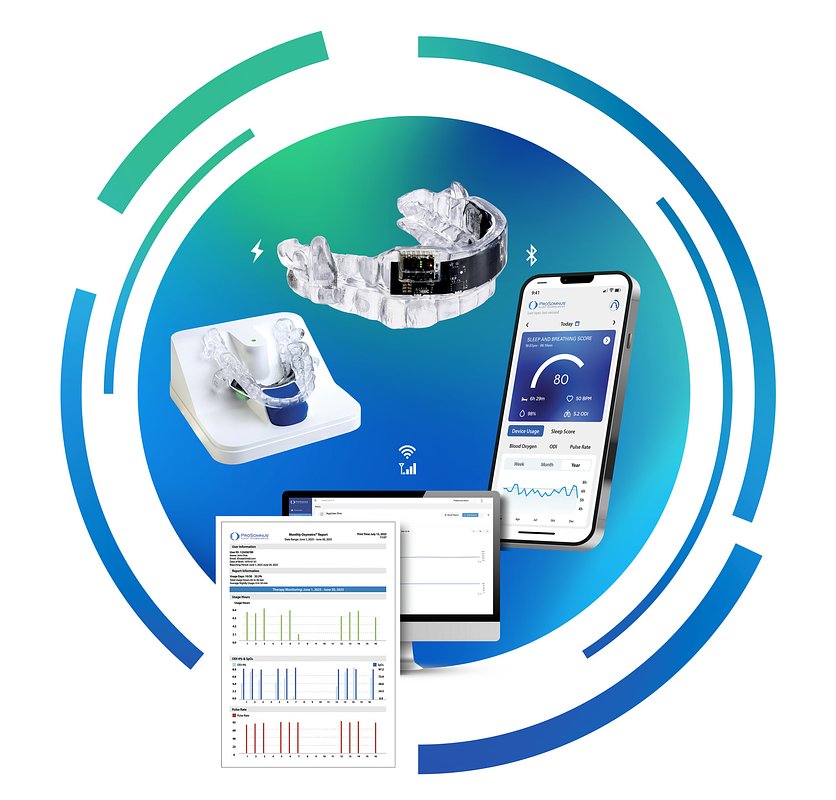
FDA Clears ProSomnus's Smart Device, Redefining Sleep Apnea Care
SAN FRANCISCO, CA – April 13, 2026 – The U.S. Food and Drug Administration (FDA) has granted Class II clearance to a novel medical device poised to transform the treatment of Obstructive Sleep Apnea (OSA), a chronic disease affecting over a billion people worldwide. ProSomnus Sleep Technologies announced the clearance for its RPMO₂ OSA Device, the first FDA-cleared “theragnostic” tool for sleep medicine, which uniquely combines therapy and diagnostic monitoring into a single, integrated platform.
The device merges a precision-engineered oral appliance, a leading non-CPAP treatment option, with a fully embedded, multi-night pulse oximeter. This breakthrough allows clinicians and patients to move beyond episodic, single-night studies and gain continuous insight into treatment effectiveness, heralding a new era of what the company calls “Smart Sleep Medicine.”
The Dawn of 'Smart Sleep Medicine'
For decades, the management of OSA has been split between diagnosis, often a one-night sleep study, and treatment, such as a CPAP machine or a custom oral appliance. The ProSomnus RPMO₂ device collapses this divide. Patients wear a custom-fit oral appliance that gently repositions the jaw to keep the airway open during sleep. Simultaneously, a miniaturized oximeter, encapsulated within the device, safely and continuously measures blood oxygen saturation (SpO₂) and pulse rate from the inner cheek mucosa. This data is transmitted via a smartphone app to a secure portal for clinicians to review.
This approach marks a significant shift from reactive adjustments to proactive, data-driven management. “The FDA’s clearance of the RPMO₂ OSA Device marks a significant milestone for sleep medicine,” stated Len Liptak, Chief Executive Officer of ProSomnus. “By integrating safe, accurate, continuous physiologic measurement into our precision oral appliance platform, we are enabling Smart Sleep Medicine—a connected, data driven model that helps clinicians manage sleep apnea as the personal, individualized and chronic disease it truly is.”
The technology represents a substantial engineering feat. “The RPMO₂ OSA Device represents years of innovation in engineering, human centric design, and rigorous scientific validation,” commented Sung Kim, ProSomnus Chief Technology Officer. “We set out to create a miniature, highly accurate, comfortable oximeter capable of real-world performance. FDA clearance confirms that we achieved this goal and opens the door to continuous insight into patient physiology.”
Empowering Clinicians in a Growing Non-CPAP Market
The clearance comes as the market for alternatives to CPAP therapy continues to expand rapidly. While CPAP is considered the gold standard, long-term adherence remains a major challenge, with some studies showing rates below 50%. Oral Appliance Therapy (OAT) has emerged as a preferred option for many with mild to moderate OSA, or for those who cannot tolerate CPAP. However, a persistent challenge for OAT has been the lack of objective, nightly data to confirm its effectiveness.
The RPMO₂ device directly addresses this gap. “Dentists play a vital role in screening and treating Obstructive Sleep Apnea (OSA),” said Mark Murphy, DDS, a leader in dental sleep medicine and ProSomnus Director. “The ProSomnus RPMO₂ OSA Device gives dental providers a powerful new tool—real world data that shows how patients are responding night after night. This enables proactive, personalized care, enhanced communication with patients and physicians, and improved outcomes.”
This flow of objective data simplifies one of the most crucial parts of OAT: titration, the process of adjusting the device to its most effective setting. “The ProSomnus RPMO2 OSA Device stands to elevate the practice of sleep medicine by simplifying device titration by allowing for the use of robust, objective SpO2 data to guide device titration where previously subjective patient feedback has been used,” noted Erin Mosca, PhD, ProSomnus Director of Scientific and Medical Affairs.
This capability fosters a more collaborative relationship between dentists and sleep physicians. With verifiable, multi-night data, dentists can provide physicians with concrete evidence of treatment efficacy, strengthening the integrated care model. “For the first time, clinicians can pair precision oral appliance therapy with continuous, longitudinal physiologic monitoring,” noted Edward Sall, MD, DDS, ProSomnus Medical Director. “This supports data driven treatment adjustments, mitigates limitations of single night testing, and positions sleep apnea care alongside modern chronic disease management paradigms.”
A Leap in Accuracy and Health Equity
Beyond its integrated design, the RPMO₂ device’s intraoral sensor placement introduces significant technological advantages over conventional fingertip pulse oximeters. The sensor is positioned in the buccal vestibule—the space between the upper lip and gums—a location that is stable, highly perfused with blood vessels, and naturally shielded from ambient light and temperature fluctuations. This design minimizes common issues like motion artifacts and poor signal quality that can plague fingertip devices.
Most critically, this innovation holds the potential to address a well-documented health disparity. Studies have shown that traditional pulse oximeters, which transmit light through the skin, can overestimate blood oxygen levels in patients with darker skin pigmentation due to melanin interference. The RPMO₂’s sensor measures through the buccal mucosa, a tissue with less melanin, aiming to provide more accurate readings for all patients, regardless of skin tone.
“The RPMO2 OSA Device provides the potential to more rapidly titrate patients on oral appliance therapy to an effective setting,” stated Sanjay V. Patel, MD. “The application of oximetry to the buccal mucosa bypasses concerns of oximetry accuracy on pigmented skin and so should help reduce existing racial disparities in sleep apnea care.”
The device’s accuracy is supported by a rigorous validation study conducted at the University of Calgary. The study, awaiting publication by Snow et al. (2025), compared the device’s readings against the clinical gold standard of arterial blood gas measurements across a wide range of oxygen levels and a spectrum of skin pigmentations. The results demonstrated strong clinical accuracy, with an Accuracy Root Mean Square (ARMS) of 2.94% for SpO₂ and no evidence of systematic bias related to skin color.
Navigating the Path to Widespread Adoption
With FDA clearance secured, the path to broad clinical adoption hinges on practical considerations like workflow integration and reimbursement. The device is well-positioned in this regard. ProSomnus notes its devices are already covered by most major commercial insurance plans, Medicare, and TRICARE for the oral appliance component, typically billed under the HCPCS code E0486.
The integrated monitoring opens a new revenue stream for clinicians through established Remote Physiologic Monitoring (RPM) CPT codes. This could allow providers to bill for device setup, data transmission, and the clinical time spent analyzing the data and managing treatment. This dual reimbursement potential makes the theragnostic approach financially viable for clinics, though it will require establishing clear workflows, particularly for collaborative billing between dental and medical providers.
Clinicians involved in preliminary research have reported transformative results. “Access to nightly physiologic data with the ProSomnus RPMO2 OSA Device has fundamentally changed how we manage OAT for OSA patients,” commented Stacey Layman, DDS. “Instead of relying on snapshot testing or symptoms alone, we can track trends over time, make more precise titration decisions, reduce unnecessary testing, and identify issues earlier.”
This level of objective data not only improves clinical decision-making but also boosts patient engagement and confidence in the therapy. “The ProSomnus RPMO₂ OSA Device has transformed how I evaluate Oral Appliance Therapy,” noted Michael J. Murray, DDS. “Multi-night, medically verified data reveals night-to-night variability that one- or two-night titration studies simply miss, enabling truly patient-specific, data-driven treatment decisions. Physician colleagues are consistently impressed by the rigor of the validation, the quality of the data, and the high patient adherence—and prefer their patients treated with therapy supported by this level of objective monitoring.”