
- 2026: Launch year of the BIBS–FF AI Robotics Institute
- February 2026: Reported start of Faraday Future's humanoid and bionic quadruped robot sales
- MOU-based: Current agreement status, with definitive terms pending FF Board approval
Experts would likely view this partnership as a strategic pivot for Faraday Future to establish itself as a leader in embodied AI, though its success hinges on overcoming significant execution challenges and industry competition.
Faraday Future's AI Gambit: New Institute Aims to Build Robot Workforce
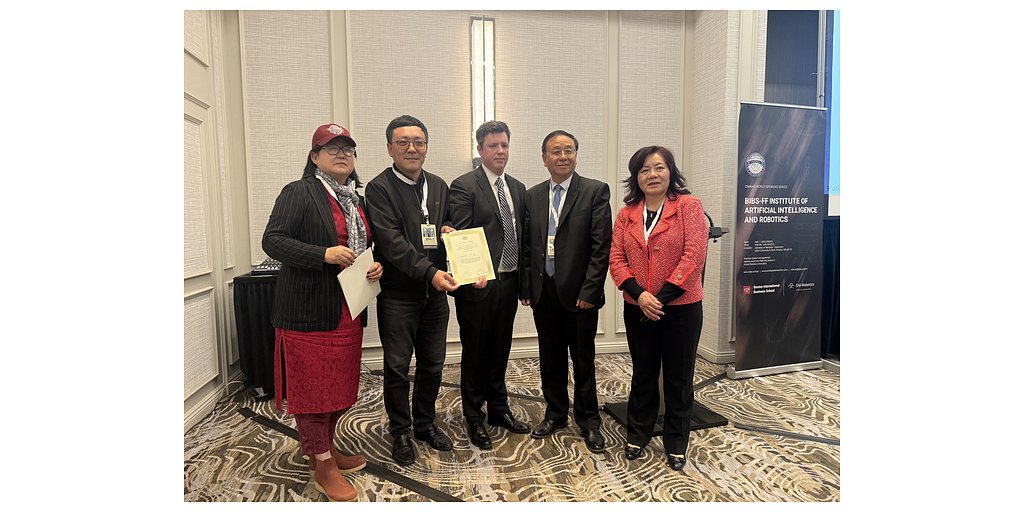
OMAHA, NE – May 08, 2026 – Amid the backdrop of the Berkshire Hathaway Annual Shareholders Meeting, a hub of traditional investment wisdom, electric vehicle maker Faraday Future announced a venture that looks squarely toward a sci-fi future. The California company has partnered with the Boston International Business School (BIBS) to launch the BIBS–FF AI Robotics Institute, an entity they proclaim is the first industry-driven Physical AI and Robotics Institute in the United States.
The announcement marks a significant strategic maneuver for Faraday Future Intelligent Electric Inc. (FFAI), a company primarily known for its luxury electric vehicles and a turbulent financial history. By co-founding an educational and standards-setting body, the company is making a bold play to position itself not just as a manufacturer, but as a foundational architect of the emerging world of embodied artificial intelligence.
A New Blueprint for AI Education?
At the core of the announcement is a novel proposed model for technical education. The institute aims to be more than a school; it's designed as an infrastructure layer for the burgeoning Physical AI era. The plan is to deeply integrate education with the real-world deployment of robotic systems, including humanoid and quadruped robots supplied by FF AI-Robotics. According to the partners, this creates a unique feedback loop.
“We are entering a new era of Physical AI, where intelligence moves from the digital world into the real world. Education is the first application scenario for our robots,” said Chris Chen, Co-CEO of FF AI-Robotics, in the official release. The vision is that “every student, every robot, and every deployment will continuously generate data to train the next generation of Physical AI systems.”
This model seeks to address a critical bottleneck in AI development: the scarcity of high-quality, real-world interaction data. While universities like MIT and Carnegie Mellon have long-standing robotics programs with deep industry ties, the BIBS-FF collaboration pitches its uniqueness in its explicit goal to use the educational process itself as a massive data factory and a testbed for setting industry-wide standards.
“Education must evolve alongside industry,” stated Professor Pedro Nueno, the distinguished co-founder of BIBS. “This collaboration represents a new model that closely integrates learning, practice, and innovation, and will cultivate truly industry-ready talent for the Physical AI era.”
Faraday Future's Strategic Pivot Beyond Cars
For industry observers, this move is less about education and more about Faraday Future's corporate evolution. After launching its high-end FF 91 EV in 2023, the company has struggled to gain traction in a competitive market. This partnership signals a dramatic expansion of its identity from an automaker to an “Embodied AI (EAI) ecosystem company.”
The company only recently announced its entry into the Embodied AI Robotics business, with sales of humanoid and bionic quadruped robots reportedly beginning in February 2026. The creation of the institute just a few months later suggests it is a cornerstone of this new strategy. By defining the curriculum and certification for the technicians who will operate, deploy, and maintain physical AI systems, Faraday Future could embed its technology and standards at the ground level of a new workforce.
However, the plan is still in its early stages. The announcement was based on a Memorandum of Understanding (MOU), with the press release noting that “Definitive agreements will be negotiated and are subject to approval by the FF Board of Directors.” This indicates that crucial details regarding funding, governance, and long-term financial commitments are yet to be finalized, adding a layer of uncertainty to the ambitious venture.
The Audacious Goal of Standardizing an Industry
The most ambitious component of the institute's mission is its goal to become a global standard-setting authority. The partnership aims to define and issue certifications for everything from robot operation and deployment to AI development, multi-scenario automation design, and data collection.
This effort comes at a time when the physical AI and robotics field is a veritable wild west of innovation. Companies like Boston Dynamics, Tesla with its Optimus project, and Figure AI are all developing sophisticated robots with proprietary software and operating principles. While standards bodies like the IEEE work on technical guidelines, there is no universally accepted framework for talent or professional certification in the rapidly advancing field of physical AI.
Creating such standards could bring much-needed coherence to the industry, ensuring a baseline of safety, skill, and interoperability. It could also give the BIBS-FF institute and its partners significant influence over the direction of the industry. The institute is launching a global call for academic partners—from K-12 schools to universities—offering them access to robotic systems, curriculum, and certification pathways in a bid to build this ecosystem from the ground up.
Execution Hurdles in a Crowded Field
Despite the grand vision, the partnership faces significant hurdles. Faraday Future is attempting this strategic pivot while still navigating the notoriously difficult automotive market. The success of its new robotics division, and by extension the institute, is far from guaranteed.
Furthermore, the Boston International Business School appears to be a relatively new entity. While its co-founders, Pedro Nueno and Liya Rong, bring extensive experience from world-class institutions, BIBS itself does not yet have the established track record or clear accreditation status of the powerhouse universities it will inevitably compete with for talent and prestige in the Boston area and beyond.
The venture enters a field populated by giants. Top-tier universities already have multi-million dollar robotics labs and deep-rooted relationships with tech behemoths like Google, Amazon, and Meta, all of which are pouring resources into embodied AI research. The BIBS-FF institute will need to demonstrate a compellingly unique value proposition to attract the best students, faculty, and industry partners.
The success of this ambitious project will ultimately hinge on execution. Finalizing the agreements, securing substantial funding, and quickly building a network of credible academic partners are critical next steps. As the global call for collaborators goes out, the tech and education worlds will be watching to see if this ambitious blueprint can be built into a lasting reality.