
- 2,500-metre drill program: Falcon Gold will conduct up to 20 drill holes to test the potential of its Central Canada Gold Project.
- Conceptual exploration target: 500,000 to 1,200,000 tonnes grading between 8 and 12 g/t gold (not NI 43-101 compliant).
- Historical high-grade results: Previous drilling revealed intercepts of 10.17 g/t gold over 3.0 metres and 18.6 g/t gold over 1.0 metre.
Experts would likely conclude that while Falcon Gold's Central Canada project shows promising high-grade potential and a compelling geological setting, the upcoming drill program is critical to validating its conceptual target and determining the project's economic viability.
Falcon Gold Drills into Ontario's Past for Future Riches
VANCOUVER, BC – May 12, 2026 – Falcon Gold Corp. has secured a critical exploration permit, clearing the way for a new diamond drilling campaign at its Central Canada Gold Project near Atikokan, Ontario. The move allows the junior exploration company to begin a 2,500-metre program, testing the potential of a site steeped in over a century of mining history and buoyed by recent high-grade discoveries.
The permit greenlights up to 20 drill holes, representing a pivotal step for the company as it seeks to validate a promising, yet highly conceptual, geological target. Situated within the historically productive Atikokan gold camp, the project lies on a major geological structure that has drawn comparisons to some of the region's most significant gold deposits. For Falcon Gold, the drills turning this season will be the ultimate test of whether this historic property holds the key to a modern, large-scale discovery.
A Golden Legacy in the Quetico Fault Zone
The Central Canada project is not a new name on the geological map. Its exploration history dates back to the early 20th century, a period that saw initial shaft sinking and small-scale production. Records from 1901 to 1907 show that a small operation yielded 27 ounces of gold from just 18 tonnes of ore—an exceptionally high grade that hinted at the area's richness. The property adjoins the past-producing Sapawe Gold Mine, which historically produced over 4,500 ounces of gold, further cementing the region's pedigree.
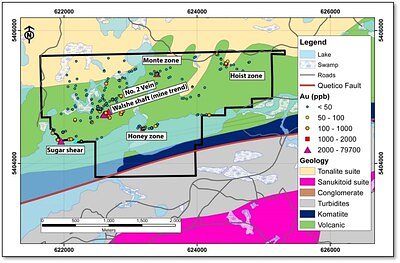
What makes this particular patch of northwestern Ontario so compelling to geologists is its position along the Quetico Fault Zone. This massive, continent-spanning structural corridor is a well-known conduit for gold mineralization. Falcon Gold's property covers a significant 10-kilometer stretch of this fault. The geological setting is often compared to that of Agnico Eagle's nearby Hammond Reef deposit, a multi-million-ounce gold resource associated with a similar major structural system. This geological "address" is a key factor driving exploration interest, suggesting that the right conditions for a major deposit could exist at Central Canada.
Falcon Gold's own work in 2020 and 2021 has already added a modern chapter to this history. Previous drilling campaigns confirmed the presence of high-grade, structurally controlled gold, with some core samples revealing visible flecks of the precious metal. Highlights from that work, including an intercept of 10.17 grams per tonne (g/t) gold over 3.0 metres and another of 18.6 g/t gold over 1.0 metre, demonstrated that the high-grade potential first identified a century ago persists at depth.
The Allure and Risk of a Conceptual Target
Bolstered by these results and historical data, Falcon Gold has outlined a conceptual exploration target that captures the project's potential scale: 500,000 to 1,200,000 tonnes grading between 8 and 12 g/t gold. While these numbers are tantalizing, the company has been transparent that this target is not compliant with National Instrument 43-101 (NI 43-101), the rigorous Canadian standard for reporting mineral resources.
This distinction is critical for investors. An NI 43-101 compliant resource estimate is based on extensive, systematic drilling and verified by an independent Qualified Person. A conceptual target, by contrast, is an early-stage projection based on geological interpretation, historical data, and limited drilling. It serves primarily as an internal guide for exploration—a hypothesis to be tested. There is no guarantee that the gold is present in the quantities or grades suggested, or that it will ever be economically viable to mine.
The upcoming drill program is designed to do exactly that: test the hypothesis. By systematically drilling the property's priority zones—including the Central Canada Mine Trend, the J.J. Walshe Zone, and the Sugar Shear—the company aims to gather the hard data needed to begin evaluating the system's true size and continuity.
"Our previous drilling confirmed high-grade mineralization and visible gold across multiple zones," said Karim Rayani, CEO of Falcon Gold, in a recent statement. "With the addition of our conceptual exploration target, this next phase of drilling is designed to systematically test and expand these zones and further evaluate the scale of the system."
From Paper to Paydirt: The Realities of Modern Exploration
Receiving the drill permit is more than just a bureaucratic checkbox; it represents the culmination of a complex regulatory process. In Ontario, securing an exploration permit requires navigating the Mining Act, which includes stringent conditions for environmental protection and mandatory consultation with local and Indigenous communities whose treaty rights may be affected. This process ensures that modern exploration is conducted with a degree of oversight and responsibility far removed from the gold rushes of the past.
With the permit in hand, the focus now shifts to the significant logistical and financial challenges of executing a 2,500-metre drill program in northwestern Ontario. Diamond drilling is an expensive and precise operation. It involves deploying heavy machinery to remote locations, establishing a temporary camp, and meticulously recovering, logging, and assaying thousands of metres of rock core.
Each drill hole is a calculated geological query, aimed at understanding the three-dimensional geometry of the gold-bearing structures. Geologists will be looking for confirmation of structural continuity between known zones, the distribution of high-grade versus low-grade mineralization, and clues about the overall geological controls on the gold system. The results from this program will be instrumental in refining the geological model and determining if the project has the potential to advance towards a maiden NI 43-101 compliant resource estimate.
A Pivotal Moment for Falcon Gold
For a junior exploration company like Falcon Gold, this drill program is a make-or-break moment. The company's value is intrinsically tied to the speculative potential of its assets, and the Central Canada project is its flagship. The funds being deployed represent a significant investment, and the market will be watching the results closely.
Positive drill results—particularly long intercepts of high-grade gold—could validate the company's geological thesis, lend credibility to its conceptual target, and attract the further investment needed for larger-scale exploration. Such success would not only be a boon for Falcon Gold and its shareholders but could also reignite interest in the historic Atikokan gold camp. Conversely, disappointing results could send the project back to the drawing board and temper market enthusiasm. This is the inherent high-risk, high-reward nature of mineral exploration, where the turn of a drill bit can determine the future of a company and, potentially, a region's next mining venture.