
- 300th F1 event milestone for Marelli's SDR, marking 30 years of safety and regulatory compliance.
- SDR 5 doubles bandwidth and monitors up to 5,000 data channels with AI-driven real-time analysis.
- 10 high-speed CAN FD interfaces and new Automotive Ethernet ports for enhanced data fidelity.
Experts agree that the SDR 5 represents a transformative leap in F1 safety and data governance, integrating AI to enable proactive issue detection and regulatory compliance.
F1's New AI Guardian: Marelli's SDR 5 Redefines Racing Safety and Data
SAITAMA, Japan – June 11, 2026 – At the Monaco Grand Prix, amidst the roar of engines and the glamour of the principality, a quiet but profound milestone was celebrated. Marelli, in partnership with the Fédération Internationale de l'Automobile (FIA), marked the 300th Formula 1 event for its Surveillance Data Recorder (SDR)—the unsung hero of F1 safety and regulation. More than just a commemoration, the event heralded a new chapter: the debut of the SDR 5, a next-generation unit poised to embed artificial intelligence at the very heart of the sport's governance.
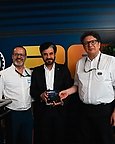
For years, the SDR has served as the official, mandatory data logger installed on every F1 car. It is the FIA's all-seeing eye, a black box that provides a continuous stream of information crucial for accident analysis and ensuring teams adhere to the sport's famously complex technical regulations. The celebration, which saw Marelli Motorsport Head Riccardo De Filippi present a commemorative unit to FIA President Mohammed Ben Sulayem, underscored the deep-rooted collaboration that has become fundamental to the integrity and safety of modern Formula 1.
The AI Co-Pilot in Every Car
The leap from the previous generation to the new SDR 5 is not merely incremental; it's a paradigm shift. Compliant with the forthcoming 2026 regulations, the new unit is a powerhouse of data acquisition. It boasts doubled bandwidth, ten high-speed CAN FD interfaces, new Automotive Ethernet ports, and the capacity to monitor up to 5,000 data channels at faster sampling rates. In a sport where a thousandth of a second matters, this exponential increase in data fidelity is a game-changer.
However, the headline feature is the integration of artificial intelligence. The SDR 5 is designed not just to collect data but to interpret it. Its onboard AI capabilities enable advanced, real-time analysis, allowing the system to detect anomalies and flag potential issues before they escalate. This transforms the SDR from a passive recorder into an active surveillance partner for FIA officials.
"Real-time data analysis is absolutely critical in advanced motorsport," stated Riccardo De Filippi, Head of Marelli Motorsport. "The introduction of the new SDR 5 will empower officials with more accurate, reliable and actionable information than ever before." This sentiment was echoed by the FIA's leadership.
"The SDR is vital for Formula 1, providing the FIA with the high-quality data needed to support safety and ensure regulatory compliance," said FIA President H.E. Mohammed Ben Sulayem. "Innovation has always been at the heart of motorsport and advanced technologies such as the new SDR 5 will play an increasingly important role in supporting FIA officials with faster, more accurate and more comprehensive data."
This move aligns with Marelli's broader strategic focus on intelligent systems. The company has already been developing AI-equipped Vehicle Control Units (VCUs) for racing applications, capable of real-time video processing and predictive analysis. The SDR 5 is a clear signal that AI is no longer a peripheral technology in motorsport but a core component of its operational fabric.
A Partnership Forged Over 300 Races
The 300-event milestone is a powerful testament to the durability and success of the Marelli-FIA partnership. The journey of data logging in F1 has been one of relentless evolution. From the rudimentary cassette-tape systems of the 1970s, used for post-race analysis, the technology has advanced to a point where terabytes of data are generated and processed over a single race weekend. Marelli has been at the forefront of this evolution, serving as a key technical partner to the sport.
The SDR's role is twofold. In the event of an accident, it provides an invaluable, second-by-second record of vehicle dynamics, sensor readings, and G-forces, allowing for precise reconstruction and analysis that directly informs future safety improvements. Concurrently, it acts as the ultimate scrutineer, monitoring everything from engine parameters to energy deployment to ensure that all teams are operating within the strict confines of the technical regulations. This dual function makes the SDR one of the most critical, albeit invisible, components in Formula 1.
The development of the SDR 5 in alignment with the 2026 regulations demonstrates a forward-looking partnership. As Formula 1 prepares for a new era of power units and aerodynamic rules, the tools to govern it must evolve in tandem. The enhanced capabilities of the new unit ensure the FIA is equipped to manage the next generation of F1 cars effectively, maintaining a level playing field and pushing the boundaries of safety even further.
From High-Speed Labs to Public Highways
While the SDR 5's immediate impact will be felt on the world's grand prix circuits, its significance extends far beyond the racetrack. For Marelli, a global mobility technology supplier with around 40,000 employees, motorsport is a high-speed laboratory. The extreme demands of Formula 1—where components must be lightweight, hyper-efficient, and unfailingly reliable—serve as an accelerator for technologies that eventually find their way into consumer vehicles.
The principles behind the SDR 5 are directly applicable to the future of mobility. Advanced data logging, high-speed connectivity, and AI-driven diagnostics are central to the development of safer, greener, and better-connected passenger cars. The expertise gained in managing thousands of data channels in an F1 car can inform the architecture of increasingly complex Software-Defined Vehicles (SDVs), where software governs everything from powertrain management to infotainment.
This technology transfer is a core part of Marelli's strategy. Innovations in power management, direct current reading, and flexible actuator management within the SDR 5 have clear parallels in the development of electric vehicle battery management systems and advanced driver-assistance systems (ADAS). As the automotive industry navigates a seismic shift towards electrification and autonomy, the lessons learned in the crucible of F1 provide an invaluable competitive edge. The SDR 5 is more than just a component; it is a glimpse into a future where every vehicle is a sophisticated, data-driven machine.