
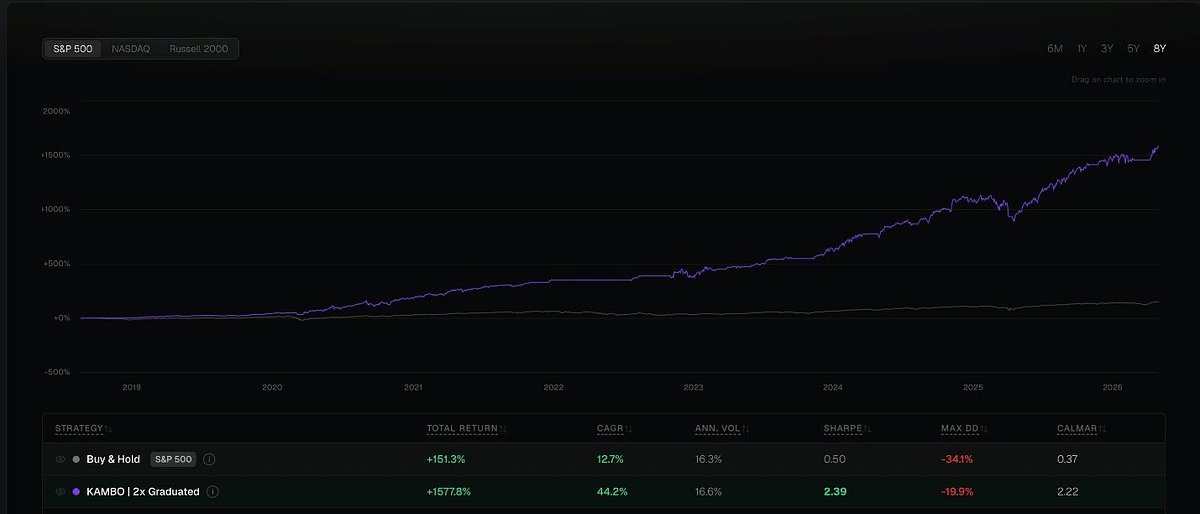
- 1,577.8% Return: Exent AI's Kambo Score achieved a simulated +1,577.8% total return over eight years, outperforming the S&P 500's +151.3%. - 92.9% Accuracy: The Kambo Score correctly identified 'Risk-On' market conditions 92.9% of the time since 2018. - Leveraged Strategy: The '2x Graduated strategy' simulated a 16x return but involved 2x leveraged ETFs, amplifying both gains and risks.
Experts would likely conclude that while Exent AI's Kambo Score presents a compelling, data-driven approach to market regime analysis, its historical performance must be balanced against the inherent risks of backtesting, leverage, and real-world execution challenges.
Exent AI's 10x Claim: Is This Wall Street's Edge for Main Street?
NEW YORK, NY – June 02, 2026
The headline is the kind that stops you cold: a proprietary AI signal that beat the S&P 500 by a factor of ten over eight years. Fintech firm Exent AI made waves today with a press release detailing the performance of its 'Kambo Score,' a market regime indicator that, in a historical analysis, generated a staggering +1,577.8% total return, dwarfing the benchmark's +151.3% over the same period.
On the surface, it’s a story about the triumph of artificial intelligence in the chaotic world of public markets. But beneath the jaw-dropping numbers lies a more profound narrative about the ongoing democratization of finance. Exent AI claims it has packaged the kind of institutional-grade intelligence once reserved for hedge funds and is now offering it to the self-directed investor. The question that hangs in the air, however, is as old as Wall Street itself: Is this a revolutionary new edge for Main Street, or is it another black box with a siren song of impossible returns?
The 'Institutional Edge' in a Box
To understand Exent AI’s claims, one must first look past the traditional tools of the retail investor. Most market timing signals available on consumer platforms rely on technical analysis—chart patterns, moving averages, and momentum indicators like RSI. These are, by definition, lagging indicators; they describe what price has already done, not the fundamental forces driving the market.
Exent AI asserts its Kambo Score is built on a different premise. Instead of looking at the market’s shadow, it aims to analyze the machine casting it. The score synthesizes four distinct sub-scores: liquidity, capital stress, cycle, and sentiment. This multi-factor framework is designed to mirror the analytical process inside large asset management firms.
The inputs are not derived from price charts alone. The platform ingests a stream of institutional-grade data, including Federal Reserve balance sheet figures, the status of the Treasury General Account, high-yield credit spreads via the NFCI, and volatility derivatives like the MOVE index. These are the vital signs of the financial system, tracking the flow of capital, the appetite for risk, and the underlying health of the economy.
“We built the Kambo Score because the average self-directed investor has no way to systematically know when market conditions favor risk-taking versus capital preservation,” the Exent AI Research Team stated in their release. By consolidating and interpreting over 20 proprietary macro inputs, the company argues it is providing a coherent narrative of market conditions—identifying 'Risk-On' and 'Risk-Off' regimes with what it claims is remarkable accuracy. The historical data suggests the signal correctly aligned with positive market outcomes 92.9% of the time in Risk-On episodes and anticipated weak periods 93.8% of the time in Risk-Off regimes since 2018. It’s a compelling argument for a shift away from reactive technicals toward a proactive, fundamentals-driven strategy.
Deconstructing the 1,577% Return
Extraordinary claims demand extraordinary evidence, and the 1,577.8% figure is nothing short of extraordinary. This performance was achieved through a simulation of the '2x Graduated strategy,' which the company’s analysis shows would have turned a hypothetical investment into nearly 16 times its initial value. This strategy involves using 2x leveraged ETFs during periods the Kambo Score identifies as 'Risk-On' and holding a standard, non-leveraged S&P 500 position during more neutral phases.
The use of leverage is a crucial detail. It acts as an amplifier, magnifying both gains and losses. While the strategy’s simulation also shows a lower maximum drawdown (-19.9%) than a buy-and-hold approach (-34.1%), indicating superior risk management during downturns, the presence of leverage adds a significant layer of risk that retail investors must understand and respect.
More importantly, these numbers are the product of a backtest. As one quantitative analyst who reviewed the methodology noted, “Backtests are a starting point, not a destination. They are conducted in a frictionless vacuum, free of transaction costs, slippage, or the emotional panic that causes real investors to deviate from a strategy at the worst possible moment.” The performance figures are calculated on a 'gross basis,' meaning they don't account for the trading fees, expense ratios of ETFs, or potential taxes that would eat into real-world returns.
The most significant risk in any AI-driven model is 'overfitting'—the danger that the model has been so finely tuned to past data that it perfectly explains history but fails to predict the future. While Exent AI’s use of fundamental economic data may mitigate this risk compared to pure price-based models, the firm’s own disclosure is the most telling guide: “Results reflect performance the strategy would have generated under historical conditions and do not represent actual trading... Past performance is not a reliable indicator of future performance.”
The New Arsenal for the Retail Investor
Even with these necessary caveats, the Exent AI platform represents a significant step in the evolution of retail investing. The Kambo Score is the headline act, but it is part of a broader suite of tools designed to bring a data-driven, institutional mindset to personal portfolio management. The platform includes a 'Radar' multi-factor screening engine, AI-driven portfolio diagnostics, and tools for analyzing concentration risk and sector exposure.
This is part of a wider fintech trend that is rapidly eroding the information asymmetry between professional and retail investors. For decades, the most powerful analytical tools were locked away in expensive terminals like those from Bloomberg or Refinitiv. Exent AI and its competitors are part of a movement to unbundle those capabilities and offer them in more accessible, user-friendly formats. The goal is to empower the self-directed investor to move beyond gut feelings and simple stock-picking to a more systematic approach to managing their capital.
By providing a clear signal for 'Risk-On' and 'Risk-Off' environments, the Kambo Score aims to solve one of the most difficult problems for any investor: when to be aggressive and when to be defensive. The platform’s visual dashboards and portfolio review features are designed to translate complex macro analysis into actionable insights, helping users understand not just what they own, but how their holdings are positioned in the context of the broader market regime.
A Tool, Not an Oracle
The rise of platforms like Exent AI signals a new era for the modern enterprise and the investors who fund it. The 'security-first' mindset is no longer just about firewalls and data protection; it extends to financial security and the strategic deployment of capital. AI-driven tools are becoming a core part of that strategy, not just for corporations, but for the individuals who are increasingly taking control of their own financial futures.
Exent AI is careful to frame its product correctly. The Kambo Score is a 'research signal,' not a crystal ball. Its own disclaimers state it is 'not investment advice.' This is a critical distinction. The platform provides sophisticated analysis, but the ultimate decision—and the assumption of risk—remains with the user. The value of a tool like this is not in blindly following its signals, but in using it to build a more robust, disciplined, and informed investment process.
The line between institutional and retail investing is becoming increasingly blurred. The advent of powerful AI, coupled with the drive to democratize data, is arming individual investors with an arsenal of tools previously unimaginable. Yet, the fundamental principles of investing—due diligence, risk management, and a healthy dose of skepticism—are more important than ever. The Kambo Score may indeed offer a powerful new edge, but it is an edge that must be wielded with wisdom and a clear understanding of its limitations.