
- 1.5 million federal FOIA requests in 2024 - Government-wide backlog surpassed 200,000 requests in FY 2022 - $60 million enterprise-wide agreement with the Department of Justice (2025)
Experts view Everlaw Prime as a promising solution to modernize government public records management, leveraging AI to streamline workflows and reduce backlogs, though challenges like algorithmic bias and regulatory compliance remain critical considerations.
Everlaw Prime Targets Government Records Chaos with Unified AI
OAKLAND, CA – May 12, 2026 – Legal technology company Everlaw has unveiled Everlaw Prime, a new platform extension designed to streamline the complex and often-overwhelming world of government public records requests. The announcement signals a significant push to equip federal, state, and local agencies with a unified, AI-powered tool to manage the full lifecycle of Freedom of Information Act (FOIA) and public records requests, from initial intake to final delivery.
Anticipated for full commercial availability this summer, Everlaw Prime integrates public records management directly into the company’s established cloud-native e-discovery platform. The move aims to replace the disjointed and often antiquated systems that currently hamstring government transparency efforts, creating a single source of truth for agencies under pressure.
“FOIA teams are being asked to manage rising request volumes and increasing scrutiny, often with the same resources and across disconnected systems,” said Pauline Day, Product Director at Everlaw, in the company's announcement. “With Prime, we’re extending those capabilities into public-facing request intake portals and case management tools – bringing those pieces together so teams can focus on the work itself instead of managing the gaps between tools.”
The Crushing Weight of Public Records
Everlaw's entry into this specific government vertical comes at a critical juncture. Government agencies are struggling under the immense weight of public records requests. According to government data, the number of federal FOIA requests has soared, approaching 1.5 million in 2024. This surge is compounded by a government-wide backlog that surpassed 200,000 requests for the first time in fiscal year 2022.
The problem isn't just volume; it's complexity. Agencies report that requests are becoming more intricate, involving vast amounts of digital data scattered across emails, messaging apps, and various databases. This digital sprawl, combined with limited budgets and staffing shortages, has created a perfect storm of inefficiency. Many public records programs rely on a fragmented patchwork of technologies—one system for tracking requests, another for searching for documents, and yet another for performing redactions. This technological disconnect forces personnel to waste valuable time navigating system gaps instead of processing records.
This strain was echoed by Angela Martin-Van der Baan, Records Manager for the City of Murrieta. “Before Everlaw, a single public records search could return thousands of broad results and take more than a day to manually sort through,” she stated. The promise of a unified system is to turn that day of manual sorting into a more focused, efficient review.
A Unified Contender in a Competitive Field
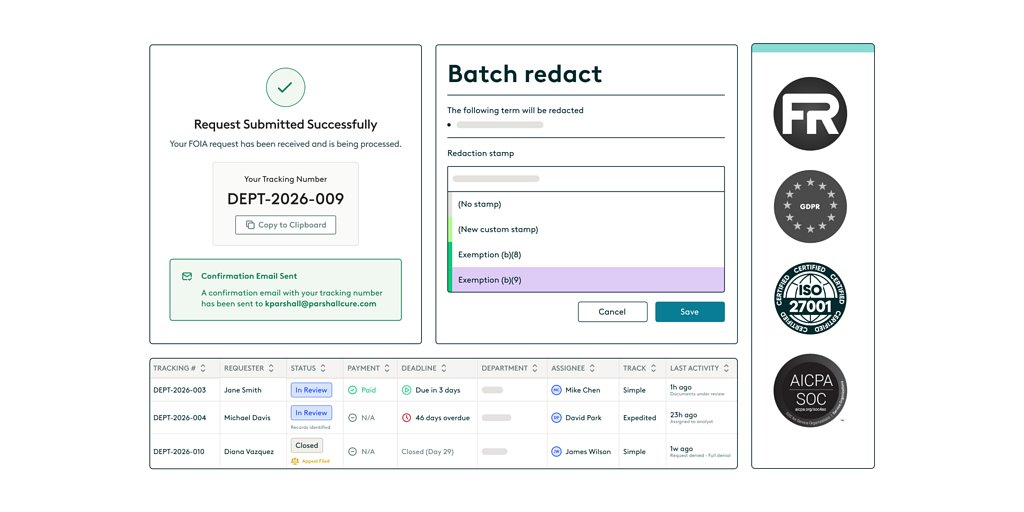
Everlaw Prime proposes to solve this fragmentation by offering an end-to-end solution. The platform’s key features include a public-facing portal for request submission, centralized case management tools for tracking deadlines and assignments, and a seamless connection to the core Everlaw review platform. This integration automatically creates a dedicated workspace for each request, allowing for rapid data ingestion and analysis.
However, Everlaw is not entering an empty arena. The government legal tech space is a competitive environment, with established players like Relativity, Nuix, and OpenText offering their own cloud-based, FedRAMP-authorized e-discovery platforms for government use. Specialized FOIA software from companies like OPEXUS (with its widely adopted FOIAXpress) and Casepoint also offer comprehensive solutions. These competitors similarly tout end-to-end capabilities and AI-driven features.
Everlaw aims to differentiate itself through its user-centric design and the seamlessness of its integration. The platform’s reputation for intuitive workflows is a key selling point. Michael Sarich, former Director of FOIA at the U.S. Department of Veterans Affairs, highlighted this in his endorsement. "What I value about Everlaw is that they listened to FOIA officers, built to our workflows, and created something that fits the way FOIA processing actually works," he said. This focus on mirroring the actual day-to-day work of FOIA officers, rather than forcing them to adapt to rigid software, could be a critical advantage.
The Promise and Peril of AI in Government
At the heart of Everlaw Prime's efficiency promise is its use of artificial intelligence. The platform leverages e-discovery-grade tools, including AI-assisted review, predictive coding, and automated redaction suggestions. These features are designed to dramatically accelerate the most time-consuming part of the records request process: sifting through thousands of documents to find responsive information and redact sensitive material.
AI can help agencies identify relevant documents with greater accuracy, ensure redactions are applied consistently, and ultimately reduce the crippling backlogs. For a records manager like Angela Martin-Van der Baan, this means “we can zero in on what’s actually responsive much faster and spend our time reviewing records instead of wrestling with the system.”
Yet, the deployment of AI in sensitive government functions is not without its challenges. The potential for algorithmic bias, the “black box” problem of not understanding how an AI reaches a conclusion, and ensuring data security are significant concerns. Government bodies and oversight organizations are actively working to create guardrails. Frameworks like the NIST AI Risk Management Framework are being developed to promote transparency, fairness, and accountability in AI systems used by the public sector. For companies like Everlaw, navigating this evolving regulatory and ethical landscape will be as important as the technology itself.
Building on a Foundation of Government Trust
While Everlaw Prime is a new offering, Everlaw is not a new player in the government space. The company has methodically built a foundation of trust with public sector clients. It has achieved critical StateRAMP and FedRAMP authorizations, security certifications that are prerequisites for handling sensitive government data. In January 2025, Everlaw secured a $60 million enterprise-wide agreement with the Department of Justice for its e-discovery platform, a significant vote of confidence.
More recently, the company announced that its generative AI features received FedRAMP authorization, making it one of the first e-discovery providers to have its full GenAI portfolio approved for public sector use. This existing infrastructure and security posture give Everlaw Prime a running start, allowing it to be presented not as a risky new venture but as a logical extension of a trusted platform.
By unifying request intake, case management, AI-powered review, and production into a single workflow, Everlaw Prime represents a significant step toward modernizing a critical government function. Its success will depend not only on the power of its technology but also on its ability to deliver a genuinely seamless experience that empowers overburdened public servants to fulfill their mission of transparency.
Topics & Related
Software & SaaS
AI & Machine Learning
Artificial Intelligence
Generative AI
Cloud Migration
AI Governance
Acquisition
Revenue
Related Company Pulse