
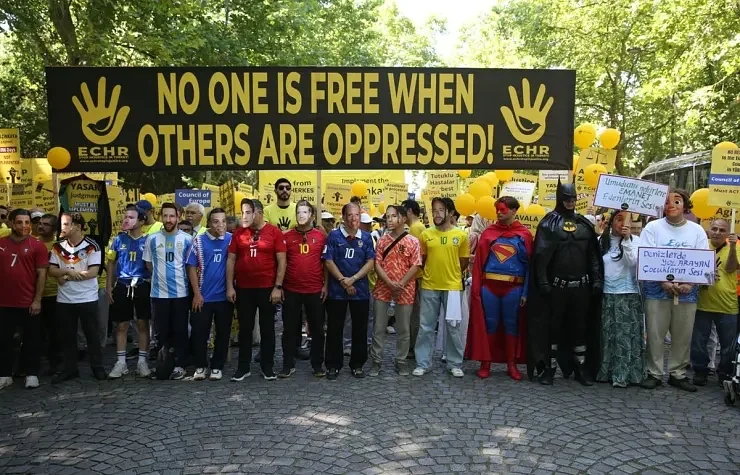
- 5,000+ protesters gathered in Strasbourg to demand enforcement of ECtHR rulings.
- 700 million Europeans across 46 member states rely on the ECtHR for human rights protections.
- Two high-profile cases: Osman Kavala and Selahattin Demirtaş remain imprisoned despite binding ECtHR release orders.
Experts warn that the systemic failure to enforce ECtHR rulings, particularly in Turkey, risks undermining Europe's rule of law and human rights architecture.
Europe's Crisis of Credibility: When Justice is Ruled, But Not Delivered
STRASBOURG, France – June 26, 2026 – A crowd of over 5,000 gathered this week not just to protest, but to deliver a verdict of their own. Standing before the Council of Europe headquarters, a coalition of expatriates, human rights advocates, and journalists issued a stark ultimatum: enforce the law or risk the collapse of the continent's entire human rights architecture. The rally, organized by the Peaceful Actions Platform and supported by groups like the International Journalists Association (IJA), was a direct challenge to the institutional paralysis that allows binding court judgments to be ignored, turning legal victories into hollow pronouncements.
At the heart of this confrontation is the European Court of Human Rights (ECtHR), an institution whose authority is being openly defied. The protestors’ message was clear: when a member state can imprison journalists, activists, and politicians in direct violation of the Court’s orders, the very concept of European rule of law is on trial. This is more than a diplomatic spat; it's a systemic failure with profound implications for strategic stability and democratic governance across the continent.
The Widening Crack in Europe's Legal Foundation
The ECtHR was established as the ultimate guarantor of rights and freedoms for 700 million Europeans across 46 member states. Its judgments are not advisory; they are legally binding obligations. The supervision of their enforcement falls to the Council of Europe's Committee of Ministers, a political body designed to ensure compliance. For decades, this system, while imperfect, has operated as a crucial backstop against state overreach. But its integrity is now facing an unprecedented stress test, primarily from Turkey.
Ankara's refusal to implement key ECtHR rulings has created a slow-burning crisis. As German MEP Michael Bloss declared to the crowd in Strasbourg, "a binding judgment left unenforced is a right denied." This simple truth exposes the widening gap between judicial authority and political will. When enforcement mechanisms are weak or unused, the Court's power evaporates, leaving it as a forum for moral pronouncements rather than a dispenser of justice. The concern, echoed by legal experts, is the risk of contagion. If one state can defy the Court without meaningful consequence, it sets a dangerous precedent for others, eroding the shared legal standards that underpin European cooperation.
The Human Face of Institutional Paralysis
This systemic crisis is not an abstract legal debate. It has a devastating human cost, personified by the individuals whose freedom hangs in the balance. The cases of civil society leader Osman Kavala and politician Selahattin Demirtaş were focal points of the rally. Both men remain imprisoned in Turkey despite multiple, unequivocal ECtHR rulings ordering their immediate release.
The Court found their detentions were not based on reasonable suspicion but pursued an "ulterior purpose" of silencing them and stifling public debate—a damning indictment of political persecution. Yet, Kavala is serving an aggravated life sentence, and Demirtaş was recently sentenced to 42 years. Their continued incarceration is a daily reminder of the system's failure.
Beyond these high-profile cases, the rally gave voice to the countless journalists, teachers, and civil servants caught in the post-2016 purge. The International Journalists Association, a Germany-based nonprofit supporting exiled and persecuted media professionals, highlighted the plight of its colleagues. "When binding court rulings are ignored and journalists remain imprisoned despite legal vindication, the foundation of press freedom and the rule of law in Europe is undermined," said Mustafa Kilic, IJA's Director of International Affairs. The organization has documented a pattern where Turkish authorities use penal codes to criminalize reporting, a practice that continues despite ECtHR judgments condemning it.
Civil Society as a Strategic Check on Power
When formal institutions falter, other actors must step into the breach. The Strasbourg rally represents a critical evolution in strategic advocacy, where civil society is no longer just observing but actively intervening to hold power accountable. The mobilization of 17 civil society organizations, alongside European lawmakers and thousands of citizens, demonstrates a new operational model for defending the rule of law. They are, in effect, performing a function that the intergovernmental bodies are failing to execute with sufficient urgency.
Participants delivered a formal letter to the Council of Europe, demanding it use its supervisory tools, including infringement proceedings—a rarely used mechanism initiated against Turkey in Kavala's case but which has yet to secure his release. The presence of parliamentarians from across Europe added political weight to the activists' demands. British MP James MacCleary's warning against trading "away human rights for short-term convenience" was a pointed critique of the realpolitik that often paralyzes international institutions. Similarly, Dutch parliamentary leader Jan Paternotte's assertion that the Court's rulings "are not there for show" but "to be honored" captured the deep frustration with the diplomatic inertia.
This coalition's actions underscore a fundamental shift: if the established guardians of a system cannot or will not enforce its rules, the stakeholders themselves will organize to force the issue. The IJA and its partners are not merely asking for help; they are demanding that the Council of Europe defend its own legitimacy. The question now is whether the Council will heed the call from its own doorstep, or if its binding judgments will become mere suggestions in the face of political defiance.