
- 1,311-metre drill program at the Zappa target
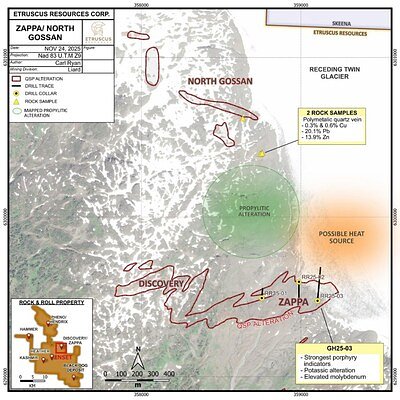
- Potassic alteration intercepted in drill hole RR25-03
- Elevated levels of molybdenum and rare earth elements (REEs) detected
Experts would likely conclude that Etruscus Resources Corp. has made significant progress in identifying a potential copper-gold porphyry system, supported by compelling geological evidence and strategic positioning within the Golden Triangle.
Etruscus Hits Porphyry Markers in Golden Triangle's Icy Depths
VANCOUVER, BC – November 25, 2025
The story of British Columbia’s Golden Triangle is one of legendary riches, geological marvels, and the persistent hunt for the next world-class deposit. In this high-stakes arena, where mining giants like Newmont and Seabridge Gold command vast resources, junior explorers must rely on sharp science and strategic execution to make their mark. Etruscus Resources Corp. (CSE: ETR) did just that this week, announcing results from its first-ever drill program at the Zappa target that have the market buzzing. While not a discovery hole in the traditional sense, the data provides compelling evidence that the company is vectoring in on a significant copper-gold porphyry system, a discovery that could transform its future.
The inaugural 1,311-metre program on its 100%-owned Rock & Roll Property didn't yield bonanza-grade intercepts. Instead, it delivered something arguably more valuable at this early stage: a clear, data-driven roadmap pointing directly toward a potential prize concealed beneath the ice of the Twin Glacier. For investors and analysts watching the capital currents in Canada’s most prolific mining district, Etruscus has just moved from a speculative play to a science-backed prospect with a well-defined target.
Deciphering the Geological Clues
Porphyry deposits are the engines of the global copper and gold supply. These massive, mineralized systems, formed by fluids released from cooling magma deep within the Earth's crust, are prized for their immense scale. Finding them, however, is a complex geological exercise in following faint clues. Etruscus’s latest results show its technical team is reading the signs correctly.
The key to this interpretation lies in alteration patterns—the mineralogical changes in host rock caused by the heat and chemistry of the mineralizing fluids. The press release highlighted three critical indicators. First, and most importantly, drill hole RR25-03 intercepted zones of potassic alteration. In the world of porphyry exploration, this is the bullseye. Potassic alteration, characterized by potassium-rich minerals, typically forms in the hot, central core of the system where the highest grades of copper and gold are deposited. Finding it is a definitive sign that drilling is getting close to the system's heart.
Second, all three drill holes encountered intense quartz-sericite-pyrite (QSP) alteration. This phyllic alteration halo typically forms a vast shell around the potassic core. Its widespread presence across the Zappa target confirms the existence of a large, powerful, and long-lived hydrothermal system—a prerequisite for a major deposit. Finally, hole RR25-03 also returned elevated levels of molybdenum, a classic pathfinder element that forms its own halo around a porphyry's copper-rich center. Geochemical vectors from the molybdenum and alteration patterns all point northeast, suggesting the main intrusive body lies just beyond the reach of this initial program, under the glacier.
As Fiore Aliperti, President and CEO of Etruscus, noted in the release, "The identification of potassic and QSP alteration is a strong indicator that we're close to the heart of the system... our first-ever drill results at Zappa clearly show we're on the right path." This methodical, science-driven approach is precisely what institutional investors look for, as it systematically de-risks a project with each dollar spent.
A Hot Spot in a Legendary District
Etruscus's Zappa target doesn't exist in a vacuum. It sits within the Golden Triangle, a region hosting some of the planet's most significant mineral endowments, including Seabridge Gold's KSM complex—Canada's largest undeveloped porphyry system—and Newmont's Red Chris mine. The area is a hotbed of activity, with over $680 million in exploration spending in 2024 alone, as majors and juniors alike vie for the next major discovery.
The significance of the Zappa results is amplified by their geological context. The drilling has confirmed that the Bronson Porphyry Trend, a known belt of mineralized intrusions, extends onto Etruscus's property. This effectively connects their project to a proven, productive geological feature, dramatically increasing its prospectivity. Furthermore, recent mapping at the North Gossan area, located a kilometer north of the Zappa drilling, suggests the mineralizing system is far larger than previously understood. The discovery of new high-grade lead-zinc-copper veins in this area reinforces the potential for a large, multi-faceted mineral district centered on a porphyry intrusion.
This regional activity provides a crucial benchmark for Etruscus. Nearby discoveries, such as Amarc Resources' recent shallow copper-gold find at its JOY project, demonstrate that the Triangle continues to deliver. For a junior like Etruscus, proving up a target in a neighborhood with such geological pedigree and active corporate interest is a major strategic advantage.
The Dual Play: Copper, Gold, and Critical Minerals
Buried within the technical data of the press release was another intriguing development that adds a compelling layer to the Etruscus story. A specific rock unit in hole RR25-03, a quartz feldspar porphyry dike, returned surprisingly elevated values of rare earth elements (REEs), including cerium, lanthanum, and niobium. While the primary focus remains the copper-gold porphyry, this finding is far from trivial.
These REEs point to a "highly evolved magma," and more importantly, create a tangible link to Etruscus's adjoining Pheno Property, which is being explored specifically as a rare earth element target. This raises the possibility of a "dual play" asset, where a single project area could host both a conventional base and precious metals deposit and a resource of critical minerals essential for high-tech and green energy applications. In an investment climate increasingly focused on supply chain security for critical minerals, this potential for commodity diversification could significantly broaden Etruscus's appeal and strategic value.
The Path Forward: Drilling Under Ice
With a clear target now in their sights, the next steps for Etruscus are both exciting and challenging. The company has announced plans to expand drilling northeastward, directly targeting the inferred porphyry core beneath the Twin Glacier. This is where the exploration story moves into its next critical phase.
Drilling under a glacier is technically complex and carries a heightened level of environmental and regulatory scrutiny. The company will need to navigate British Columbia's rigorous permitting process, which includes demonstrating robust environmental stewardship and, crucially, engaging in meaningful consultation with local First Nations. The Tahltan Nation, whose traditional territory covers much of the Golden Triangle, is a key partner in any successful resource development in the region, and securing their consent is a non-negotiable step for project advancement.
Despite these hurdles, the geological prize is tantalizing. The company has methodically followed the scientific clues, and the evidence now points to a specific, drillable location. The forthcoming drill program will test the hypothesis built on this initial success. For investors, Etruscus has successfully transitioned from a grassroots explorer to a company with a high-priority, data-supported target in one of the world's premier mining jurisdictions. The market will be watching closely to see if the next drill bit that spins beneath the ice can unlock the riches of a new Golden Triangle discovery.