
- 400 times per second: The Coherix system analyzes adhesive bead profiles at this rate for real-time corrections.
- 25% cost reduction: Claimed savings in material and labor by eliminating rework and inspection.
- $100 million invested: Coherix's financial commitment to developing its Adaptive Process Control (APC) technology.
Experts would likely conclude that this AI-driven robotic system represents a transformative leap in manufacturing quality control, shifting from reactive inspection to proactive, real-time error correction with significant cost and efficiency benefits.
Erasing Defects: How AI and Robotics Are Building a Perfect Assembly Line
ANN ARBOR, MI – June 02, 2026 – For decades, the hum of the assembly line has been punctuated by a costly reality: human and machine error. From cars to consumer electronics, the process of joining parts with industrial adhesives has been a game of probabilities, where a certain percentage of defects—gaps, bubbles, misalignments—is simply accepted as the cost of doing business. This leads to expensive rework, wasted materials, and a constant, nagging threat to product integrity. But what if the assembly line could become self-aware, correcting its own mistakes in the blink of an eye?
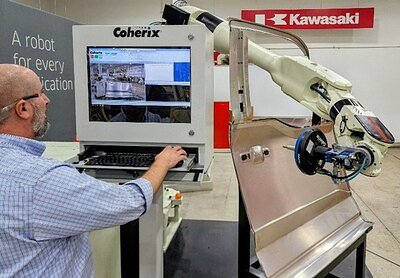
This month at the AUTOMATE 2026 conference in Chicago, a demonstration from Ann Arbor-based Coherix and industrial robotics giant Kawasaki Robotics aims to prove that this future is already here. Inside Chicago's McCormick Place, a Kawasaki 7-axis robot will glide over a Ford F-150 door skin, dispensing a bead of sealant. To the casual observer, it looks like just another automated process. But beneath the surface, a revolution is taking place. This isn't just a robot executing a pre-programmed path; it's an intelligent system that sees, thinks, and adapts, promising to make adhesive defects a relic of manufacturing's past.
From Post-Mortem Inspection to Real-Time Prevention
The traditional approach to quality control is fundamentally reactive. A part is produced, and only then is it inspected for flaws. If a problem is found—a gap in a crucial adhesive bead, for instance—the part is either sent for time-consuming manual rework or scrapped entirely. This post-mortem process is a major source of inefficiency, driving up labor and material costs.
The system Coherix and Kawasaki are showcasing fundamentally flips this paradigm on its head. It transforms quality control from a separate, downstream step into an integrated, real-time function of the manufacturing process itself. At the heart of the solution is Coherix's 3D laser-based Adaptive Process Control (APC) technology.
Mounted on the Kawasaki robot arm, the Coherix system projects a laser line onto the adhesive bead as it's being dispensed. A sensor captures the profile of that bead up to 400 times per second, analyzing its width, height, and placement with microscopic precision. If the system detects a deviation from the programmed specifications—a gap, a thin spot, or a shift in position—it doesn't just flag it for later. It instantly calculates a correction and communicates it to the robot and the dispensing equipment, adjusting the path or flow rate on the fly to fix the error before the robot has even moved on. It’s the difference between reading an autopsy report and having a doctor monitor a patient’s vitals during surgery, making life-saving adjustments in the moment.
Coherix claims this closed-loop system can reduce material and labor costs by 25 percent or more. By eliminating the need for downstream inspection stations and rework loops, manufacturers can reclaim valuable floor space, reduce labor, and, most importantly, operate at full production-line speed without compromising quality.
A Synergy of Software and Steel
This leap forward isn't the work of one company alone; it’s a product of strategic synergy. Coherix, a company that has poured over $100 million and a million engineering hours into its software, provides the intelligent 'eyes' and 'brain' of the operation. Kawasaki Robotics, with over half a century of experience in industrial automation, provides the sophisticated 'arm'—the physical instrument capable of executing the software's commands with the necessary speed and precision.
The demonstration at AUTOMATE features Kawasaki’s BU015X Series robot, a 7-axis model specifically engineered for dispensing applications in complex, hard-to-reach spaces common in automotive manufacturing. Its hollow-arm design protects cables from wear and simplifies installation, a key consideration for long-term reliability in demanding factory environments. The robot's seventh axis provides an extra degree of freedom, allowing it to maneuver around obstacles and maintain an optimal angle for dispensing, something that is critical for ensuring a perfect bead on a contoured surface like a car door.
This partnership extends far beyond a single trade show. Dwight Carlson, Coherix's chairman and CEO, noted that the companies have collaborated on multiple fronts. This includes a 'factory of the future' program at Eastern Michigan University, where a grant from Coherix and a donated Kawasaki robot are helping train the next generation of mechanical engineers in these advanced manufacturing techniques. Furthermore, Coherix’s own Innovation Center in Ann Arbor is equipped with Kawasaki robots, creating a testbed for the rapid development and validation of new solutions. This deep integration of hardware and software is what allows the system to move beyond the theoretical and deliver tangible results on the factory floor.
The Intelligence in the Machine
In an era where 'AI' is often a loosely applied marketing buzzword, the intelligence in Coherix's system is specific and purposeful. The machine learning algorithms are not just identifying patterns; they are actively solving physical problems. The system's 3D vision provides the robot with depth perception, allowing it to understand the geometry of the part in front of it, even if there are slight variations from one unit to the next.
This is where the technology truly distinguishes itself from competitors. While other companies like Nordson and Graco offer highly precise automated dispensing systems, the market has largely focused on consistency and post-process inspection. Coherix's claim to have the 'only technology in the world' capable of this level of real-time adaptive control hinges on its ability to proactively correct errors in-line. If the AI detects a gap, it can command the robot to go back and fill it before the cycle is complete, ensuring a 100% compliant part moves to the next station. It’s a move from a world of high statistical probability to one of near-certainty.
Beyond the Assembly Line
While the automotive industry—with its massive scale and unforgiving quality standards—is the initial proving ground, the implications of this technology are far broader. The challenge of dispensing precise amounts of material is universal in advanced manufacturing. In the electronics industry, where components are shrinking to microscopic sizes, ensuring the integrity of adhesive bonds is critical for the reliability of everything from smartphones to medical implants.
The aerospace industry relies on advanced adhesives for structural integrity and weight reduction. In medical device manufacturing, where a single failure can have life-or-death consequences, the ability to guarantee a perfect seal or bond is paramount. Coherix's technology, by providing detailed process data and traceability for every single part, aligns perfectly with the stringent quality reporting required in these highly regulated sectors.
What Coherix and Kawasaki are demonstrating is more than just a better way to apply glue. It is a tangible example of Industry 4.0 in action—a fusion of the physical and digital worlds where intelligent, connected systems not only monitor production but actively improve it. As manufacturers face relentless pressure to increase efficiency, reduce waste, and improve quality, this shift from reactive inspection to proactive perfection may be the most important upgrade they can make.