
- Market Value: Consumer 3D printing market valued at over $1 billion in 2025
- Elegoo's Revenue: $300 million in 2025
- Market Share: 8.4% of the personal 3D printer market in 2024
Experts would likely conclude that Elegoo's Centauri Carbon 2 Combo represents a significant step toward mainstream adoption of multicolor 3D printing, leveraging automation and user-friendly features to challenge established competitors in a rapidly growing market.
Elegoo Targets Mainstream with Centauri Carbon 2 Multicolor 3D Printer
By George Millen
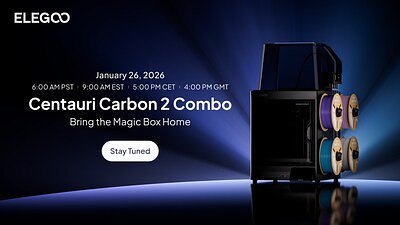
SHENZHEN, China – January 19, 2026 – Smart manufacturing firm Elegoo has announced the upcoming launch of its Centauri Carbon 2 Combo, a multicolor 3D printer aimed at moving advanced creative technology from the specialist's workshop into the family home. Set for release on January 26, the new machine is positioned to challenge the market by simplifying the historically complex process of multi-filament printing, making it accessible to beginners and hobbyists without sacrificing professional-grade capabilities.
This move comes as the consumer 3D printing market, valued at over $1 billion in 2025, continues its rapid expansion, driven by increasing demand for personalization and accessible technology. Elegoo, a major player with over $300 million in 2025 revenue, is betting that ease of use is the key to unlocking the next wave of mainstream adoption.
Democratizing Color: A New Era for Home 3D Printing
For years, creating vibrant, multicolored 3D prints was the domain of dedicated enthusiasts and professionals willing to navigate complex hardware modifications and meticulous software calibration. Elegoo aims to dismantle these barriers with the Centauri Carbon 2 Combo's intelligent CANVAS system. According to the company, this integrated system automates the entire color-switching process, managing instant filament loading and providing a built-in backup to ensure prints continue without interruption.
A key innovation is the use of RFID-based filament detection. The printer will automatically identify the type of material loaded, a feature designed to take the guesswork out of print preparation. The system then recommends optimal settings, streamlining a workflow that often requires significant trial and error. This automation is crucial for making the technology approachable for users who are more interested in the final product than the technical process.
The Centauri Carbon 2 also features a high-temperature nozzle, expanding its material compatibility beyond standard plastics and opening the door for more durable or specialized projects. Combined with faster and smarter auto-leveling, these upgrades suggest a machine built not just for simplicity, but also for reliability and versatility, catering to a spectrum of users from a child printing a school project to a professional prototyping a new product.
A Printer for the Living Room?
Elegoo is making a concerted effort to position the Centauri Carbon 2 as a household appliance rather than a piece of workshop equipment. A significant part of this "family-friendly" push is its quiet operation, rated at just 45 decibels—comparable to the ambient noise in a library. This low noise level means the printer could run in a home office, shared creative space, or even a living room without causing a disturbance.
The user experience is further simplified by a 5-inch capacitive touchscreen that promises a smartphone-like feel and supports 11 languages, making it accessible to diverse family members. This focus on an intuitive interface is critical for appealing to a non-technical audience.
Perhaps the most important element of this strategy is the integration with Nexprint, Elegoo's proprietary platform for sharing and downloading 3D models. By providing a direct pipeline of printable content, Elegoo allows users to bypass the steep learning curve of computer-aided design (CAD). This ecosystem, which the company has supported with a $1 million fund for creators, enables anyone to start printing complex, multicolor models almost instantly. This approach mirrors a successful strategy seen across the tech industry: hardware sales are increasingly driven by the strength and accessibility of the accompanying software ecosystem.
Navigating a Crowded and Competitive Market
Elegoo's ambitious push into accessible multicolor printing does not go unchallenged. The company enters a fiercely competitive landscape dominated by innovative brands that have already made significant inroads. Competitors like Bambu Lab have earned widespread acclaim for their "it just works" philosophy, particularly with their Automatic Material System (AMS) that offers reliable, high-speed multicolor printing. Similarly, Prusa Research has a loyal following and its Multi-Material Upgrade (MMU) is lauded for its efficiency, while its high-end Original Prusa XL is considered a benchmark for precision tool-changing systems.
Other major players, including Creality and Anycubic, have also launched their own multi-material systems, turning the consumer market into a hotbed of innovation. In this environment, differentiation is key. Elegoo appears to be banking on a holistic package of user-centric features—the quiet operation, RFID-powered automation, and deep integration with the Nexprint content platform—to carve out its niche.
With a reported 8.4% share of the personal 3D printer market in 2024 and a dominant position among Chinese manufacturers who supply 95% of entry-level printers, Elegoo has the market presence and financial muscle to make a significant impact. The Centauri Carbon 2 Combo represents a strategic leap from its established strength in the resin printer market into the larger and rapidly growing filament printing segment, directly challenging the industry's most successful incumbents.
The Broader Impact on Creativity and Prototyping
The launch of printers like the Centauri Carbon 2 Combo signals a broader shift in the additive manufacturing landscape. As advanced features become more affordable and user-friendly, their impact is set to expand far beyond the hobbyist community. In education, such tools can transform STEM learning by allowing students to create detailed, multicolored anatomical models, complex engineering prototypes, or vibrant artistic expressions, making abstract concepts tangible.
For home users, the ability to easily produce customized, multi-hued objects opens up new avenues for personalized decor, custom organizers, and unique gifts. This trend feeds a growing consumer desire to move away from mass-produced goods toward items that reflect individual style and needs.
Furthermore, for entrepreneurs and small businesses, the accessibility of reliable multicolor prototyping can dramatically accelerate product development cycles. The ability to create functional, aesthetically pleasing prototypes in-house at a low cost lowers the barrier to innovation, empowering a new generation of creators. As the technology continues to democratize, it promises to embed the power of manufacturing into an ever-increasing number of homes and small enterprises around the world.
Topics & Related
Generative AI
Artificial Intelligence
E-Commerce
Software & SaaS
Related Company Pulse