
- ASEAN PPE market projected to exceed USD 8 billion by 2030, growing at over 8% annually.
- New Tyvek® platform aims to improve worker comfort and safety compliance in hot, humid climates.
- DuPont's ASEAN headquarters established in Singapore in 2016, with regional production plants.
Experts would likely conclude that DuPont's new Tyvek® innovation represents a strategic and timely response to the growing ASEAN industrial market, addressing critical gaps in worker comfort and safety compliance through advanced materials science.
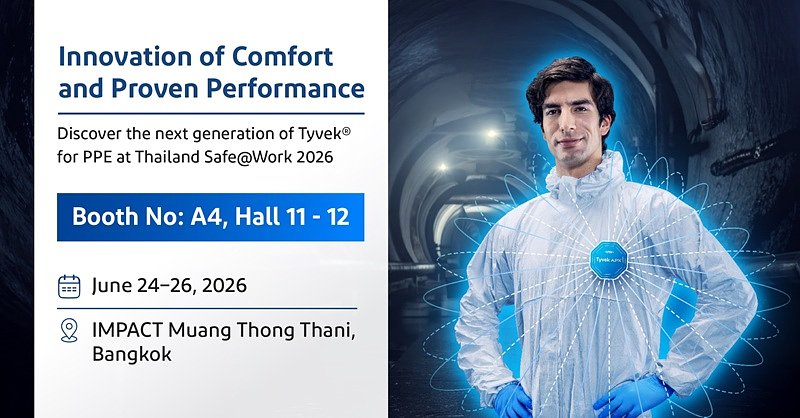
DuPont's New Tyvek® Targets Worker Well-being in Booming ASEAN Market
BANGKOK, Thailand – June 16, 2026
DuPont, a titan in materials science, has announced it will unveil a significant innovation within its trusted Tyvek® portfolio later this month at the Safe@Work 2026 conference. While the specifics remain under wraps until the June 24 launch, the announcement signals a strategic pivot that goes far beyond a simple product upgrade. The new platform is explicitly designed for the ASEAN market, aiming to solve a persistent challenge in industrial safety: the critical intersection of protection, comfort, and productivity.
For over 50 years, Tyvek® has been synonymous with barrier protection, a lightweight yet durable shield against particles and liquids in industries from pharmaceuticals to chemical processing. This upcoming launch, however, highlights a deeper understanding of modern workplace dynamics. It acknowledges that true safety isn't just about the material's specifications but about the human wearing it. By emphasizing worker well-being, DuPont is tapping into a fundamental truth that safety managers have known for years: uncomfortable personal protective equipment (PPE) is often ineffective PPE.
The Human Factor in Protective Gear
In demanding industrial environments, the decision to wear PPE correctly—or at all—is often dictated by comfort. An ill-fitting or non-breathable garment can lead to dangerous heat stress, fatigue, and reduced focus, directly compromising safety and efficiency. This is particularly acute in the hot and humid climates prevalent across the Association of Southeast Asian Nations (ASEAN).
"If a worker is battling heat exhaustion inside their protective suit, their compliance and their performance both suffer," noted an occupational safety consultant who advises multinational firms in the region. "They might be protected from a chemical splash, but their risk of making a critical error due to fatigue or heat-related impairment skyrockets. The most effective safety systems are the ones people will actually use consistently and correctly."
This is the core problem DuPont appears to be tackling. The press release points to an innovation that supports both "worker protection and wearer comfort." This suggests a material engineered to offer a higher degree of breathability and ergonomic design. Drawing from recent trends, such as the company's March 2026 launch of a lightweight, breathable, and more sustainable cleanroom garment, we can infer that this new Tyvek® platform will likely focus on reducing the physiological load on workers. Features may include enhanced moisture vapor transmission to allow sweat to evaporate, lighter overall weight to reduce fatigue over long shifts, and a design that allows for greater freedom of movement.
A Strategic Move in a High-Growth Market
The decision to tailor and launch this innovation for the ASEAN market is a calculated strategic move. The region is in the midst of an industrial boom, with its PPE market projected to exceed USD 8 billion by 2030, growing at a compound annual rate of over 8%. Rapid industrialization in nations like Vietnam and Indonesia, coupled with increasingly stringent government regulations on occupational health and safety, has created immense demand.
DuPont is not merely entering this market; it is deepening its existing roots. The company established its ASEAN headquarters in Singapore back in 2016, creating a regional hub for science and technology with a network of production plants. This new Tyvek® platform is the logical next step in that strategy—a solution designed not just for a generic global standard, but for the specific climatic, industrial, and regulatory needs of Southeast Asia.
By addressing the comfort deficit in PPE, the materials science leader positions itself as a premium partner for businesses that understand the link between worker well-being and operational excellence. As companies across the pharmaceutical, manufacturing, and chemical sectors compete for skilled labor and strive for higher safety ratings, providing comfortable and effective PPE becomes a competitive advantage. It signals a corporate culture that values its workforce, which in turn can improve morale, retention, and productivity.
Beyond the Barrier: The Future of Personal Protection
This impending launch is reflective of a broader evolution in the protective textiles industry. The paradigm is shifting from simply creating an impenetrable barrier to designing integrated systems that enhance human performance. Competitors are also investing heavily in advanced materials, from nanocoatings that improve repellency without sacrificing breathability to the early stages of smart fabrics that can monitor a worker's vital signs.
The focus is now on holistic protection. An effective garment must shield against external hazards while simultaneously mitigating internal ones like heat and fatigue. It must be durable enough for the job but light enough for the person. This move by DuPont underscores that materials science is at the heart of building more efficient and effective human systems in the workplace.
The full details of this new Tyvek® platform will be revealed at Thailand Safe@Work 2026, but its direction is already clear. It represents a sophisticated response to the complex demands of modern industry, where the well-being of the worker is inextricably linked to the health of the business. For the rapidly expanding industrial base of ASEAN, it could mark a new standard in what it means to be truly safe at work.