
- AI-driven data centers could consume 12% of all U.S. electricity by 2030 (McKinsey & Company, Lawrence Berkeley National Laboratory).
- Doosan can deliver large-scale gas turbines in as little as one year, compared to competitors' 5-7 year timelines.
- Doosan secured a deal with xAI for five 380-megawatt gas turbines, with delivery by the end of 2026.
Experts would likely conclude that Doosan's multi-technology approach—combining gas turbines, SMRs, and fuel cells—is a pragmatic and necessary strategy to meet AI's escalating energy demands while transitioning toward decarbonization.
Doosan's Power Play: Taming the AI Era's Insatiable Energy Demand
LAS VEGAS, NV – January 06, 2026 – As the artificial intelligence revolution accelerates, a shadow looms over its limitless potential: an insatiable appetite for electricity. Projections from industry analysts like McKinsey & Company and the Lawrence Berkeley National Laboratory warn that AI-driven data centers could consume as much as 12% of all U.S. electricity by 2030. At CES 2026, South Korean industrial giant Doosan Group has stepped into the spotlight, presenting a comprehensive, multi-pronged strategy to address this looming energy crisis before it short-circuits technological progress.
Through its subsidiaries Doosan Enerbility and HyAxiom, the company is showcasing a formidable portfolio of power generation technologies designed to provide the scalable, reliable, and increasingly clean energy that the world's most advanced data centers demand. The strategy is not a single silver bullet but a diverse arsenal, combining the proven muscle of large-scale gas turbines, the zero-carbon promise of Small Modular Reactors (SMRs), and the agile deployment of hydrogen fuel cells. It’s a pragmatic, all-of-the-above approach for an industry where downtime is not an option and growth is exponential.
Gas Turbines: The Fast-Track Power Bridge
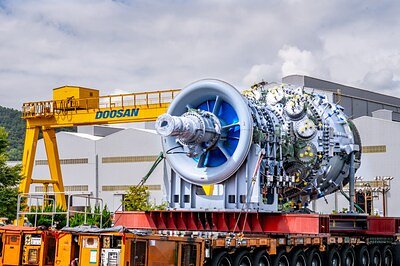
For tech giants racing to build out AI infrastructure, the most immediate need is massive, reliable power delivered on an aggressive timeline. Doosan Enerbility is meeting this demand head-on with its large-scale gas turbines. As the first in Korea and only the fifth company worldwide to commercialize its own utility-scale gas turbine, Doosan has forcefully entered a market long dominated by behemoths like GE Vernova, Siemens Energy, and Mitsubishi Power.
Its critical advantage has proven to be speed. While competitors often quote delivery timelines of five to seven years, Doosan has been able to deliver in as little as one year. This agility recently allowed it to secure a landmark deal with a prominent, high-stakes client: Elon Musk's AI startup, xAI. The U.S. tech firm placed orders for a total of five 380-megawatt gas turbines to power its burgeoning data center operations, marking the first-ever overseas export of Korea's domestically developed turbine technology. The initial units are slated for delivery by the end of 2026, a timeline that is nearly unheard of for such large-scale projects and a testament to Doosan's strategic advantage.
Looking beyond today's needs, the company is also future-proofing its technology. In line with the global push for decarbonization, Doosan is aggressively developing a 100% hydrogen-fueled version of its large gas turbine, with a target commercialization date of 2028. This places it firmly in the race alongside its main competitors to offer a clear pathway from natural gas to zero-carbon hydrogen power, providing a crucial transition for energy-intensive industries.
The Nuclear Option: SMRs for Zero-Carbon Baseload
While gas turbines provide an immediate bridge, Doosan is betting on next-generation nuclear power for the long-term, zero-carbon baseload energy that data centers will require to operate 24/7 sustainably. Rather than developing its own proprietary reactor, the company has strategically positioned itself as a premier "SMR foundry." Leveraging decades of experience manufacturing heavy components for conventional nuclear plants—having supplied 34 reactor units and 124 steam generators worldwide—Doosan is partnering with leading SMR developers to produce the core components for their advanced designs.
This approach allows the company to capitalize on the entire emerging SMR market without being tied to the success or failure of a single technology. SMRs offer the promise of scalable, carbon-free power that can be located closer to industrial sites like data centers, reducing transmission losses and strain on public grids. However, the path to widespread adoption is fraught with challenges. The industry faces significant hurdles, including high first-of-a-kind costs, complex and lengthy regulatory approvals, and unresolved questions around nuclear waste management and public acceptance.
Despite these obstacles, momentum is building. In the U.S., the ADVANCE Act, signed into law in 2024, aims to streamline the licensing process, and the Nuclear Regulatory Commission (NRC) is adapting its framework for these novel reactors. For data center operators, the prospect of a dedicated, on-site nuclear power source that guarantees uninterrupted, clean electricity is becoming an increasingly attractive proposition, and Doosan is positioning itself as the critical manufacturing backbone to make that vision a reality.
Fuel Cells: Agile, Clean Power on Demand
Complementing its large-scale solutions, Doosan's subsidiary HyAxiom addresses the need for rapid and localized power generation with its advanced fuel cell technologies. For data centers in dense urban areas or regions with grid constraints, the ability to quickly deploy a clean, efficient power source is invaluable. HyAxiom, a pioneer with roots in the Apollo space program, specializes in just that.
At CES, the company is highlighting its PureCell® Model 400, a compact system capable of generating 460 kW of power from hydrogen, natural gas, or blended fuels with minimal to no emissions. For larger needs, HyAxiom offers a 10-megawatt Power Block solution, scalable for data centers and microgrids, that can be installed on less than half an acre. This technology provides a critical advantage in speed, enabling data centers to become operational far more quickly than if they had to wait for traditional utility upgrades.
HyAxiom is also showcasing its trailer-mounted mobile power platforms, engineered for emergency situations, disaster recovery, or temporary power needs. This emphasis on flexibility and rapid deployment carves out a vital niche in a market where competitors like Bloom Energy and Plug Power are also vying to power the digital economy with fuel cells.
"The AI revolution is global and accelerating. As energy demand surges, our mission is to lead with cleaner, scalable fuel-cell solutions that support both businesses and communities," said Doo Soon Lee, CEO of HyAxiom, in a statement.
With its comprehensive strategy, Doosan is making a clear statement: powering the future of AI will require more than one type of solution. "With our eco-focused vision, global partnerships, and broad portfolio—from SMRs and gas turbines to hydrogen and wind technologies—we are exceptionally well-positioned to power the next era of AI and advanced energy needs worldwide," added Yeonin Jung, COO of Doosan Enerbility. By integrating proven technologies for immediate needs with forward-looking investments in zero-carbon power, the company is building a robust and versatile energy bridge to the AI-powered future.