
- $15 billion: Estimated value of Alaska Airlines' record fleet order with Boeing.
- 110 aircraft: Largest fleet order in Alaska Airlines' 94-year history, including 105 Boeing 737-10 jets and five 787 Dreamliners.
- 12 international destinations: Goal to serve by 2030 from Seattle hub, starting with London Heathrow and Rome in 2026.
Experts would likely conclude that this expansion marks a strategic pivot for Alaska Airlines, leveraging its Boeing partnership to challenge legacy carriers and solidify its position as a major global player, though it carries calculated risks given Boeing's certification challenges.
Alaska Airlines' Global Gambit: Record Order Signals Major Expansion
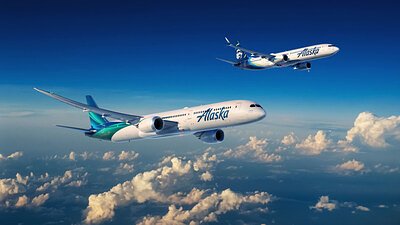
SEATTLE, WA – January 07, 2026 – Alaska Airlines today announced the largest fleet order in its 94-year history, a monumental deal with Boeing for 110 new aircraft that firmly signals its ambition to transform from a domestic powerhouse into a major global carrier. The order includes 105 Boeing 737-10 jets and five 787 Dreamliner widebodies, with options for an additional 35 737-10s, securing a delivery pipeline that extends to 2035.
This historic investment, estimated to be worth approximately $15 billion at list prices, is the cornerstone of the airline's 'Alaska Accelerate' strategic plan. The move aims to fuel significant international growth, modernize its fleet, and solidify its competitive position following its recent acquisition of Hawaiian Airlines.
"This fleet investment builds on the strong foundation Alaska has created to support steady, scalable and sustained growth, and is another building block in executing our Alaska Accelerate strategic plan," said CEO Ben Minicucci in a statement. "These planes will fuel our expansion to more destinations across the globe and ensure our guests travel aboard the newest, most fuel-efficient and state-of-the-art aircraft."
Charting a New Global Course
The most significant aspect of the order is its clear focus on international expansion. The five new 787s, which will be the larger -10 variant, are critical to the airline's goal of serving at least 12 long-haul international destinations from its Seattle hub by 2030. This brings the airline's firm future 787 fleet to 17 aircraft, a formidable tool for challenging the long-haul dominance of legacy carriers like United, Delta, and American Airlines.
This expansion is already taking shape. The airline will inaugurate daily, year-round service to London Heathrow in May 2026, followed by daily summer seasonal flights to Rome. These European routes will complement its growing Asia-Pacific network, which, through synergies with the Hawaiian Airlines acquisition, will see new nonstop services from Seattle to Tokyo and Seoul beginning in 2025.
To mark this global pivot, the new 787s will feature a striking new global livery inspired by the Aurora Borealis. The design, with its deep blues and emerald greens, is intended to symbolize the airline's vision for international growth and its connection to the Pacific Northwest. While the new livery will adorn the widebody fleet flying to Europe and Asia, the company confirmed that the iconic Alaska Native portrait will remain on the tails of its narrowbody aircraft serving North America, and Hawaiian Airlines' Pualani tail art will continue to represent the brand within the Hawaiian Islands.
A Crucial Vote of Confidence in Boeing
This massive order provides a significant boost for Boeing, Alaska's Pacific Northwest neighbor. The deal serves as a powerful vote of confidence at a time when the manufacturer has been under intense scrutiny for production delays and quality control issues, most notably following a January 2024 incident involving a door plug on an Alaska Airlines 737 MAX 9.
The order's heavy reliance on the 737-10, the largest variant of the MAX family, is particularly noteworthy. The aircraft has yet to receive its final certification from the Federal Aviation Administration (FAA), with approval anticipated later in 2026. Alaska Airlines has built flexibility into the contract, retaining the right to convert the orders to other MAX models if certification faces significant delays. This calculated risk underscores the deep, long-standing relationship between the two Seattle-area companies.
For Boeing, the order helps solidify its production backlog and provides a clear path forward. The manufacturer, which delivered approximately 600 jets in 2025, aims to ramp up production to 700 in 2026 and 800 in 2027. This order from a key customer is a critical endorsement of its ability to overcome recent challenges and deliver on its commitments.
The Financial Blueprint for Growth
Financially, the fleet expansion is a core component of a strategy designed to generate substantial returns. Alaska Air Group projects capital expenditures between $1.4 billion and $1.5 billion for fiscal year 2025 to support its growth. The 'Alaska Accelerate' plan, bolstered by the Hawaiian Airlines merger, aims to deliver $1 billion in incremental profit and achieve an ambitious earnings per share (EPS) of at least $10 by 2027 for the combined entity.
The integration with Hawaiian Airlines is central to this financial outlook. The acquisition, which included assuming $0.9 billion in Hawaiian's debt, is expected to unlock at least $500 million in synergies. The combined network strength and operational efficiencies are projected to fuel what the company calls an "unprecedented level of revenue growth" over the next three years. This new fleet order provides the necessary capacity to realize that growth.
Transforming Travel and the Regional Economy
For travelers, especially in the Pacific Northwest, this expansion promises more destinations and an enhanced passenger experience. The Boeing 787 Dreamliner is renowned for its passenger-focused design, featuring larger windows, a lower cabin altitude to reduce jet lag, and quieter engines. The new 737-10s will continue the modernization of the narrowbody fleet, offering a more comfortable and efficient ride on domestic and regional routes.
This focus on modern aircraft also comes with significant environmental benefits. The 737 MAX and 787 families are substantially more fuel-efficient than the older planes they will replace, reducing carbon emissions per seat and aligning with the airline's sustainability goals. This commitment helps ensure Alaska maintains one of the youngest and most fuel-efficient fleets in the industry.
The impact on Seattle-Tacoma International Airport (SEA) and the surrounding region is expected to be transformative. The surge in international flights will cement SEA's status as a premier global gateway, boosting tourism, business travel, and cargo operations. However, this growth will also place new demands on airport infrastructure, likely requiring the Port of Seattle to accelerate development plans for gates, customs facilities, and ground transportation to accommodate the increased traffic.