
- 15% growth: Dolby forecasts 15% revenue growth in 2026 from Dolby Atmos and Dolby Vision licensing.
- 60% cost reduction: Dolby AC-4 codec cuts audio data costs by up to 60% for providers.
- 35 automotive brands: Dolby Atmos is now supported by over 35 car brands across 150+ models.
Experts view Dolby's strategy as a transformative leap in entertainment technology, solidifying its role as the industry standard for immersive audio and visual experiences across multiple platforms.
Dolby's Grand Vision: A New Standard for Every Screen and Speaker
LAS VEGAS, NV – January 06, 2026 – By Nancy Torres
Dolby Laboratories arrived at the 2026 Consumer Electronics Show not just to showcase new products, but to unveil a meticulously crafted strategy for ubiquitous entertainment dominance. Through a series of high-profile partnerships and technological debuts, the company has made its intentions clear: whether you are streaming a blockbuster, watching live sports, listening to music in your car, or gaming on the go, the experience will be powered by Dolby. The announcements reveal an aggressive push to embed its premium audio and visual standards into every major consumer touchpoint, transforming the brand from a feature into the fundamental fabric of modern media consumption.
"From the living room to the car and beyond, we're bringing visions to life for creators across film, music, sports, and social, reimagining how people see, hear, and feel entertainment," said John Couling, Senior Vice President of Entertainment at Dolby Laboratories, in a statement that encapsulates the company’s sprawling ambition.
The Streaming Revolution Gets a Technical Upgrade
Kicking off its CES showcase, Dolby announced a landmark partnership with NBCUniversal's Peacock, marking it as the first streaming service to commit to Dolby's complete suite of innovations. This integration goes beyond the now-familiar Dolby Vision and Dolby Atmos, extending to the next-generation Dolby Vision 2 and the highly efficient Dolby AC-4 audio codec. Peacock plans to initially roll out Dolby Vision and Atmos for live sports like Sunday Night Football, a move that promises to bring cinematic immersion to the unpredictable thrill of live events.
This partnership is pivotal as it serves as a powerful case study for the technical prowess of Dolby's newer formats. Dolby Vision 2 is more than just an HDR update; it's a comprehensive image enhancement system. Powered by an AI-driven engine called Content Intelligence, it introduces features like "Precision Black" for superior detail in dark scenes and "Light Sense," which adapts the picture to a room's ambient lighting—addressing a common viewer complaint that HDR content can appear too dark in bright environments. Early hands-on impressions from the CES show floor have been overwhelmingly positive, with one reviewer noting that the new technology makes the original Dolby Vision "look a bit washed out and murky by comparison." Critically, the technology is designed in tiers, with Dolby Vision 2 Max for premium sets and a standard version engineered to dramatically elevate the picture quality of more budget-friendly TVs.
Complementing the visual leap is Dolby AC-4, an audio codec built for the streaming age. It offers up to 50% greater compression efficiency than its predecessor, Dolby Digital Plus. For consumers, this means higher quality, immersive Dolby Atmos sound at lower bitrates, resulting in less buffering. For providers like Peacock, and potentially automakers, the benefits are even clearer: a collaboration with Qualcomm to integrate AC-4 into its Snapdragon Automotive platform aims to cut audio data costs by as much as 60%, a significant saving at scale.
Reinventing the Home and Expanding the Ecosystem
Dolby's vision for the home is becoming more flexible and intelligent. In partnership with LG, the company unveiled the LG Sound Suite, a modular home audio system featuring the world's first soundbar powered by Dolby Atmos FlexConnect. This technology untethers users from rigid speaker placement rules, allowing for up to 27 different configurations. The system intelligently calibrates itself to deliver an optimal Dolby Atmos experience regardless of where the speakers are positioned. Early demonstrations highlighted a "Sound Follow" feature, which uses ultra-wideband (UWB) tech to shift the audio sweet spot to follow the listener's location in the room, making personalized immersion a reality.
Simultaneously, the company is ensuring its visual technologies are just as widespread. Major television manufacturers including Hisense, TCL, and TP Vision (for its Philips brand) have all pledged support for Dolby Vision 2 in their upcoming 2026 premium TV lineups. This broad adoption by leading brands ensures that the next generation of picture quality will not be confined to a niche market, but will quickly become a new baseline for high-quality home viewing.
This two-pronged hardware strategy—making audio more flexible and visual quality more accessible—is reinforced by Dolby's strong financial outlook. While analysts project a slight decline in traditional Consumer Electronics revenue post-pandemic, the company forecasts approximately 15% growth in revenue from its Dolby Atmos and Dolby Vision licensing in fiscal year 2026, signaling strong market confidence in these newer, experience-driven technologies.
Beyond the Living Room: Dolby Takes the Driver's Seat
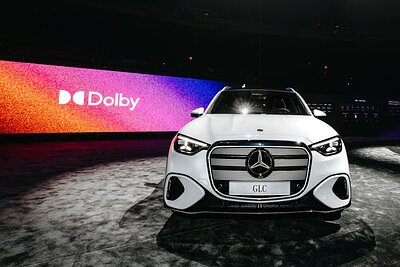
Perhaps the most significant frontier for Dolby's expansion is the automobile. With cars evolving into dynamic living spaces, the demand for premium in-car entertainment has skyrocketed. Dolby Atmos is now embraced by over 35 automotive brands across more than 150 models, from luxury flagships to entry-level vehicles. At CES, Mercedes-Benz announced it is among the first to enable Spatial Audio with Dolby Atmos through Apple CarPlay in its latest models, allowing drivers to seamlessly access immersive tracks from services like Apple Music.
Reviewers at CES described the in-car Dolby Atmos experience as transformative, with one calling it "some of the best sound I've ever heard." The technology overcomes the challenging acoustics of a car cabin to create a precise, three-dimensional soundstage where individual instruments and vocals can be clearly placed.
Recognizing that the majority of cars on the road are not brand new, Dolby's strategy extends to the aftermarket. The introduction of Pioneer's SPHERA, the world's first aftermarket in-dash receiver with Dolby Atmos, is a game-changer. It democratizes the immersive audio experience, using intelligent tuning to optimize sound for vehicles with as few as four existing speakers. This move brings premium audio to a vast new audience, extending Dolby's reach far beyond the new car showroom.
The push into automotive is a calculated financial move, with Dolby's revenue from this sector expected to grow in the high teens. Collaborations with Qualcomm to integrate Dolby Vision, Dolby Atmos, and the data-efficient AC-4 codec into next-gen infotainment platforms further solidify its position as an essential partner for automakers building the connected car of the future. As the industry moves toward greater autonomy, Dolby is positioning itself to be the core provider for the in-car entertainment explosion that is sure to follow.