
- 3% increase: Median director compensation rose by 3% in 2025, reflecting a measured approach despite expanding responsibilities.
- 29% pay growth: Compensation committee chairs saw a 29% pay increase between 2020 and 2025 due to rising complexity in executive pay design.
- 8% surge in micro-caps: Smaller public firms (micro-caps) experienced an 8% jump in median director pay amid a talent war.
Experts conclude that while boardroom duties and risks have significantly expanded, director compensation remains disciplined and aligned with long-term shareholder interests, emphasizing transparency and simplicity in pay structures.
Director Pay Rises 3% as Boardroom Duties and Risks Expand
WASHINGTON, Jan. 29, 2026 – Public company directors saw their median compensation rise by a modest 3% in 2025, a measured increase that belies a significant expansion of their duties and oversight responsibilities. The findings, part of the 27th annual Director Compensation Report from the National Association of Corporate Directors (NACD) and consultancy Pearl Meyer, highlight a crucial balancing act in today's boardrooms: rewarding directors for a more demanding role while maintaining disciplined pay practices that align with shareholder interests.
The report, which analyzed compensation at 1,400 public companies, shows that boards are navigating an increasingly complex landscape of strategic risks, from cybersecurity and artificial intelligence to sweeping environmental, social, and governance (ESG) mandates. Despite the growing workload, compensation trends remain conservative, reflecting a focus on transparency and long-term value creation.
"Boards are being asked to oversee a far broader set of risks and strategic issues than in the past, yet director compensation continues to reflect a disciplined and measured approach," said Peter Gleason, president and CEO of NACD. "The data show boards adapting their structures and practices to meet new demands while keeping pay aligned with long-term value creation and shareholder interests."
This 3% increase is consistent with historical trends over the past decade, which have generally seen modest, single-digit annual growth. After a brief dip in 2020 due to pandemic-related pay cuts, compensation has steadily returned to its pattern of measured, predictable increases.
The New Boardroom Mandate: More Work, More Complexity
The expanding scope of a director's role is the central force shaping modern corporate governance. What was once a position focused primarily on financial oversight and executive succession has evolved into a multifaceted role requiring deep expertise across a range of non-financial areas. Boards are now on the front lines of overseeing complex issues that have a direct impact on long-term corporate strategy and reputation.
Key areas of expanding board expectations include:
- ESG Oversight: Directors are increasingly responsible for integrating climate risk, human capital management, and diversity initiatives into corporate strategy, driven by intense pressure from institutional investors and regulators.
- Technology and Cybersecurity: With cyber threats becoming more sophisticated, boards must ensure robust defenses are in place. This requires a deeper understanding of technology risk, incident response planning, and the strategic implications of emerging technologies like AI.
- Human Capital Management: Beyond executive pay, boards are now deeply involved in overseeing broader workforce strategy, including talent retention, corporate culture, and employee well-being, recognizing that people are a primary driver of value.
- Supply Chain Resilience: Recent global disruptions have pushed supply chain risk to the forefront, requiring board-level oversight of strategies to build more resilient and ethical sourcing networks.
This explosion of responsibilities has placed a premium on specialized expertise, particularly on board committees. According to the report, audit committee chairs remain the highest-paid, but compensation committee chairs have seen the most significant pay growth, with a 29% increase between 2020 and 2025. This surge reflects the growing complexity of designing executive pay plans that stand up to shareholder scrutiny and drive performance.
A Shift Toward Simplicity and Long-Term Alignment
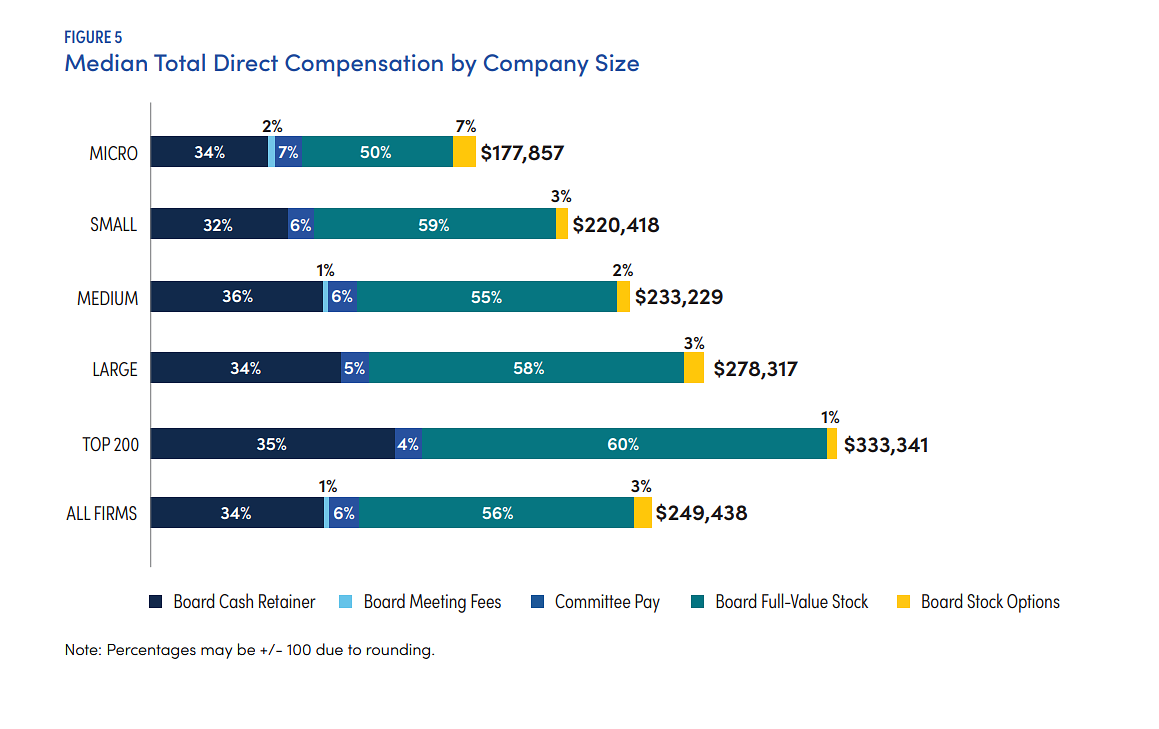
In response to the evolving environment, boards are simplifying how directors are paid. The trend is a decisive move away from complex, variable elements like meeting fees and stock options, which were once common. Today, compensation structures are anchored by two core components: predictable annual cash retainers and full-value equity awards.
The report notes that while median cash retainers remained flat across companies of all sizes, equity awards saw a modest increase. This continues a long-term shift toward making stock a larger portion of total pay. For large public companies, equity now comprises 64% of director compensation, up from 58% a decade ago. This structure is heavily favored by investors and governance experts as it directly aligns the financial interests of directors with those of long-term shareholders.
"Director compensation trends remain steady because boards are focused on simplicity, transparency, and alignment," said Ryan Hourihan, managing director at Pearl Meyer. "As responsibilities expand—particularly around technology oversight and risk—boards are refining pay programs to support effective governance without introducing unnecessary complexity."
This simplified model not only strengthens shareholder alignment but also reduces administrative burdens and minimizes the risk of scrutiny from proxy advisory firms, which often flag overly complex or opaque pay structures.
Micro-Caps Lead in Pay Growth Amid Talent War
While the overall pay increase was modest, one segment stood out: micro-cap companies, with revenues between $50 million and $500 million. These smaller public firms saw median director compensation jump by 8% in 2025. This significant increase highlights the unique pressures these companies face in the war for talent.
Smaller firms must compete with their larger, better-resourced counterparts to attract directors with the specialized skills needed for effective governance. They are subject to many of the same demanding regulatory and compliance burdens but often have smaller internal teams to manage them, placing a greater hands-on workload on board members. Furthermore, serving on a smaller company's board can carry a higher personal risk profile, necessitating more competitive compensation to attract qualified candidates.
This 8% surge is part of a broader "catch-up" phenomenon, as smaller companies work to bring their pay practices in line with market benchmarks to secure the expertise needed to navigate complex challenges and drive growth.
Reshaping Governance Beyond the Paycheck
Beyond compensation figures, the NACD report illuminates several crucial structural shifts that are reshaping corporate governance. These trends point toward a broader movement to enhance board independence, effectiveness, and responsiveness to stakeholder expectations.
One of the most significant changes is the trend toward greater board refreshment. The median tenure for a public company director has declined to 6.1 years, down sharply from 8.7 years in 2015. This acceleration in turnover is a direct response to investor calls for fresh perspectives in the boardroom, particularly as companies confront new challenges in technology and sustainability.
In another move toward greater independence, the practice of combining the CEO and board chair roles continues its long-term decline. In 2025, only 35% of companies maintained a combined leadership structure. Separating the roles is widely seen as a governance best practice that enhances the board's ability to provide objective oversight of management.
These structural changes, combined with a disciplined and transparent approach to compensation, paint a picture of a corporate governance landscape in a state of deliberate evolution, adapting to meet the demands of a rapidly changing world.
Topics & Related
Cybersecurity
Financial Services
AI & Machine Learning
Revenue
EBITDA
Related Company Pulse