
- 765W power output: Dinto Solar's new HJT modules achieve up to 765 watts, placing them among the most powerful commercially available panels.
- 98% bifaciality: The modules capture reflected light on their rear side with market-leading efficiency.
- 40% CAGR: The European agrivoltaics market is projected to grow at a compound annual rate of over 40% by 2030.
Experts view Dinto Solar's 765W HJT panels and vertical PV solutions as a significant advancement in solar technology, particularly for addressing Europe's land-use challenges and improving energy yield in diverse climates.
Dinto Solar Unveils 765W HJT Panels, Targets Vertical PV in Europe
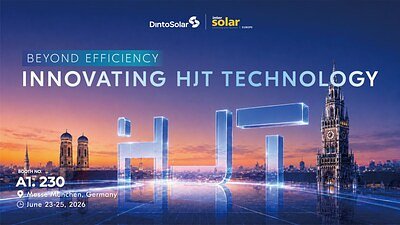
MUNICH, Germany – May 26, 2026 – As the global solar industry converges on Intersolar Europe, Chinese HJT specialist Dinto Solar is set to make a significant statement with the unveiling of its next-generation solar modules. The company, backed by the world's largest clean energy enterprise, will showcase high-power 1/3-cut heterojunction (HJT) panels alongside innovative vertical solutions aimed squarely at solving Europe's land-use challenges.
The announcement signals a new phase in the battle for solar supremacy, where raw power output is increasingly paired with advanced reliability and application-specific design to accelerate the energy transition.
The New Benchmark in HJT Efficiency
At the heart of Dinto Solar’s presentation (Booth A1. 230) are its next-generation 1/3-cut HJT modules, which push the boundaries of commercially available technology. The company is touting a power output of up to 765 watts, placing it in the elite tier of global manufacturers alongside competitors like Risen Energy and Huasun.
This impressive power rating is complemented by what could be a market-leading bifaciality of up to 98%. Bifaciality measures a panel's ability to capture reflected light on its rear side, and a figure this high promises substantial gains in energy yield, particularly in installations over reflective surfaces like snow, sand, or white roofing. The modules also feature a 94.59% active-area ratio, maximizing the light-capturing surface to enhance overall system efficiency.
Beyond the headline numbers, the significance lies in the underlying heterojunction (HJT) technology. HJT cells, which combine crystalline silicon with amorphous silicon thin-film layers, offer distinct advantages over other n-type technologies like TOPCon. HJT boasts a superior temperature coefficient (around -0.24%/°C), meaning it loses less power in hot conditions—a crucial factor for stable energy yield in warming climates. It also demonstrates near-zero light-induced degradation (LID) and an exceptionally low annual degradation rate of around 0.25%, promising greater longevity and a better return on investment over the panel's 30-year-plus lifespan.
The module’s 1/3-cut cell architecture is not just about efficiency; it's also engineered for durability. By using smaller cells and flexible interconnection structures, the design distributes mechanical stress more evenly, significantly reducing the risk of microcracks—a common cause of long-term performance loss.
A Vertical Vision for Europe's Crowded Landscape
While the 1/3-cut modules represent an evolution in panel performance, Dinto Solar's vertical HJT solutions signal a strategic pivot towards market-specific needs. Recognizing that land scarcity and complex permitting are major hurdles for solar deployment in Europe, the company is targeting applications like agri-PV, building-integrated fencing, and roadside infrastructure.
Vertical installations, where bifacial panels are mounted upright in east-west facing rows, offer a compelling solution to land-use conflicts. This approach is particularly promising for agri-PV, where solar arrays can coexist with crop cultivation or livestock grazing. Research has shown that such systems can improve land-use efficiency by over 170% and even increase yields for certain shade-tolerant crops.
The European agrivoltaics market is poised for explosive growth, with some analysts projecting a compound annual growth rate (CAGR) of over 40% to reach nearly $2.5 billion by 2030. Nations like Germany, France, and Italy are actively promoting this model with supportive regulations and financial incentives, creating a fertile market for Dinto's specialized products.
Furthermore, vertical systems generate a unique "dual-peak" power profile, with production spikes in the morning and late afternoon. This generation curve aligns better with daily electricity demand and peak pricing periods in European markets, potentially improving project revenue and overall economic viability. The vertical orientation also naturally reduces losses from dust accumulation and snow coverage, enhancing performance in diverse climates.
The Powerhouse Behind the Panels
Dinto Solar's ambitious push is underpinned by its powerful parent company, the State Power Investment Corporation (SPIC). Established in 2017 by SPIC's Central Research Institute, Dinto Solar is a key component of the state-owned enterprise's strategy to build a vertically integrated photovoltaic industry chain. As the world's largest solar power generator, SPIC provides Dinto with immense strategic, financial, and market access advantages.
SPIC's aggressive clean energy goals—targeting 75% renewable capacity by 2030—drive Dinto's focus on high-efficiency, next-generation technologies. This backing has enabled Dinto to plan for a massive 15 GW annual HJT manufacturing capacity across its facilities in Zhejiang and Sichuan provinces.
This industrial scale is crucial for tackling one of HJT’s main challenges: cost. HJT production has historically been more expensive than TOPCon due to its complex manufacturing process and reliance on costly silver paste for metallization. However, with large-scale production and ongoing R&D—including industry-wide efforts to reduce silver content by substituting it with copper—the cost gap is expected to narrow significantly by 2026.
From Lab to Global Landscape
Dinto Solar is already proving its technology is ready for commercial deployment. The company has successfully delivered modules for over 100 benchmark projects globally, from a 100 MW utility-scale farm in Xinjiang to an 80 MW deployment in South Asia and a 50 MW project in the Balkans.
These real-world applications validate the performance and reliability claims made in the lab. A recent 4.4 MW shipment of HJT modules for a solar-powered irrigation system in the Philippines demonstrates the company's ability to tailor solutions for distributed energy and smart agriculture applications.
The company's public roadmap further solidifies its long-term vision. It aims to mass-produce modules exceeding 800 W by 2028 and is targeting power outputs over 1,000 W by 2030 through the integration of HJT with next-generation perovskite tandem technology. This forward-looking strategy positions Dinto Solar not just as a participant in the current solar market, but as a key architect of its future, aiming to deliver ultra-high-efficiency solutions that can power the next stage of the global energy transition.