
- 6 TOPS: The HUSKYLENS 2 delivers up to 6 Tera Operations Per Second (TOPS) of AI computing power.
- 20+ Pre-trained Models: The device includes over 20 pre-trained AI models for tasks like face recognition and emotion detection.
- 1.6GHz & 800MHz Cores: The Kendryte K230 processor features dual-core RISC-V architecture with high-speed and power-efficient cores.
Experts view DFRobot's HUSKYLENS 2 as a pivotal tool in democratizing AI education, leveraging RISC-V's open architecture to make advanced AI vision accessible and interactive for students and makers.
DFRobot's HUSKYLENS 2 Puts RISC-V AI Vision in Students' Hands
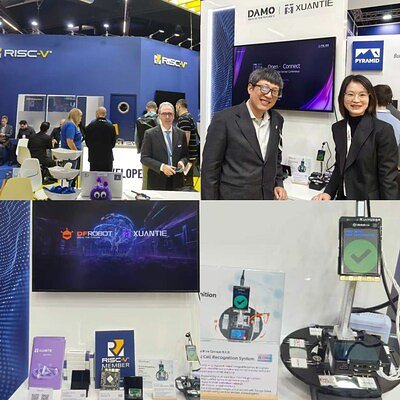
NUREMBERG, GERMANY – March 11, 2026 – Amid the bustling halls of embedded world 2026, a major theme is emerging: the maturation of the RISC-V open-source architecture from a niche alternative to a mainstream powerhouse. Nowhere is this more apparent than at the RISC-V International booth, where robotics and open-source hardware specialist DFRobot is demonstrating its HUSKYLENS 2, a device that aims to place the power of advanced AI vision directly into the hands of students and makers.
The showcase highlights a significant shift in technology education. By leveraging the open and customizable nature of RISC-V, DFRobot is not just launching a new product, but is championing a movement to democratize artificial intelligence, making it an intuitive, hands-on subject for the next generation of innovators.
From Black Box to Building Blocks
For years, teaching AI in schools has been a challenge, often confined to abstract theories or high-level programming that requires significant prior knowledge. DFRobot's HUSKYLENS 2 is designed to dismantle these barriers. The device is a compact, user-friendly AI vision sensor that works out of the box. With more than 20 pre-trained AI models—including face recognition, object tracking, and even emotion detection—learners can power it on and immediately begin experimenting.
At its booth, DFRobot presented a compelling real-world application: an AI Cell Recognition System. Using a HUSKYLENS 2 attached to a microscope, the system identifies different types of cells in real-time on a UNIHIKER K10 board. This isn't just a pre-canned demo; it illustrates the entire AI workflow that the device enables. Students can use the platform to collect images of cells, label them, train a custom recognition model, and deploy it—all through an accessible, visual interface.
This end-to-end experience is a cornerstone of the product's educational philosophy. It moves beyond simply using AI as a 'black box' and empowers students to become creators of AI. By integrating with block-based programming platforms like MindPlus, HUSKYLENS 2 allows learners to visually construct their own models, watching how the AI learns from the data they provide. This demystifies concepts like machine learning, making them tangible and interactive.
"The goal is to lower the technical barriers, allowing learners to intuitively understand, experience, and apply AI concepts," the company stated in its press release. This approach addresses a critical need identified by education experts: the necessity for tools that foster critical thinking and problem-solving rather than rote memorization. By providing a complete, hands-on toolkit, HUSKYLENS 2 encourages creativity and experimentation, turning complex processes into engaging learning experiences.
The Power of Open-Source Edge AI
While its user-friendly interface is designed for beginners, the technology powering the HUSKYLENS 2 is anything but basic. At its core lies the Kendryte K230 processor, a sophisticated System-on-Chip (SoC) built on the RISC-V architecture. This choice is deliberate and significant. Unlike proprietary architectures, RISC-V is an open standard, which fosters collaboration, customization, and innovation without licensing fees.
The K230 is a dual-core RISC-V powerhouse, featuring a high-speed 1.6GHz processor alongside a more power-efficient 800MHz core. Critically, it integrates high-performance XuanTie C908 cores from T-Head Semiconductor, which include specialized vector processing capabilities. This advanced design allows the HUSKYLENS 2 to deliver up to 6 TOPS (Tera Operations Per Second) of AI computing power. This level of performance enables the device to run complex neural networks directly on the hardware—a concept known as edge AI—with minimal latency.
This edge computing capability is crucial. By processing data locally rather than sending it to the cloud, the HUSKYLENS 2 ensures real-time responsiveness, enhances privacy, and can operate in environments without internet connectivity. It transforms the device from a simple camera into an intelligent sensor that understands what it sees. It can generate structured descriptions of a scene—identifying who is present and what they are doing—which can then be used to provide more nuanced interactions with other systems, including Large Language Models (LLMs).
The adoption of RISC-V for such demanding edge AI tasks signals the architecture's growing maturity. It is increasingly seen in a wide array of applications, from automotive microcontrollers to data center accelerators, proving its flexibility and efficiency.
A Strategic Bet on the RISC-V Ecosystem
DFRobot's focus on HUSKYLENS 2 and the RISC-V architecture is more than just a product decision; it's a strategic investment in the future of technology. By building accessible educational tools on an open-source platform, the company is helping cultivate a new generation of engineers and developers who are native to the RISC-V ecosystem.
This strategy appears to be company-wide. DFRobot has been observed integrating RISC-V chips into other product lines, such as its FireBeetle 2 series for IoT applications, signaling a deep commitment to the architecture. This long-term vision involves a symbiotic relationship: as more students and makers learn and build with RISC-V, the talent pool grows, which in turn accelerates the architecture's adoption and strengthens the entire ecosystem.
The collaboration with RISC-V International and the involvement of powerful components from the XuanTie ecosystem demonstrate a shared commitment to this goal. By championing open-source hardware in education, DFRobot is not only shaping its own market but is also contributing to a more open, collaborative, and accessible future for the entire technology industry. As tools like HUSKYLENS 2 make their way into more classrooms and workshops, they are planting the seeds for future innovation, empowering creators to build the intelligent systems of tomorrow.