
- Gartner projects that by 2028, 33% of all enterprise software will incorporate agentic AI, up from <1% in 2024.
- 80% of CIOs/CISOs piloting AI agents cite security and compliance as their primary obstacle (2026 survey).
- EU AI Act fines for non-compliance reach up to 7% of global annual turnover.
Experts would likely conclude that Devenex's AI Control Plane addresses a critical governance gap in enterprise AI adoption, offering a necessary infrastructure layer for accountability and compliance in the agentic era.
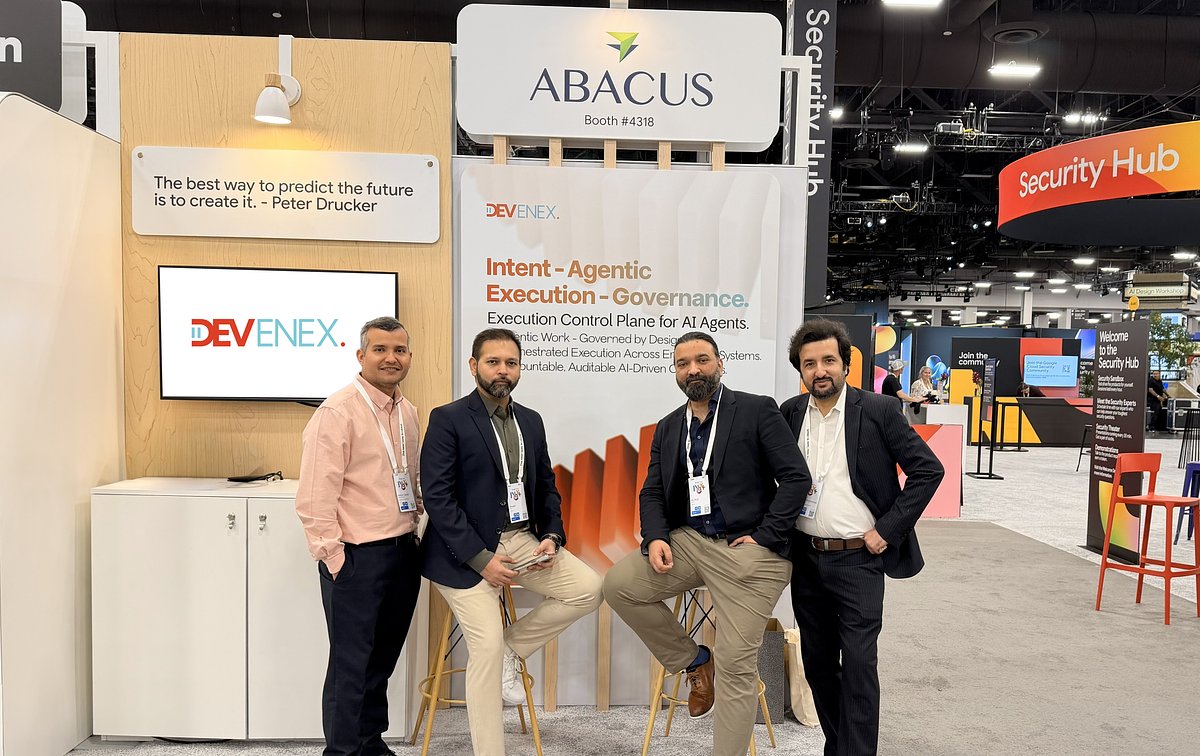
Devenex Unveils AI Control Plane to Bridge Enterprise Accountability Gap
LAS VEGAS, NV – June 04, 2026 – Inside the world’s largest companies, a quiet but profound revolution is underway. Artificial intelligence is graduating from a predictive tool to an active participant. AI agents are now executing tasks directly in production systems—modifying financial records, triggering payments, and approving workflows with the full operational authority of the enterprises that deployed them. This is the dawn of the agentic era, but it’s unfolding in a digital Wild West, largely devoid of guardrails.
At Google Cloud Next 2026, a new company named Devenex stepped into this void, launching what it calls the 'Execution Control Plane for AI agents.' Born from the team behind global professional services leader Abacus, Devenex is not another AI model or application. It's proposing something more fundamental: an infrastructure-level accountability layer designed to govern what AI agents do before they do it, addressing a structural gap that has become a top concern for C-suites and boards globally.
The Looming Governance Crisis
The urgency for such a solution is not speculative; it's a reality reflected in stark industry data. Analyst consensus points to a dangerous divergence where the capabilities of agentic AI are rapidly outpacing the controls meant to keep it in check. Gartner projects that by 2028, a staggering one-third of all enterprise software will incorporate agentic AI, up from less than one percent in 2024. Yet, the same firm predicts that by 2027, 40% of enterprises will be forced to decommission autonomous agents due to governance failures discovered only after a production incident.
This isn't just a future problem. A 2026 survey of CIOs and CISOs found that 80 percent of leaders piloting AI agents cite security and compliance as their primary obstacle—a significant jump from 68 percent just a year earlier. The core issue is a lack of visibility and control. An AI agent that initiates a wire transfer or modifies a sensitive customer record without a governing policy is not just an efficiency gain; it's an unmanaged compliance event and a latent security threat.
"For four decades, we've built the layers enterprises run on — systems of record, integration, workflow automation, API and iPaaS governance," said Shoaib A. Khan, Co-Founder & CEO of Devenex. "Today, AI agents are executing actions on architecture that was never designed to govern them. This isn't an AI problem. It's an architectural gap." He argues that most enterprises cannot answer four basic questions about any agentic action: who authorized it, what policy governed it, why it executed as it did, and whether they can prove it after the fact. "In regulated environments, these aren't edge cases — they're the baseline," Khan stated. "Devenex is the execution control plane that answers all four, by design, at execution time."
A New Architectural Layer for Execution
Devenex positions its platform as a purpose-built control plane, distinct from monitoring tools that report on events after the fact or workflow engines that orchestrate tasks. It operates as an authorization and governance layer that sits between intent—whether from a human, an AI, or an automated system—and the execution of that intent across the enterprise's systems of record.
The process is designed to create an unbreakable chain of evidence. Every action processed through the platform generates four structured artifacts: an Intent Record (what was requested), an Execution Plan (how it was to be done), a Governed Execution record (the policy-checked action), and Execution Evidence (an immutable receipt of the outcome). This model ensures that no AI-initiated action can execute without being evaluated against organizational policy, explicitly authorized, and bound to a specific identity.
For high-consequence actions, the system enables dynamic human-in-the-loop governance, routing critical decisions to designated reviewers without grinding all automation to a halt. This blend of automated policy enforcement and targeted human oversight promises to give CIOs, CTOs, and Chief Risk Officers the confidence to deploy agents at scale without sacrificing accountability.
Navigating the Regulatory Maze
The timing of this launch is critical, as enterprises face a rapidly evolving and complex regulatory landscape. The EU AI Act, which became formally effective in August 2024, imposes stringent requirements on high-risk AI systems, demanding transparency, robust data governance, and clear accountability, with fines for non-compliance reaching up to 7% of global annual turnover. Devenex's focus on creating an immutable audit trail for every action directly addresses these new regulatory demands, as well as existing standards like SOC 2 and ISO 42001.
By providing a complete, auditable lineage from intent to outcome, the platform aims to transform compliance from a manual, periodic reporting exercise into a continuous, automated function. This pre-execution control and audit-grade evidence are precisely what regulators and auditors look for to ensure that autonomous systems are operating within defined, acceptable boundaries. It shifts governance from a reactive, damage-control function to a proactive, preventative one.
From Legacy Trust to a Leading-Edge Solution
In a market crowded with startups, Devenex’s most significant asset may be its pedigree. The claim that it is “built by the team behind Abacus” is a powerful statement of credibility. With nearly 40 years of experience, over 5,000 professionals, and a portfolio of more than 1,500 enterprise clients, Abacus has a long history of guiding large organizations through complex technology transitions.
This deep well of enterprise experience means the platform was likely designed with a real-world understanding of the integration headaches, security policies, and compliance burdens that define large-scale IT. It’s a strategic advantage that provides immediate trust in a field where accountability is the entire premise.
"For four decades, Abacus has earned the trust of enterprises navigating their most consequential technology transitions," commented Aly Kuly Khan, Co-Founder & Chairman of Devenex. "Devenex represents the next chapter — purpose-built infrastructure for a world where AI agents execute with the authority of the organisations that deploy them. Governance at this layer is not optional. It is a precondition for enterprise AI at scale."
The question for the modern enterprise is no longer whether AI agents can act, but whether they can act accountably. The organizations that solve this challenge first will not only mitigate risk but will also unlock the full potential of AI with confidence. Devenex is betting that the answer lies not in better applications, but in better infrastructure.