
- 11 artists featured in the 2026 edition, including Saudi and international talents
- 65-square-kilometer Wadi AlFann project set to open from 2028
- $15 billion masterplan for AlUla, aiming to create 38,000 jobs and contribute $32 billion to Saudi GDP by 2035
Experts view Desert X AlUla 2026 as a pivotal moment in Saudi Arabia's cultural transformation, blending contemporary art with ancient heritage while balancing ambitious development with ecological and archaeological preservation.
Desert X AlUla 2026: Art, Ambition, and Antiquity in Saudi Arabia
ALULA, Saudi Arabia – January 15, 2026 – Amidst the towering sandstone canyons and vast, silent deserts of Northwest Saudi Arabia, a new layer of human history is being written. Today marks the opening of Desert X AlUla 2026, the fourth edition of the ambitious international art biennial that places monumental, site-responsive artworks in dialogue with one of the world's most profound natural and historical landscapes.
Running through February 28, 2026, the open-air exhibition features newly commissioned works by 11 acclaimed Saudi and international artists. Organized by Arts AlUla in collaboration with the California-based Desert X, the event solidifies AlUla's rapidly emerging status as a global destination for land art, where the lines between gallery, landscape, and archaeological wonder blur into a singular, immersive experience.
This year's theme, 'Space Without Measure,' inspired by the writings of Kahlil Gibran, invites both artists and visitors to contemplate the infinite horizons of the desert and the boundless nature of human imagination. The result is a collection of installations that are as diverse in form as they are unified in their deep connection to the spirit of AlUla.
The Art of 'Space Without Measure'
The curatorial team—led by artistic directors Neville Wakefield and Raneem Farsi, with curators Wejdan Reda and Zoé Whitley—has assembled a multigenerational lineup whose works explore a vast spectrum of ideas and materials. From kinetic sculptures that dance with the desert wind to soundscapes that echo through canyons, each piece is a direct response to AlUla's unique environment.
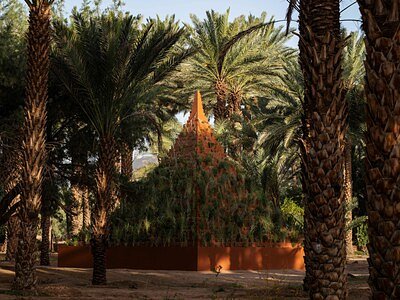
Among the highlights is The Living Pyramid by the pioneering land artist Agnes Denes. An iteration of her globally recognized series, this work explores life cycles by creating a pyramid from the very soil of AlUla, planted with native seeds destined to blossom over the course of the exhibition. It is a powerful statement on ecology and time, situated in a landscape that measures time in millennia.
Saudi artist Sara Abdu's A Kingdom Where No One Dies: Contours of Resonance revives ancient construction techniques, creating sculptural rammed earth walls layered with poetry and geological strata. Elsewhere, Mohammad Alfaraj’s What was the Question Again? weaves a labyrinth of living fables around a central palm tree crafted from grafted trunks, drawing on childhood memories of the region's agricultural landscapes.
The exhibition also honors the past masters of Saudi modernism. For the first time, five works from the 1980s by the late Mohammed AlSaleem are on public view, their geometric forms engaging in a timeless conversation with the natural rock formations. This juxtaposition of the contemporary with the modern and the ancient is a defining feature of the biennial, creating a powerful artistic lineage.
Other notable works include Imole Red by Cuban-American artist Maria Magdalena Campos-Pons, which draws on AlUla's sunset hues and Yoruba traditions, and Future Fables by New Delhi-based Vibha Galhotra, a meditation on climate change that encases fragments of demolished local buildings within a stark steel framework.
A Canvas Millennia in the Making
The profound impact of Desert X AlUla stems from its unparalleled setting. AlUla is not a blank canvas; it is a landscape dense with history. For thousands of years, it was a crucial crossroads on the incense trade routes, home to successive civilizations. The artworks are set against a backdrop that includes Hegra, Saudi Arabia's first UNESCO World Heritage Site, famous for the elaborate, rock-cut tombs of the Nabataean Kingdom.
Visitors to the exhibition find themselves wandering through a region that also holds the ancient capitals of Dadan and Lihyan, and Jabal Ikmah, an open-air library of rock inscriptions in multiple languages. The art, therefore, does not dominate the landscape but rather becomes the latest chapter in a long story of human creativity. Basmah Felemban’s Murmur of Pebbles, for instance, magnifies the geological elements of the ancient riverbed that once shaped AlUla, transforming limestone into monumental sculptures that feel both new and eternal.
This dialogue between past and present is a deliberate strategy. By inviting artists to respond to the heritage and environment, Arts AlUla is fostering a new appreciation for the region's legacy while simultaneously forging a contemporary cultural identity.
Building a Permanent Legacy: From Biennale to Wadi AlFann
While Desert X AlUla is a temporary biennial, it serves a much grander, long-term purpose. It functions as a recurring preview and creative laboratory for Wadi AlFann, or 'Valley of the Arts,' a colossal project set to establish a permanent, 65-square-kilometer land art destination.
Set to begin unveiling from 2028, Wadi AlFann will feature monumental, permanent commissions from some of the world's most influential artists. The initial roster includes Light and Space icon James Turrell, land art pioneer Michael Heizer, and two of Saudi Arabia’s most prominent artists, Manal AlDowayan and Ahmed Mater. Agnes Denes will also create a permanent pyramid installation for the valley, expanding on her work for the current biennial.
This transition from a temporary exhibition to a permanent, world-class cultural landmark represents a monumental commitment to the arts. It aims to create an unparalleled global destination where visitors can experience era-defining works of art in a landscape of breathtaking scale and history, effectively creating an open-air museum for the 21st century and beyond.
The Cultural Cornerstone of Vision 2030
The immense investment in AlUla's cultural infrastructure is a cornerstone of Saudi Arabia's Vision 2030, a national strategy to diversify the economy away from oil, foster national pride, and open the kingdom to the world. AlUla is the flagship project in this cultural transformation, with a reported $15 billion masterplan designed to create over 38,000 jobs and contribute more than $32 billion to the national GDP by 2035.
As Hamad Alhomiedan, Director of Arts & Creative Industries at the Royal Commission for AlUla (RCU), stated, "At Desert X AlUla 2026, audiences will engage with art that deeply converses with AlUla's unique landscapes and rich heritage. These compelling commissions highlight AlUla's dynamic transformation into a major global destination, where ancient and contemporary expressions converge."
He noted that the exhibition is integral to "positioning AlUla in the global dialogue of contemporary art and as a precursor to monumental projects like Wadi AlFann." The strategy is clear: to use art and heritage not only to attract high-value tourism but also to reshape the nation's global image, fostering cross-cultural dialogue and positioning Saudi Arabia as a vital center for creative industries.
Balancing Ambition with Preservation
Developing a project of this magnitude in a sensitive ecological and archaeological zone presents significant challenges. The Royal Commission for AlUla has publicly committed to a framework of "Comprehensive Regeneration," guided by a Sustainability Charter that prioritizes heritage preservation and environmental protection.
RCU's sustainability reports detail ambitious goals, including achieving carbon neutrality and implementing large-scale conservation efforts. These initiatives range from reintroducing native flora and fauna, such as the successful breeding of endangered Arabian leopards, to achieving 'Dark Sky' certification for its reserves to protect the pristine night skies. A heritage campaign, 'I Care,' has been launched to engage the local community and educate youth on the importance of protecting the region's historical assets.
This dual focus on ambitious development and meticulous preservation is critical to the project's long-term success. The goal is to ensure that as AlUla becomes a global stage for contemporary art, its ancient soul and natural splendor are not only protected but are thoughtfully enhanced for generations to come.