
- $615 million CAD acquisition of Covelya Group, one of the largest in the subsea technology sector.
- 790 engineers, scientists, and technicians combined, with over 110 patents in the new entity.
- Projected 2025 revenues of $365 million CAD with a 24% adjusted EBITDA margin for the merged company.
Experts would likely conclude that Kraken's acquisition of Covelya Group represents a strategic breakthrough in subsea technology, consolidating industry-leading expertise to create a dominant, integrated solution provider for underwater missions.
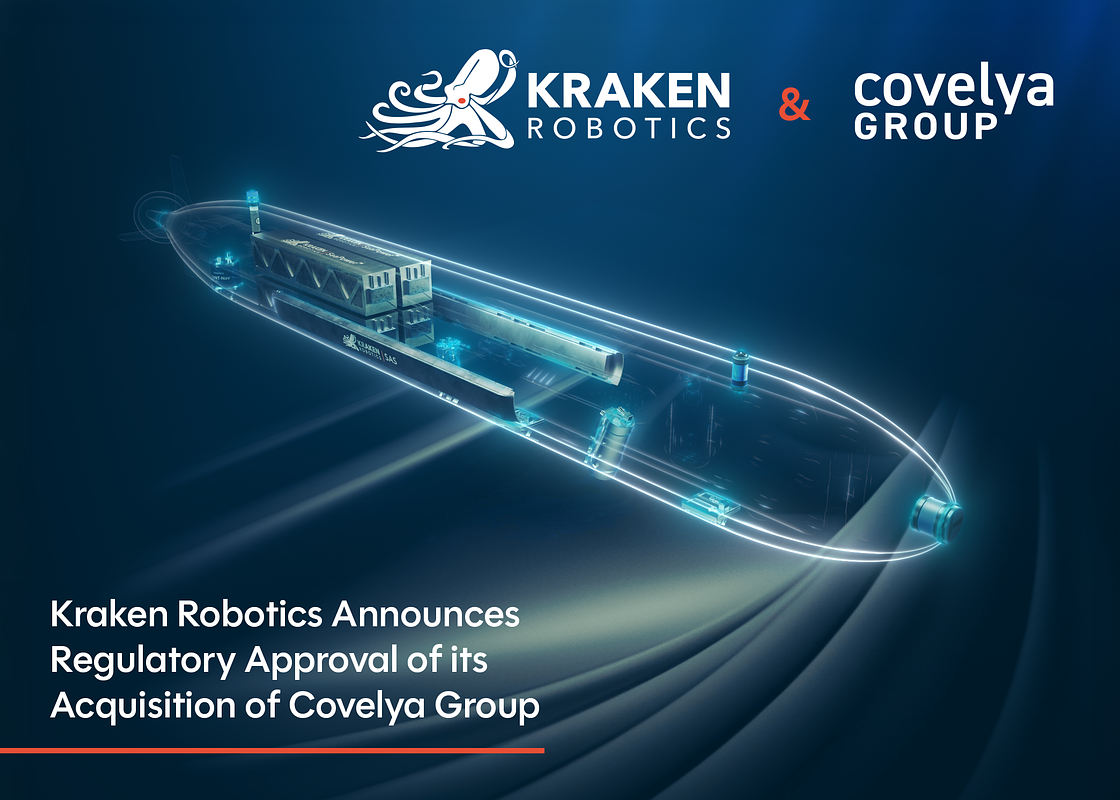
Deep-Sea Dominance: Kraken's Transformative Leap in Subsea Technology
ST. JOHN'S, NL – June 18, 2026 – The final regulatory hurdle has been cleared, and the future of underwater technology is about to be reshaped. Canadian firm Kraken Robotics has officially received all approvals for its landmark acquisition of the UK-based Covelya Group. This move, set to close on July 2, is far more than a standard corporate merger; it is a strategic fusion of innovation that creates a global powerhouse poised to dominate the subsea domain.
For years, progress in ocean exploration has been driven by specialists—companies excelling in imaging, others in navigation, and still others in software. Kraken's acquisition signals a paradigm shift. By uniting its own advanced 3D imaging sensors and robotics with Covelya's vast and varied portfolio, the company is building a one-stop-shop for complex underwater missions. As Kraken's President and CEO, Greg Reid, stated, the goal is to create "a global leader in mission-critical solutions for underwater platforms and subsea sensors/monitoring systems." This isn't just about expanding market share; it's about fundamentally altering the art of the possible in one of Earth's last great frontiers.
A Strategic Consolidation of Deep-Sea Expertise
To understand the magnitude of this deal, one must look below the surface at the technologies being combined. Kraken Robotics built its name on best-in-class synthetic aperture sonar and revolutionary pressure-tolerant batteries, giving underwater vehicles the endurance and vision to operate in challenging environments. Now, it absorbs a federation of industry legends under the Covelya umbrella.
At the forefront is Sonardyne International, a world leader in underwater acoustic positioning, inertial navigation, and wireless communication for over 50 years. Its systems are the gold standard for accurately tracking and controlling subsea assets. Then there is EIVA, a Danish engineering firm whose NaviSuite software is the brain behind countless offshore construction and survey operations. Voyis Imaging, another Canadian innovator within the group, brings high-resolution laser scanners capable of creating millimeter-accurate 3D models of underwater structures.
Further rounding out the portfolio are Chelsea Technologies, which designs critical environmental sensors for monitoring water quality and pollution, and Wavefront Systems, a specialist in advanced sonar detection. The strategic genius of this acquisition lies in its complementarity. A client looking to inspect an offshore wind farm, for example, will no longer need to source a robotic platform from one vendor, imaging from another, and navigation from a third. The new, unified Kraken can provide an integrated solution: the robotic vehicle, powered by its own high-endurance batteries, navigated with Sonardyne's precision acoustics, conducting its survey with Kraken's sonar and Voyis's lasers, all while EIVA's software processes the data in real-time and Chelsea's sensors monitor the environmental impact. This holistic capability dramatically reduces complexity and increases efficiency for customers across the energy, defense, and ocean science sectors.
Fueling the Next Wave of Subsea Innovation
The true impact of this merger will be measured in the innovations it unleashes. The combined entity will boast a formidable R&D engine, with approximately 790 engineers, scientists, and technicians and a portfolio of over 110 patents. This concentration of talent and intellectual property is set to accelerate the development of next-generation underwater systems.
For the burgeoning offshore renewable energy market, this means faster, safer, and more cost-effective inspection and maintenance of subsea cables and turbine foundations. In the defense sector, the integration of Sonardyne’s and Forcys's naval technology with Kraken’s platforms creates powerful new tools for mine countermeasures, seabed surveillance, and maritime security—critical capabilities in an era of renewed geopolitical competition. According to one industry analyst, this positions the company as an essential partner for naval system integrators who are facing accelerating demand.
For the scientific community, the merger promises more powerful and accessible tools to explore the deep ocean. The ability to create high-fidelity 'digital twins' of the seabed by fusing sonar, laser, and optical data will revolutionize our understanding of marine geology, deep-sea ecosystems, and the impacts of climate change. This convergence of technologies is the very essence of progress, enabling us to see and understand our planet in ways that were previously impossible.
The Financial and Market Ripple Effect
This transformative vision is backed by significant financial muscle. The $615 million CAD transaction, funded by a mix of cash and stock, is one of the largest in the sector's recent history. The projected financials are compelling: the combined entity anticipates revenues of $365 million CAD in 2025 with a healthy adjusted EBITDA margin of 24%. This demonstrates that the acquisition is not just strategically sound but immediately accretive.
This bold move is timed perfectly to capitalize on a surging market. The global push for energy security, digital connectivity through subsea cables, and offshore resource development is fueling unprecedented demand. The marine robotics market alone is projected to grow from $6.66 billion in 2026 to nearly $20 billion by 2034, a compound annual growth rate of almost 15%. Kraken is not just aiming for a larger piece of the existing pie; it is positioning itself to capture a dominant share of a rapidly expanding market. The investment community has taken note, with Kraken's stock price surging 166% over the past year—a clear vote of confidence in the company's ambitious strategy.
By uniting a diverse array of best-in-class technologies under a single, ambitious vision, Kraken Robotics is doing more than just acquiring a company. It is charting a new course for the entire subsea industry, creating an integrated technology leader with the scale, depth, and innovative capacity to meet the immense challenges and opportunities that lie in the deep.