
- 85% market share: DEEP Robotics holds over 85% dominance in China's multi-robot power inspection market.
- Extreme durability: The Lynx M20 operates in temperatures ranging from -20°C to 55°C with an IP66 protection rating.
- Award recognition: The Lynx M20 won the 2026 German iF Design Award, alongside global brands like Kia and Honda.
Experts view the Lynx M20 as a breakthrough in embodied AI, validating China's growing role in advanced robotics with its rugged, adaptable design and industrial applications.
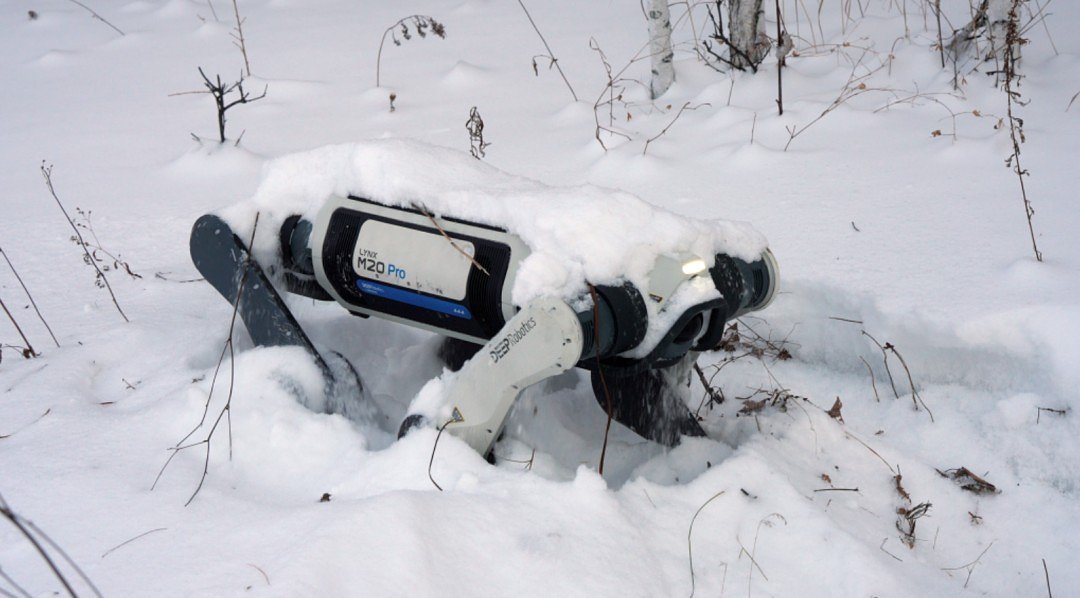
DEEP Robotics' Lynx M20 Wins Top Design Award, Signals New Era for Robots
HANGZHOU, China – March 27, 2026 – DEEP Robotics, a key player in the embodied AI sector, has earned one of the world's most coveted design accolades, the 2026 German iF Design Award, for its Lynx M20 wheeled-legged robot. The win places the Chinese-developed machine in an elite circle of products recognized for groundbreaking design and innovation, sharing the spotlight with global brands like Kia and Honda, who were also honored this year.
The award is not just a nod to the robot's aesthetics but a validation of its core engineering, which blends sophisticated design with the grit required for hazardous industrial work. This recognition, following a CES 2026 Innovation Award and a China Design Intelligence Silver Award, underscores a significant trend: the rise of highly advanced, practical robotics from China gaining serious traction on the world stage.
A Fusion of Form and Rugged Function
At the heart of the Lynx M20's success is a design philosophy of "form follows function." The robot eschews unnecessary ornamentation for a deeply integrated structure where every element serves a purpose. Its most striking feature is the innovative "wheel-legged hybrid" system, a direct solution to the classic mobility trade-off in robotics. While wheels provide speed and efficiency on flat surfaces, legs offer unparalleled ability to traverse obstacles. The Lynx M20 combines both, allowing it to roll efficiently across a factory floor and then seamlessly switch to legged locomotion to climb stairs or navigate rubble.
This hybrid approach is a key trend in modern robotics, aiming to create machines that can adapt to the unpredictable and unstructured environments of the real world. The leg configuration itself is notable, with a "front elbow, rear knee" design that distributes force more evenly and allows the limbs to retract compactly within the fuselage. This, combined with a front-back symmetrical body, makes the robot exceptionally nimble in narrow corridors and tight industrial spaces.
Modularity is another cornerstone of its design. Key components, including the head, limbs, and main control unit, are designed for quick disassembly. The limbs are even interchangeable, drastically simplifying field maintenance and reducing downtime—a critical factor for industrial clients who rely on operational continuity. This focus on serviceability and robustness demonstrates a deep understanding of the demands of industrial application, moving beyond the lab and into the field.
Redefining Work in Extreme Environments
The Lynx M20 is engineered to go where humans can't, or shouldn't. Its primary mission is to replace manual labor in hazardous scenarios, directly improving worker safety. With an IP66 protection rating, the robot is sealed against dust, rain, and snow. It operates in an ultra-wide temperature range, from a frigid -20°C to a scorching 55°C, enabling round-the-clock deployment in nearly any weather.
These capabilities are not just specifications on a data sheet; they are actively being deployed in critical infrastructure sectors. In power inspection, the Lynx M20 autonomously patrols substations and converter stations for partners like State Grid and Singapore Power Group. It uses its sensors to detect equipment anomalies, thermal hotspots, and other potential failures far more consistently than human inspectors, who face risks and physical limitations. The inclusion of hot-swappable batteries ensures these missions can continue for extended periods without interruption.
Beyond power grids, the robot is finding its footing in security and emergency response. It has been deployed for autonomous patrols by the Nanchang Public Security Bureau and at large commercial centers, providing persistent surveillance. Its versatility has also been demonstrated in more novel scenarios: it served as an independent broadcast camera at the CSL Finals, offering a world-first robotic perspective on professional sports, and it transported critical supplies in the high-altitude, low-oxygen environment of Hoh Xil, mitigating risks for human workers on the Tibetan plateau.
Navigating a Competitive Global Landscape
The Lynx M20's success arrives as the global market for industrial quadruped robots becomes increasingly competitive. DEEP Robotics has stated it achieved the top global market share for industry applications in 2025, a claim that, while ambitious, points to its significant penetration in specific niches. Industry analysis suggests the company holds a dominant position, reportedly over 85%, in China's multi-robot power inspection market. However, the broader landscape includes formidable competitors.
Boston Dynamics' Spot robot is a well-established leader, widely used for industrial monitoring in manufacturing and energy sectors. Swiss company ANYbotics offers its highly durable ANYmal robot, which is certified for use in explosive atmospheres in the oil and gas industry. Within China, Unitree Robotics presents stiff competition with a wide range of cost-effective quadruped robots that have captured a large share of the consumer, education, and research markets.
In this crowded field, DEEP Robotics is carving out its space by focusing on the wheeled-legged hybrid design and extreme environment durability. The Lynx M20 isn't just another quadruped; it's a specialized tool built for all-terrain industrial endurance. The iF Design Award provides a crucial differentiator, validating its unique approach to engineering and design on an international level and signaling that Chinese firms are not just competing on volume but on innovation and quality.
The Dawn of Embodied Intelligence
More broadly, the Lynx M20 is a powerful example of "embodied AI." This is the next frontier of artificial intelligence, where algorithms are not confined to digital servers but are given a physical body to interact with, learn from, and manipulate the physical world. Unlike traditional, rigid automation designed for repetitive tasks in a controlled factory setting, embodied AI systems like the Lynx M20 use a constant stream of sensory data—from cameras, LiDAR, and other sensors—to perceive their surroundings, make decisions, and act dynamically.
This capability is what allows the robot to navigate a muddy field in Fuling, Chongqing, to transport crops, or to autonomously patrol a sprawling industrial park. It is learning by doing, adapting its movements and mission parameters based on real-world feedback. This convergence of advanced mechanical design, robust hardware, and intelligent software is what makes such robots transformational.
The continued development and deployment of these systems promise to unlock new levels of efficiency and safety across dozens of industries, from emergency services and construction to logistics and agriculture. As these robots become more capable and accessible, they will increasingly become collaborative partners for human workers, handling the most dangerous, dirty, and dull tasks, and freeing up human talent for more complex, creative, and strategic work.