
- 83,000 visitors at SMTS 2026, with 10,000 at Daesang's booth
- 5,000 samples of fermented products distributed, all sold out
- 2,400 servings of fusion tasting menu depleted
Experts would likely conclude that Daesang's strategic fusion of traditional Korean fermentation with Japanese culinary preferences positions it to capitalize on a growing demand for authentic K-food in Japan.
Daesang's Fermented Future: K-Food Giant Targets Japanese Palates
CHIBA, Japan – February 23, 2026 – South Korean food conglomerate Daesang Corporation has signaled a major offensive in the Japanese market, leveraging a highly successful debut at the nation's largest food and retail exhibition to capitalize on a growing local appetite for authentic Korean cuisine. The company's first-ever appearance at the Supermarket Trade Show (SMTS) 2026, held from February 18-20, was marked by bustling crowds, sold-out tasting menus, and high-level talks with Japan's leading retailers, underscoring a strategic push to deepen its four-decade presence in the country.
A Taste of Success at Japan's Premier Food Expo
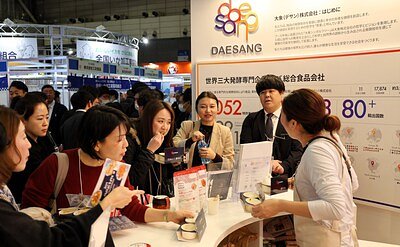
Marking its 60th anniversary, SMTS 2026 was the largest in the event's history, drawing approximately 83,000 visitors and over 2,200 companies to Chiba. Amidst this sprawling landscape, Daesang's distinctive red booth, designed to evoke the vibrant color of kimchi, became a significant center of gravity. The company reported that its booth attracted roughly 10,000 visitors over the three-day event, a testament to the rising interest in K-food.
The main attraction was a sophisticated tasting program designed to bridge the gap between traditional Korean flavors and the modern Japanese palate. Under the popular "Delica" concept of ready-to-eat and ready-to-cook supermarket foods, Daesang offered four fusion menu items. These included creative dishes like a Kimchi Tuna Mayo Sandwich and Gochujang Nikujaga (a Korean twist on the classic Japanese meat and potato stew), demonstrating the versatility of its core products. The response was overwhelming, with all 2,400 prepared servings of the main tasting menu quickly depleted. An additional 2,600 samples of Mat Kimchi and Dubu Kimchi also vanished, bringing the total samples distributed to 5,000.
Japanese food influencer Chiharu Asao, who developed the menu, noted the positive reception, even for less conventional pairings. "We created a fusion dish by adding kimchi to tamagoyaki, a familiar Japanese egg dish, ensuring that the spiciness and umami of Ilpum Kimchi harmonize with the soft texture of the egg," she commented in a statement. "Although some visitors were initially unfamiliar with the idea of kimchi in a sandwich, they were pleasantly surprised by how well the flavors complemented each other after tasting it."
Riding the Wave of Authentic Fermentation
Daesang's success at SMTS 2026 taps directly into a significant evolution in Japanese consumer preferences. For years, the Japanese kimchi market was dominated by non-fermented, lightly pickled products tailored to local tastes. However, a cultural shift is underway, with a growing number of consumers seeking the complex, deeper flavors of authentic, traditionally fermented kimchi.
This trend played directly into Daesang's hands. The company prominently featured its flagship "Jongga" brand, which it cites as Korea's No. 1 kimchi brand based on Nielsen Korea data from 2007-2024. Distributors at the show expressed particularly strong interest in "Ilpum Kimchi," a product that promises the genuine taste of traditional Korean fermentation. This shift represents a crucial market opening for Daesang, allowing it to leverage its core competency in advanced fermentation technology.
Alongside kimchi, the company’s "O'food Gochujang," a traditional red chili paste crafted using methods from the historic Sunchang region, also drew keen interest. By showcasing these heritage products, Daesang is positioning itself not just as a food manufacturer, but as a purveyor of authentic Korean culinary culture, meeting a demand for authenticity that is resonating with a new generation of Japanese food enthusiasts.
From Trade Show Floor to Supermarket Aisles
Beyond generating consumer buzz, Daesang's participation was a calculated business-to-business maneuver that yielded tangible results. The company confirmed it held a series of promising business meetings with representatives from some of Japan's most powerful retail and distribution players, including supermarket giant AEON, wholesale club Costco, and convenience store chain Ministop.
According to the company, these were not merely introductory meetings but "detailed discussions toward new supply agreements." A breakthrough with these major retailers would dramatically expand Daesang's footprint, moving its Jongga and O'food products from specialty stores into the mainstream grocery aisles frequented by millions of Japanese shoppers daily. Securing shelf space in chains like AEON and Ministop is critical for any brand seeking mass-market penetration in Japan, and the positive engagement at SMTS 2026 suggests Daesang is on the cusp of a significant expansion of its distribution network.
This direct engagement with retail buyers is a crucial step in translating trade show success into long-term market share, potentially accelerating the availability of authentic K-fermented foods across the Japanese archipelago.
A Long-Term Playbook for the Japanese Market
While the SMTS debut was a high-profile event, it represents just one part of a much broader, long-term strategy for the Japanese market. Daesang is no newcomer to Japan, having first established a local subsidiary, Daesang Japan Inc., back in 1978. This decades-long presence has provided the company with invaluable market insights, which it is now leveraging for a more aggressive expansion phase.
A pivotal move in this new strategy was the establishment of Daesang Foods Japan Inc. in 2023. This new entity is tasked with securing local production capabilities, a strategic decision that signals a deep commitment to the market. Local production will allow Daesang to create products specifically tailored to the lifestyles and preferences of Japanese consumers, improve supply chain efficiency, and respond more nimbly to market trends. This follows other recent consumer engagement efforts, such as the "Kimchi Blast Tokyo 2025" pop-up event held in the trendy Shibuya district, which aimed to embed kimchi culture within Japanese youth and lifestyle scenes.
Lim Jung-bae, CEO of Daesang Corporation, framed the recent success within this larger strategic context. "Our participation in SMTS 2026 served as an important opportunity to reaffirm the status of fermented foods—the core of K-food—in the Japanese market and to expand our local distribution network," he stated. "Moving forward, we will continue to introduce innovative products tailored to the lifestyles of local consumers, led by Jongga and O'food, to further strengthen our presence in Japan." This multi-pronged approach, combining cultural marketing, strategic retail partnerships, and investment in local production, positions Daesang to turn the current K-food wave into a lasting presence in the Japanese food landscape.
Topics & Related
Related Company Pulse