
- 15-20 years: The duration over which Salesforce environments have accumulated undocumented dependencies and complexity.
- 750 hours annually: The projected time saved by SailPoint using Sweep's platform for impact analysis.
- 30 minutes to 2 minutes: Reduction in time required for impact analysis at SailPoint.
Experts agree that AI-driven platforms like Sweep are essential for managing the complexity and compliance risks of legacy Salesforce environments, enabling enterprises to modernize with confidence and reduce operational risks.
Cybersecurity Leaders Use AI to Govern Decades of Salesforce Complexity
NEW YORK, NY – March 12, 2026 – In a significant move that underscores the mounting pressure of digital transformation and regulatory scrutiny, some of the world's top cybersecurity companies are turning to artificial intelligence to clean up their own backyards. Leading firms, including Wiz, SailPoint, Varonis, and Vanta, have adopted Sweep, an AI-driven platform, to manage, document, and audit their sprawling Salesforce environments, according to a recent announcement.
The adoption by these security-first organizations highlights a critical, often-overlooked challenge in the modern enterprise: the silent accumulation of complexity within core business systems. For many, Salesforce has evolved from a simple CRM into a central nervous system, but after 15 to 20 years of continuous customization, it can become a labyrinth of undocumented dependencies, convoluted automations, and inconsistent data models. This technical debt poses a substantial risk to agility, security, and compliance.
The Compliance Crucible
Cybersecurity companies operate in a high-stakes environment where trust is paramount and regulatory oversight is non-negotiable. These firms are subject to a stringent alphabet soup of compliance frameworks, including SOC 2, SOX, HIPAA, and the latest SEC cybersecurity disclosure rules. A single misstep in managing internal systems that handle sensitive customer or financial data can have catastrophic consequences, jeopardizing deals, inviting fines, and eroding market confidence.
While cloud platforms like Salesforce are compliant themselves, they operate on a shared responsibility model. The onus is on the customer to manage configurations, user permissions, and changes in a compliant manner. This becomes exceptionally difficult in a legacy system where no single person understands the full impact of a proposed change. Modifying a single field could unknowingly break a critical automation tied to revenue reporting, creating a SOX compliance nightmare. Similarly, granting a new permission could inadvertently expose sensitive data, violating SOC 2 or HIPAA principles.
"Cybersecurity companies are wired to think about risk in everything they do," said Ido Gaver, CEO and cofounder of Sweep. "That includes how they manage and scale their Salesforce environment. They choose Sweep because they need complete visibility and control within their Salesforce configurations, so they can make changes with confidence, stay audit-ready, and modernize without risk."
Modernizing the Unmanageable
The challenge is particularly acute for mature companies preparing for major business transformations, such as an IPO, a merger, or a large-scale ERP rollout. These events require clean, auditable, and predictable systems. However, decades of quick fixes and unmanaged growth in Salesforce can create a tangled web that hinders progress.
SailPoint, a leader in identity security, faced this exact problem. With a Salesforce environment nearly two decades old, the company's internal systems were deeply layered with complex dependencies. According to Josie Smets, Head of Revenue CRM at SailPoint, this complexity made any significant change a high-risk endeavor.
"Sweep gives us visibility we simply didn't have before," Smets stated. "Our Salesforce environment is nearly two decades old. The dependencies and automation are deeply layered. Sweep allowed us to assess impact in minutes and move forward with structural changes without introducing downstream risk."
The results were tangible. By using Sweep's platform to map and analyze its configuration, SailPoint reduced the time required for impact analysis from an average of 30 minutes to just two. This efficiency gain is projected to reclaim over 750 hours of Salesforce team capacity annually. More strategically, this newfound clarity enabled the company to complete a major architectural modernization in preparation for IPO-level compliance, all without the post-deployment fires that often accompany such large-scale changes.
The Dawn of the 'Agentic Layer'
Sweep's solution represents a broader technological shift toward what industry experts are calling an "agentic layer" for enterprise systems. This concept moves beyond simple, task-based automation. Instead, it involves creating an intelligent, decision-making fabric that sits across applications, data, and workflows. This layer allows AI agents to interpret intent, reason across different systems, and act autonomously to achieve goals within a governed framework.
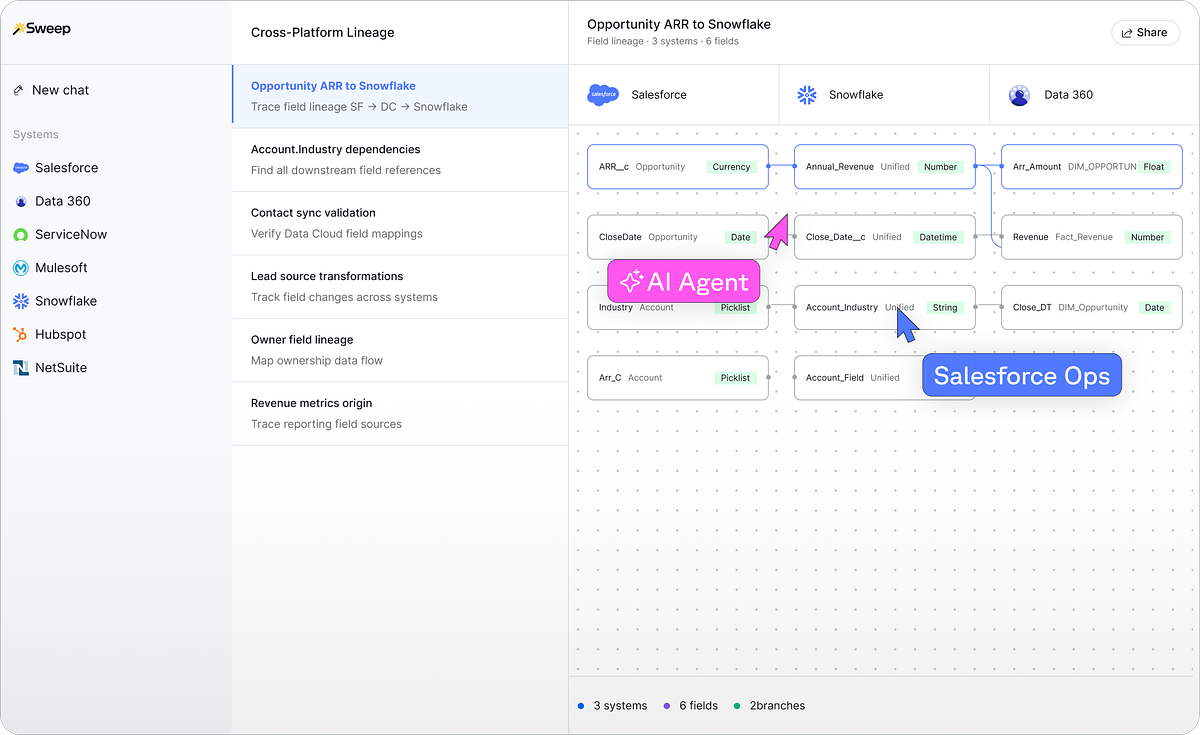
Sweep achieves this by connecting to a system like Salesforce and continuously ingesting and mapping its metadata—the data that describes the system's structure, logic, and permissions. It builds a unified, dynamic model of how the business system actually works. This model becomes a durable, searchable asset for the enterprise.
With this full context in place, teams can ask plain-language questions about their system, instantly analyze the downstream impact of any proposed change, and automatically generate documentation. This not only de-risks manual changes but also provides the necessary guardrails for AI agents to safely operate and make modifications to these complex environments in the future.
This move toward cross-platform intelligence is central to Sweep's strategy. The company recently launched a Multi-Org Mode to help enterprises manage multiple Salesforce instances across different regions or business units. Furthermore, it plans to extend its agentic layer to other critical enterprise platforms, with support for the data warehouse Snowflake and the ITSM platform ServiceNow expected in the coming weeks. This expansion signals a future where enterprises can achieve a unified, intelligent, and governable view not just of one application, but of their entire digital estate.