
- $100 million revenue target within 12-18 months through aggressive acquisitions.
- Focus on acquiring IT service firms generating $10M–$75M in annual revenue.
- Global ambitions with prior acquisition activity in Abu Dhabi.
Experts would likely conclude that CyberAI's 'Buy & Build' strategy, while high-risk, is a calculated move to dominate the fragmented IT services market through disciplined acquisitions and proprietary AI-driven cybersecurity innovation.
CyberAI's Blueprint: Building a Digital Empire One Acquisition at a Time
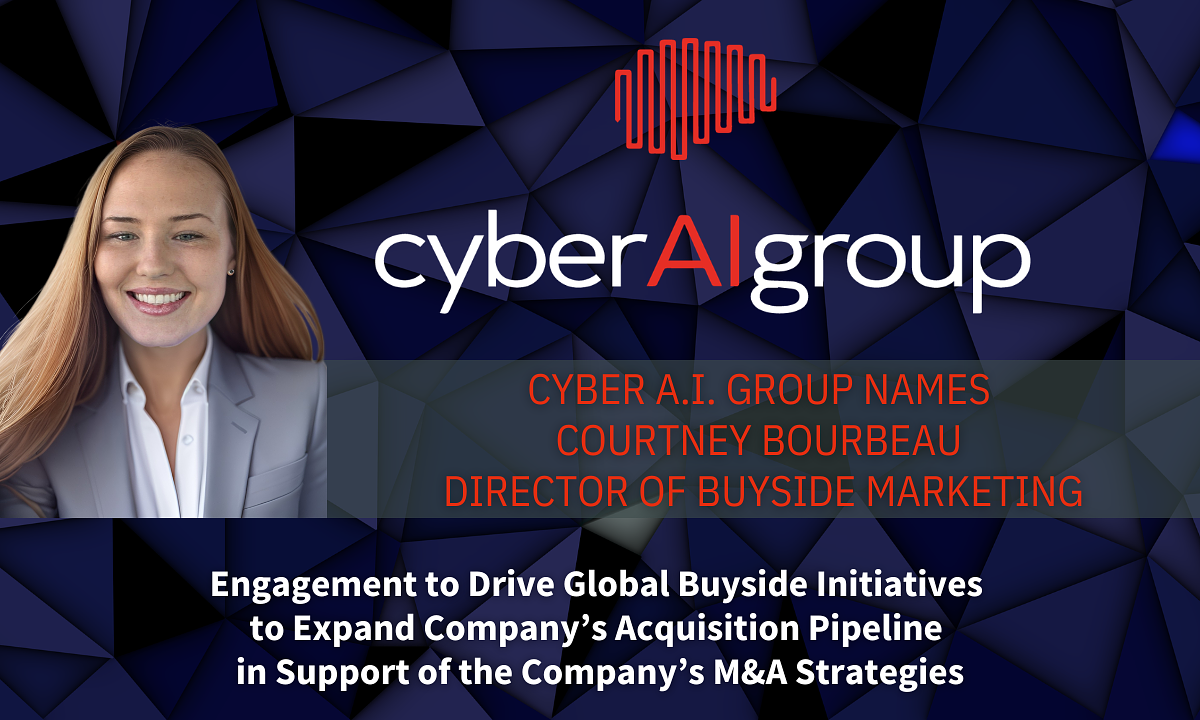
LONDON and MIAMI and NEW YORK – June 15, 2026 – In a move that signals a dramatic acceleration of its growth strategy, Cyber A.I. Group, Inc. has appointed Courtney Bourbeau as its new Director of Buyside Marketing. While a new hire in a specialized marketing role might seem like standard corporate shuffling, in this case, it’s a clear telegraph of intent. CyberAI is activating a high-stakes 'Buy & Build' model designed to rapidly consolidate the fragmented IT services market, with an eye on a $100 million revenue target and an eventual Initial Public Offering (IPO).
This isn't just about growth; it's about constructing a new kind of entity in the digital infrastructure space. The company is pursuing a dual-thrust strategy: aggressively acquiring established IT service providers while simultaneously developing its own proprietary, AI-driven cybersecurity platforms. By appointing a specialist to hunt for acquisition targets, CyberAI is making a bold statement that the foundation of its future empire will be built with the bricks of other companies, mortared together by its own technological vision.
The 'Buy & Build' Engine Gets a New Driver
Courtney Bourbeau is stepping into a pivotal role, tasked with fueling CyberAI’s M&A engine. Her mandate is to use “advanced digital research, data intelligence and market-mapping tools” to identify and court acquisition candidates. The targets are not startups, but established, profitable IT services firms generating between $10 million and $75 million in annual revenue. This focus on existing profitability and growth potential is a hallmark of a disciplined roll-up strategy, aiming to acquire stable revenue streams rather than speculative ventures.
Jessica Walters, President of Cyber A.I. Group, expressed deep confidence in the appointment. “I have worked closely with Courtney over the past year and a half and I’ve been continually impressed by her ability to apply sophisticated digital marketing, research and business intelligence tools to identify high-quality acquisition opportunities on a global basis,” Walters stated. While Bourbeau’s public-facing professional history is not extensively detailed, the strong internal endorsement from leadership suggests a track record of delivering results behind the scenes.
This methodical hunt for acquisitions is governed by a strict set of principles. A.J. Cervantes, Jr., the company's Chairman, described the process as “highly disciplined with very specific criteria.” He elaborated on key factors: “profitability, growth potential, market segments, continuation of senior management post-acquisition and embracing our maximum transparency ethos.” This emphasis on retaining existing leadership and ensuring cultural fit is critical for any acquirer hoping to avoid the common pitfalls of post-merger integration, where value is often destroyed through operational clashes and talent drain.
A High-Stakes Consolidation Play
The landscape for IT services M&A is both fertile and fiercely competitive. The relentless march of digital transformation has made specialized IT firms, particularly those with cybersecurity and cloud expertise, highly attractive assets. CyberAI is wading into a crowded field where private equity firms and larger strategic acquirers are also on the hunt. The availability of “meaningfully profitable” targets is finite, and competition often drives valuations skyward.
However, the company’s strategy appears to have been in motion for some time. Public records show that in late 2025, Cyber A.I. Group announced a Letter of Intent to acquire an AI-driven cybersecurity company in Abu Dhabi, signaling global ambitions early on. This prior activity suggests that Bourbeau’s appointment is not the start of the strategy, but a move to pour gasoline on a fire that has already been lit. The goal is to create a pipeline so robust that the company can consistently execute deals to meet its aggressive revenue target of $100 million in annualized revenues in the next 12 to 18 months.
The acquired companies represent more than just revenue; they are the on-the-ground nodes of the global digital backbone. They manage the networks, secure the data, and provide the critical support that allows modern commerce to function. By consolidating these firms, CyberAI isn't just buying companies; it's acquiring a direct and influential position within the essential infrastructure of the digital economy.
Fusing Acquisitions with AI Innovation
The second pillar of CyberAI’s strategy is what differentiates it from a standard private equity roll-up. The company is not just a holding company but a technology developer in its own right, pioneering “patent-pending technologies that enable autonomous threat detection, adaptive risk mitigation and intelligent system resilience.”
The plan is symbiotic. The acquired IT services firms will provide CyberAI with a significant number of “captive customers.” This built-in distribution channel is an invaluable asset, allowing the company to deploy its proprietary AI-driven cybersecurity technologies across a wide and immediate client base. In turn, these technologies are intended to transform the acquired firms from traditional IT service providers into next-generation cybersecurity powerhouses, increasing their value and creating a powerful competitive moat.
This approach, however, hinges on the strength of its technology. The cybersecurity market is saturated with AI-powered solutions, and the term “market disruptive” is used far more often than it is earned. With its core technology still in the “patent-pending” stage, the specifics remain under wraps. The company’s success will depend on whether its platforms offer a genuinely superior, scalable, and cost-effective alternative, particularly for the small and medium-sized businesses it targets.
Charting the Course to Wall Street
The ultimate goal for this flurry of activity, as stated by the company, is an Initial Public Offering. The aggressive M&A timeline and the $100 million revenue target are classic milestones on the road to a public listing. This path, however, is fraught with challenges, especially for a 'Buy & Build' entity.
Public market investors will demand a clear and compelling story of sustainable growth, not just a collection of disparate parts. They will scrutinize CyberAI’s ability to successfully integrate its acquisitions, realize meaningful synergies, and maintain consistent financial reporting and operational controls across a rapidly expanding global organization. This is likely why the company’s leadership repeatedly emphasizes its “highly disciplined” approach and the use of third-party Quality of Earnings (QOE) audits—to build a foundation of trust and transparency for future investors.
The volatility of the IPO market adds another layer of risk. A successful public offering requires not just a solid company, but also favorable market winds. By building a company through acquisition, CyberAI is betting it can assemble a vessel strong enough to navigate the turbulent waters of the public markets when the time is right. For Cyber A.I. Group, the blueprint is drawn; now comes the immense challenge of construction.