
- IPO Oversubscription: Creality's Hong Kong IPO was oversubscribed by 3,800 times, raising HK$1.38 billion (US$177 million).
- Creality Cloud Users: The platform has 6.2 million registered users.
- R&D Investment: 30% of IPO proceeds allocated to research and development.
Experts would likely conclude that Creality's strategic pivot toward AI-driven ecosystem expansion and multi-material printing innovation positions it as a leader in democratizing advanced digital manufacturing for consumers.
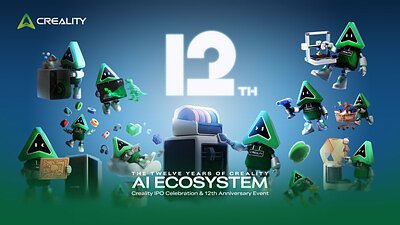
Creality Unveils AI Ecosystem, KliTek Tech in Post-IPO Growth Push
SHENZHEN, China – May 29, 2026 – Creality, a dominant force in consumer 3D printing, has marked its 12th anniversary not just with celebration, but with a profound strategic pivot. The company unveiled a suite of new technologies headlined by KliTek™, a novel multi-material printing solution, and a significant expansion of its AI-powered ecosystem. These announcements, coming on the heels of a blockbuster public listing in Hong Kong, signal Creality's evolution from a hardware manufacturer into a comprehensive, integrated platform for digital creation.
For twelve years, Creality has been synonymous with accessible desktop 3D printers. Today, under the theme "The Twelve Years of Creality: AI Ecosystem," the company is aggressively redefining its identity, aiming to lower the barrier to entry for complex digital manufacturing for millions of users worldwide.
From IPO to AI-PO: A New Era of Expansion
Creality's ambitious vision is backed by substantial financial firepower. The company recently debuted on the Hong Kong Stock Exchange (3388.HK) in a wildly successful IPO that saw its public offering oversubscribed by more than 3,800 times. Raising approximately HK$1.38 billion (US$177 million), the listing provides a massive injection of capital earmarked for innovation and global growth.
According to its filings, Creality plans to allocate 30% of the proceeds to research and development, with another 25% dedicated to expanding its Creality Cloud platform and global sales channels. This financial strategy directly underpins the anniversary announcements, transforming the company's hardware-centric past into an ecosystem-driven future. The move solidifies Creality's position not just as a product seller, but as a publicly traded technology giant shaping the future of consumer-grade creation. The successful listing is presented not as a finish line, but as the "new starting point" for a new phase of global development.
KliTek™: Tackling the Multi-Material Challenge
At the heart of the technical announcements is KliTek™, a next-generation technology designed to solve some of the most persistent headaches in multi-material 3D printing. Traditional methods have often been plagued by slow filament switching, significant material waste from purging, color bleeding, and complex maintenance.
Creality describes KliTek™ as a "nozzle-changing solution" with independent material pathways. This architecture places it in direct competition with established systems but suggests a more advanced approach. While popular multi-color systems like Bambu Lab's AMS typically use a single nozzle fed by multiple filaments—a method known for generating purge-block waste—a true nozzle-changing or tool-changing system offers distinct advantages. By dedicating a separate nozzle to each material, such systems can virtually eliminate cross-contamination and dramatically reduce waste, as there's no need to purge a shared melt zone between filament swaps.
This approach, similar in principle to high-end systems like the Prusa XL's tool changer, could allow for more reliable printing with diverse material types. Creality specifically highlights KliTek's "advanced TPU printing capabilities," a significant claim given the difficulty of handling flexible filaments in complex multi-material setups. If KliTek™ delivers on its promise, it could make advanced, multi-color, and multi-material flexible manufacturing more accessible and efficient for the consumer market.
An AI Ecosystem to Democratize Creation
Beyond the hardware, Creality is making a significant push to embed artificial intelligence across the entire user workflow. The Creality Cloud AI Ecosystem Upgrade is a cornerstone of this strategy, designed to abstract away technical complexity and empower creativity. The platform, which already boasts over 6.2 million registered users, is being enhanced with several AI-driven features.
These new capabilities include AI-assisted modeling, which can help users generate or modify designs with simple prompts; intelligent slicing optimization, which automates the complex process of preparing a model for printing; automated parameter recommendations based on the printer, material, and model geometry; and print-risk detection to proactively identify potential failures before they waste time and material.
The goal is to streamline the entire journey from a digital concept to a physical object, making 3D printing less intimidating for beginners and more efficient for experts. By integrating AI to handle tedious and technical tasks, Creality aims to enable more people to participate in 3D creation without needing an engineering background. This aligns with a broader industry trend where AI is used to optimize designs, predict failures, and automate processes, ultimately making manufacturing smarter and more accessible.
Expanding the Creator's Toolbox
Reinforcing its evolution into a full-spectrum creation company, Creality also announced several other hardware products. The Falcon T1 is an advanced multi-function laser platform for engraving and cutting, while the Pika & Sermoon P1 Scanners offer next-generation, high-precision 3D scanning solutions for creators and professionals.
Perhaps most indicative of the company's maturing vision is the M1 & R1 Filament Recycling System. This platform allows users to recycle waste materials from failed prints and supports, turning plastic scrap back into usable, customized filament. In an industry grappling with its environmental footprint—where a significant percentage of prints can become waste—providing a consumer-grade recycling solution is a major step toward sustainability. It empowers users to create a more circular workflow in their own workshops, reducing waste and dependency on virgin materials.
As Creality moves into its thirteenth year, its message is clear: the future is not just about building a better printer, but about constructing an intelligent, interconnected, and accessible ecosystem that puts the power of digital manufacturing into the hands of creators everywhere.