
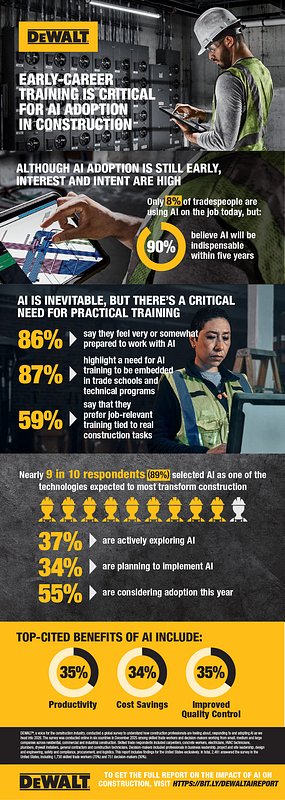
- 90% of U.S. construction professionals believe AI will be indispensable within five years, but only 8% currently use it daily.
- 87% of respondents call for AI education integration into trade schools and technical programs.
- Early AI adopters report 35% gains in productivity, quality control, and cost savings.
Experts agree that while the construction industry recognizes AI's transformative potential, a critical skills gap threatens its adoption, necessitating urgent, structured training initiatives to bridge the divide.
Construction's AI Future Hits a Critical Skills Gap
TOWSON, MD – April 23, 2026 – The construction industry is standing at the precipice of a technological revolution, with artificial intelligence promising unprecedented gains in efficiency, safety, and project management. However, a landmark new study reveals a stark and growing disconnect: while the vast majority of tradespeople believe AI is the future, very few are equipped to use it today.
A national study from DEWALT, a leading brand under Stanley Black & Decker, found that while a staggering 90% of U.S. construction professionals believe AI will be indispensable to their work within five years, a mere 8% are currently using it in their daily tasks. This chasm between belief and practice highlights a critical training gap that threatens to slow the industry's technological advancement.
The primary roadblock, according to the survey respondents, is a lack of formal, job-relevant training. An overwhelming 87% stated that AI education must be integrated into trade schools and technical programs, with 59% specifically calling for hands-on training directly applicable to real-world construction scenarios.
The Disconnect Between Readiness and Reality
DEWALT's AI in the Trades study, which surveyed nearly 2,500 U.S. construction workers and decision-makers in December 2025, paints a detailed picture of an industry eager for change but unprepared for its arrival. While 86% of professionals feel at least somewhat prepared to work with AI, their current learning methods are fragmented and informal. Many are turning to self-directed resources, with 40% using YouTube and 39% using online platforms like Coursera for AI education.
"Tradespeople are the backbone of our industry, and their hands-on expertise is what brings every project to life," said Bill Beck, President of Tools & Outdoors at Stanley Black & Decker, in the press release. "As jobsites become increasingly complex and technology-driven, the need for practical AI training has never been more important."
The small fraction of early adopters already demonstrates the technology's potential. Among those currently using AI, the top reported benefits are increased productivity (35%), improved quality control (35%), and significant cost savings (34%). These pioneers are primarily exploring AI in site operations and monitoring (46%), project planning and design (46%), and supply chain logistics (41%), offering a glimpse into a more efficient future if the training gap can be closed.
Building a Blueprint for AI Education
In response to its findings, DEWALT is taking a direct role in bridging the skills gap. The company has announced a new partnership with the Associated Builders and Contractors (ABC) to develop and deploy targeted AI training. A central component of this initiative is a new pilot program with the ABC Central Florida chapter's Innovation and Technology Center, designed to deliver the hands-on, jobsite-relevant AI training that professionals are demanding.
To ensure the initiative has a national reach, DEWALT has also committed $75,000 to ABC's Trimmer Construction Education Fund. This donation will fund grants for ABC chapters across the country to launch their own AI education programs, effectively seeding a nationwide network for AI upskilling. The Trimmer Fund is a non-profit dedicated to supporting training initiatives for the merit shop construction industry.
"Education is vital to bringing fundamental AI skillsets to our future workforce," said Matthew Abeles, ABC vice president of construction technology and innovation. "DEWALT's commitment to providing AI resources to craft professionals through its donation to the Trimmer Construction Education Fund will be invaluable to improving safety and productivity on jobsites."
This collaboration also includes DEWALT's support for ABC's "AI Toolbox Talks," a monthly webinar series aimed at its 24,000 member companies, providing a roadmap for adopting AI in areas like project design, robotics, and quality control.
An Industry-Wide Race to Upskill
DEWALT's initiative is a significant move, but it is part of a broader, industry-wide recognition that the workforce must evolve. Other major organizations are also tackling the AI skills challenge. North America's Building Trades Unions (NABTU) has partnered with Microsoft to offer no-cost AI literacy courses to its members, integrating technology training into its established apprenticeship programs.
Similarly, the U.S. Department of Labor has launched a national initiative to embed AI skills into Registered Apprenticeship programs across various sectors, including construction. Tech companies are also stepping up, with firms like Procore offering dedicated "AI in Construction" certification programs to help professionals leverage AI for smarter and safer work.
This collective push underscores the urgency of the situation. The construction industry, long reliant on traditional methods, is facing a moment of transformation where data literacy and technological proficiency are becoming as crucial as the ability to operate heavy machinery.
The New Digital Toolkit
The abstract concept of "AI in construction" is rapidly becoming concrete. On modern jobsites, AI is no longer a far-off idea but a suite of practical tools. AI-powered platforms like Buildots use 360-degree cameras and algorithms to monitor site progress and identify potential delays. In the preconstruction phase, tools like Togal.AI automate the tedious process of plan reading and material takeoffs, increasing speed and accuracy.
AI is also being integrated into Building Information Modeling (BIM) to analyze complex 3D models, identify design clashes before they become costly rework, and optimize building performance. In the field, AI-driven safety systems can analyze video feeds to detect unsafe conditions or ensure workers are wearing proper personal protective equipment. These applications are not about replacing skilled tradespeople but augmenting their expertise, freeing them from repetitive tasks to focus on complex problem-solving and craftsmanship.
These initiatives are an extension of DEWALT's long-term strategy to address the skilled labor shortage through its Grow the Trades program, which includes a commitment to invest $60 million by 2030 to expand educational access and resources.
"AI is starting to reshape the future of construction, and we need to make sure tradespeople are ready for it," Beck added. "These educational programs are about giving early-career workers and current pros access to the tools and skills that will matter on tomorrow's jobsites. DEWALT's goal is to help make AI practical, useful, and accessible for the people doing the work every day. We are committed to standing alongside trades professionals to ensure they have every opportunity to succeed in the evolving landscape of construction."