
- 11,000 attendees from over 122 countries
- HK$300 million economic impact
- 62% senior leadership among attendees
Experts agree that Hong Kong's proactive regulatory framework and strategic positioning as a global crypto hub are accelerating institutional adoption and fostering innovation in digital assets and Web3 technology.
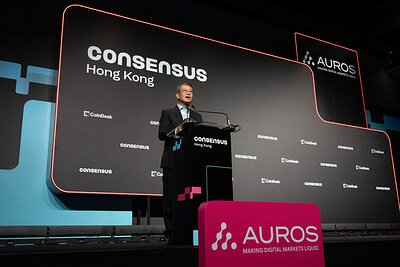
Consensus 2026 Cements Hong Kong's Status as Global Crypto Hub
HONG KONG – February 13, 2026 – Consensus Hong Kong 2026 concluded this week, leaving little doubt about the city's determined ambition to become a premier global hub for digital assets and Web3 innovation. The three-day event, held at the Hong Kong Convention and Exhibition Centre, drew 11,000 attendees from over 122 countries and is estimated to have injected nearly HK$300 million into the local economy, solidifying its role as a critical nexus for finance, technology, and policy.
More than just a conference, the event served as a powerful declaration of intent from the Hong Kong government. High-ranking officials delivered keynote addresses that outlined a clear, proactive regulatory roadmap, while industry leaders from around the world converged to discuss the maturation of digital assets and the next technological frontier: the convergence of artificial intelligence and blockchain.
A Regulatory Green Light for Global Capital
The resounding message from Hong Kong's top officials was one of unambiguous support for the digital asset industry. In his opening address, Chief Executive John KC Lee affirmed the government's commitment, stating, "The Hong Kong Government is committed to establishing Hong Kong as a global hub for innovation in digital assets. That's why over the past few years, Hong Kong has been actively building the regulatory framework to promote the steady, and sustainable, development of our Web3 ecosystem."
This commitment was substantiated with concrete policy advancements. Financial Secretary Paul Chan Mo-po emphasized a balanced approach that fosters growth while managing risk. "As the convergence of AI and blockchain continues to accelerate, the government and our regulators will work with the industry to foster concrete, high-impact use cases, while ensuring that emerging risks are properly identified, monitored and managed," he told attendees.
Further details emerged from the Securities and Futures Commission (SFC), which used the platform to announce significant updates to its regulatory framework. The SFC is greenlighting virtual asset margin financing for clients with strong credit profiles, initially allowing Bitcoin and Ether to be used as collateral. It is also developing a framework for licensed platforms to offer perpetual contracts, a popular derivatives product, though access will be limited to professional investors. These moves are designed to deepen market liquidity and provide sophisticated risk management tools that are essential for attracting institutional capital.
From Hype to High Finance: The Maturation of an Industry
The composition of the audience itself told a story of a sector in transition. With senior leadership making up 62% of attendees, the conversations on stage and on the exhibition floor moved beyond speculative hype and toward institutional integration. Panels featuring executives from Binance, the Solana Foundation, and SkyBridge Capital focused on themes like the architecture of new 'Internet Capital Markets,' the utility of stablecoins, and the tokenization of real-world assets.
This shift reflects Hong Kong's strategy to bridge the gap between traditional finance and the digital asset world. The new regulations allowing for margin financing and perpetual contracts are a clear signal to institutional players that Hong Kong is creating a familiar and robust environment for digital asset trading and investment. This regulatory clarity is seen as a key differentiator, attracting businesses weary of ambiguity in other jurisdictions.
The event showcased a growing ecosystem designed for this new phase. The Solana Foundation, for instance, debuted 'Solana Accelerate APAC at Consensus,' a dedicated track bringing together builders and executives to discuss institutional finance, payments, and DeFi within its ecosystem. This focus on building tangible, enterprise-grade solutions underscores the industry's pivot toward creating real-world value and utility.
Unveiling the 'Machine Economy': Where AI Meets Blockchain
While institutional adoption was a core theme, Consensus Hong Kong 2026 also offered a tantalizing glimpse into the future with its focus on the 'Machine Economy'—the harmonization of AI agents, robotics, and on-chain execution. This emerging paradigm envisions a world where autonomous systems can transact, own assets, and participate in the economy via secure and transparent blockchain networks.
The exhibition floor buzzed with this futuristic energy, with attendees interacting with robotics demonstrations that brought the concept to life. The innovative spirit was most palpable at the CoinDesk PitchFest and the EasyA Consensus Hackathon, which drew over 1,000 developers. The PitchFest title was claimed by zkMe Technology Limited, a project using zero-knowledge cryptography to allow users to verify credentials without disclosing personal information—a critical solution for compliant yet private identity in Web3.
Hackathon winners further illustrated the potential of this technological convergence. FoundrAI, an autonomous AI agent designed to launch entire startups, captured the imagination, while other winners like SentinelFi, which provides real-time safety scores for crypto traders, and PumpStop, a risk-management trading layer, highlighted the practical applications being built to make the digital economy safer and more efficient.
A Global Stage with an Asian Gateway
Consensus Hong Kong's success was not just in its programming but also in its global pull. The near 50/50 split between attendees from Asia and the rest of the world reinforces Hong Kong's unique position as a strategic gateway connecting East and West. The city's proactive policies and international connectivity have created an environment where global capital and Asian innovation can meet.
This global convergence, which included large delegations from the U.S., China, India, and the UAE, turned Hong Kong into a week-long hub of activity, with over 400 side events taking place alongside the main conference. The economic windfall of nearly HK$300 million highlights the event's significant contribution to the local economy and its status as a premier destination for major international gatherings.
"Hong Kong continues to prove its role as a gateway to Asia, showcasing how forward-thinking policy and innovation have helped accelerate progress in one of the fastest-growing markets for digital asset adoption," said Michael Lau, Chairman of Consensus. He noted the momentum would carry over to the Americas, with the next Consensus event scheduled for Miami.
Following its success in Hong Kong, the global dialogue on the future of digital assets will continue at Consensus Miami from May 5-7, 2026, where leaders will convene to advance the conversations that are shaping the next evolution of the global economy.