
- Stock Performance: Collective Mining's stock (NYSE: CNL) surged 162% in 2025.
- Drill Results: Deepest hole (APC143-D1) intersected 76.10 meters grading 3.26 g/t gold, including 23.35 meters at 8.24 g/t.
- Financial Position: Company holds US$135 million in cash reserves for aggressive 2026 drilling.
Experts view Collective Mining's Apollo project as a high-potential gold discovery, supported by consistent high-grade intercepts and strong financial backing, positioning it as a compelling takeover target or standalone mine.
Collective Mining's Deep Drill Hits Signal a Major Colombian Gold Find
TORONTO, ON – December 03, 2025 – Junior explorer Collective Mining is rapidly evolving into a heavyweight contender in the global gold space, and its latest drill results are sending a clear signal to the market: the story at its flagship Apollo project in Colombia is getting bigger, deeper, and richer. The company’s stock (NYSE: CNL), already up a staggering 162% in 2025, responded to news of significant high-grade gold intercepts that dramatically expand its key Ramp Zone.
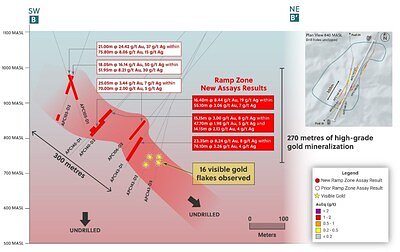
The announcement detailed a series of successful drill holes, but the star of the show was APC143-D1. As the deepest hole drilled into the Ramp Zone to date, it intersected a broad 76.10-meter interval grading 3.26 grams per tonne (g/t) gold. Within that mineralized envelope lay a core of exceptionally high-grade material: 23.35 meters grading an impressive 8.24 g/t gold. These are not just strong numbers; they are validation of a geological model that suggests the company may have only scratched the surface of a major gold system.
Drilling for Dollars: Strategy Meets High-Grade Geology
For investors parsing through the technical details, the key takeaway is systematic de-risking. The latest results have expanded the Ramp Zone to a known dimension of 300 meters along strike by 270 meters vertically, and crucially, the system remains open for expansion in all directions. This isn't a speculative, one-off hit; it's a consistent pattern of success that bolsters confidence in the deposit's scale.
“These latest drill results continue to highlight the Ramp Zone's impressive scale and high-grade potential,” commented Ari Sussman, the company’s Executive Chairman, in the official release. He highlighted that the deepest intercept demonstrates "consistent mineralization over substantial widths," a critical factor for establishing a robust, mineable resource.
This technical success is supercharged by a formidable financial position. Collective Mining is sitting on a US$135 million cash reserve, fully funding an aggressive 100,000-meter drill program planned for 2026. In the capital-intensive world of mineral exploration, this is a game-changer. It allows the company to maintain momentum, rapidly define the deposit's boundaries, and drill without the pressure of having to return to the market for dilutive financing. With ten rigs currently turning and more deep-capacity rigs arriving early next year, the flow of news and potential catalysts is set to accelerate. The market is also keenly awaiting assay results from two other completed holes where geologists logged 18 instances of visible gold—a promising, though not conclusive, indicator of high-grade mineralization.
The Continental Playbook in a World-Class District
Behind Collective’s strategy is a management team with a gilded track record. This is the same core group that founded, developed, and ultimately sold Continental Gold to China’s Zijin Mining for approximately $2 billion. That history provides a powerful narrative and a degree of investor trust that most junior explorers can only dream of. They are executing a familiar playbook: identify a promising asset in a favorable jurisdiction, systematically prove its value through the drill bit, and create a compelling takeover target or a standalone mine.
The geographical context is just as important as the management pedigree. The Guayabales project is situated in Colombia’s Middle Cauca Belt, a prolific geological region. More pointedly, it sits directly adjacent to Aris Mining’s multi-million-ounce Marmato Mine. Collective has repeatedly drawn comparisons between its deep, high-grade Ramp Zone and the Marmato Deeps Zone, which begins at a similar elevation. This isn't just marketing; it suggests the potential for a district-scale mineralized system that transcends property boundaries. As Aris Mining advances its own expansion plans at Marmato, the entire district is solidifying its reputation as one of South America's most important emerging gold camps.
Unlocking a Tier-One Asset
The geology of the Apollo system, described as a Partially Reduced Intrusion Related System (PRIRS), is key to its potential. These systems are known for their potential to host large, multi-million-ounce gold deposits. The continuous mineralization now traced from surface to over 1,370 vertical meters, culminating in the high-grade Ramp Zone at depth, supports the thesis that drilling may have only tested the upper reaches of a much larger engine.
The ultimate test of this theory will come in Q4 2026, when Collective plans to release its maiden mineral resource estimate for the Apollo system. The ongoing, aggressive drill program is squarely focused on expanding the mineralized footprint to ensure that first resource statement is as robust as possible. Each high-grade intercept, like the ones just announced, significantly contributes to the potential tonnage and grade, directly building shareholder value ahead of this critical milestone.
The Social License to Operate
While high-grade intercepts grab headlines, sophisticated investors know that a world-class deposit is worthless if you can't mine it. In Colombia, as in much of Latin America, a strong Environmental, Social, and Governance (ESG) program is not optional; it is a core business necessity. Collective appears to understand this intimately. The company has been proactive in its community engagement, investing over US$410,000 in social programs in 2024, supporting local coffee farmers, and funding infrastructure projects.
This focus on building a "social license" is a strategic imperative that mitigates non-technical risk. The company’s recent sustainability report highlighted zero environmental fines and a commitment to carbon neutrality. While the company has had to fend off allegations from a short-seller regarding its land tenure—allegations it firmly rejected as baseless—its deep investment in community relations and transparent reporting provides a significant buffer against the political and social risks that can plague mining projects. By building a foundation of local support and environmental stewardship, Collective is ensuring its geological success can translate into operational reality. With rigs continuing to turn and a steady stream of drill results expected, all eyes are on this well-funded explorer as it works to prove that the Apollo system is indeed Colombia’s next great gold discovery.