
- 61st International Art Exhibition of the Venice Biennale
- May 8, 2026: Opening date of the China Pavilion's Dream Stream exhibition
- 20-panel group piece by Yang Fudong, Solitary Hill, Plantain Rain
Experts would likely conclude that the China Pavilion's Dream Stream exhibition masterfully bridges ancient traditions with cutting-edge technology, offering a nuanced vision of cultural identity in the digital age.
China's Venice Pavilion: Where Ancient Dreams Meet Digital Streams
VENICE, Italy – May 15, 2026 – In the labyrinthine waterways and historic halls of the Venice Biennale, the China Pavilion has unfurled a vision that is both deeply ancient and startlingly futuristic. The exhibition, titled Dream Stream, which opened on May 8, offers a compelling counterpoint to the 61st International Art Exhibition's contemplative theme, In Minor Keys. Curated by the China Academy of Art (CAA) under the leadership of its president, Professor Yu Xuhong, the pavilion presents a powerful synthesis of Eastern philosophy, traditional art forms, and cutting-edge technology, creating an immersive experience that questions the very nature of creativity in the digital age.
Drawing its name from the Dream Stream Essays of Northern Song Dynasty scholar Shen Kuo, the exhibition uses the metaphor of a flowing stream to navigate the currents of time, connecting a rich cultural lineage to a future shaped by algorithms and artificial intelligence. This poetic approach resonates with the Biennale's overarching theme, which calls for a quieter, more introspective engagement with art. Where In Minor Keys invites visitors to listen to the subtle frequencies of the soul, Dream Stream channels these frequencies through a dynamic conversation between China's past and its projected future.
A Dialogue with Tradition
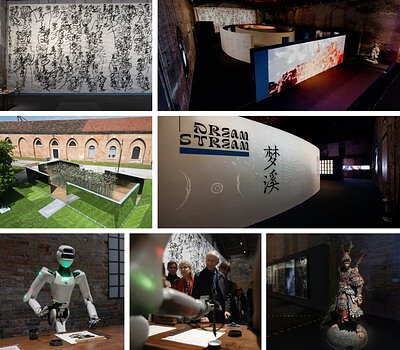
At the heart of Dream Stream is a profound respect for heritage, which serves not as a static relic but as a living source of inspiration. This is immediately apparent in the Arsenale gardens, where artist Xu Jiang’s monumental outdoor sculpture, Symbiosis, greets visitors. The large-scale copper work, which intertwines the forms of a sunflower and a lotus, is a powerful visual metaphor for harmony and the “civilizational mutual learning” that the exhibition champions.
Inside the pavilion, this dialogue continues with a stunning array of works that reinterpret classical forms. Celebrated contemporary artist Yang Fudong unveils his latest work, Solitary Hill, Plantain Rain, a 20-panel group piece that pays tribute to the reclusive literati traditions of the Song Dynasty. Using his signature “painting-film language,” Fudong creates a cinematic experience that unfolds like a traditional handscroll, inviting viewers into a contemplative space that feels both historical and deeply personal.
Perhaps the most dramatic invocation of tradition is Wang Dongling’s giant cursive script installation, Free and Easy Wandering. The monumental work, surging with energetic, dragon-like strokes, captures the unbound spirit of Zhuangzi’s philosophy. It is a testament to the enduring power of calligraphy, an art form that, in Wang's hands, becomes a contemporary performance of freedom and creative force.
The Art of the Algorithm
While grounded in tradition, Dream Stream makes its boldest statement through its seamless integration of art and technology. The exhibition doesn't just display technology; it interrogates its role, exploring, as curator Yu Xuhong puts it, the “tension and warmth of art in the age of AI.”
This tension is most vividly embodied in a collaboration with calligrapher Wang Dongling. A sophisticated robotic arm, having learned the artist's distinctive “chaotic script,” performs for the audience. With surprising grace, the machine grinds ink, dips its brush, and executes the characters for “Dream Stream” with a rhythm and force that blurs the line between precision engineering and artistic soul. The piece has become a focal point, drawing crowds who watch, mesmerized, as an ancient art form is channeled through a non-human entity. One Italian visitor, deeply moved, described it as a “beautiful form of communication.”
Further challenging conventional definitions of art, the pavilion marks the international art-world debut of Black Myth: Wukong, a highly anticipated video game from developer Game Science. Presented not just as a playable demo but as a form of “game art” through derivative sculptures and video installations, its inclusion is a landmark moment. It recognizes the immense narrative and aesthetic power of interactive digital media, positioning the epic tale of the Monkey King as a contemporary vessel for Chinese mythos on a global stage.
This fusion of art and science is also evident in Liangzhu Highlight, a spatial installation co-created by artists Zheng Jing and Wu Junyong in collaboration with scientists from Zhejiang Lab. The work projects dynamic light from above, creating an ethereal environment that reinterprets the ancient Liangzhu culture through a futuristic lens, demonstrating how scientific research and artistic vision can converge to illuminate the distant past.
Cultural Currents on a Global Stage
The China Pavilion is more than an art exhibition; it is a significant act of cultural diplomacy. Since its first official participation in 2003, China has used the Venice Biennale as a premier platform to engage in a global artistic dialogue. Dream Stream represents one of its most sophisticated efforts to date, projecting an image of a nation that is not only a guardian of ancient traditions but also a leader in technological innovation.
The exhibition’s message of openness and exchange has been well-received. Italian Deputy Prime Minister Matteo Salvini praised the pavilion for showcasing both China’s rich history and its forward-looking vision. Pietrangelo Buttafuoco, President of La Biennale di Venezia, also spoke highly of the presentation, underscoring the importance of such cultural bridges.
By framing its technological prowess within a deep-seated philosophical and artistic heritage, the exhibition aims to foster a more nuanced international understanding. It moves beyond simplistic narratives, presenting a multifaceted identity that embraces complexity. The synthesis of ancient and modern, the connection of China and the world, and the integration of art and science are not just curatorial themes but strategic expressions of a desire for “civilizational mutual learning.” Through the fluid, ever-changing currents of the Dream Stream, the pavilion offers a compelling vision of how a nation's cultural identity can evolve without losing its soul, flowing gracefully from a storied past into an uncharted digital future.