
- 250% YoY increase in Chinese robotics investment in 2025, totaling over $7 billion in 9 months
- 2 hours, 40 minutes, 42 seconds: Time taken by Embodied Tien Kung Ultra to complete a half-marathon autonomously
- 60 Hz control frequency: Enables real-time vision-to-motion translation in X-Humanoid robots
Experts agree that China is rapidly emerging as a dominant force in humanoid robotics, with X-Humanoid's practical, autonomous systems marking a pivotal shift from lab experiments to real-world industrial applications.
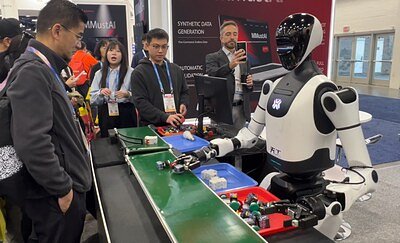
China's Robotics Leap: X-Humanoid's Robots Run Marathons and Factories
LAS VEGAS, NV – January 08, 2026 – By Timothy Bell
Amid the dazzling lights and futuristic concepts of CES 2026, a clear and powerful trend is emerging: humanoid robotics is graduating from the laboratory to the real world. Spearheading this charge is Beijing Innovation Center of Humanoid Robotics (X-Humanoid), a state-backed Chinese firm that captured attention with demonstrations focused less on novelty and more on practical, autonomous capability. Its Embodied Tien Kung series of robots weren't just on display; they were performing complex industrial tasks and achieving athletic feats previously confined to science fiction, signaling a pivotal moment for the entire industry.
While competitors showcased impressive advances, X-Humanoid's presentation stood out for its emphasis on deployable systems that are already making an impact. The company’s message, delivered through live, fully autonomous demonstrations, was unambiguous: the era of truly useful humanoid robots has begun, and China is positioning itself as a dominant force in their development and application.
From Factory Floor to Finish Line
At the heart of X-Humanoid's exhibit was the Embodied Tien Kung 2.0, a bimanual robot put through its paces in a demanding industrial simulation. Visitors watched as the robot autonomously performed a complete parts-sorting workflow on a conveyor belt. With fluid, precise movements, it grasped, identified, and placed components, seamlessly adapting to variables like shifting object positions and environmental changes. The company attributes this performance to three core strengths: speed, accuracy, and resilience.
Underpinning these capabilities is a proprietary technology called UVMC (Unified Vision-Motion Codes), which creates a direct link between visual perception and physical action. This allows the robot to react with what the company likens to a human reflex, handling unexpected situations with minimal delay. With a control frequency exceeding 60 Hz, it translates visual data into smooth motion in real-time, closing the gap between seeing and doing. Its resilience was on full display when one arm missed a part; the other immediately compensated to complete the grasp, ensuring operational continuity—a critical feature for any industrial setting.
If the Tien Kung 2.0 demonstrated industrial prowess, its sibling, the Embodied Tien Kung Ultra, proved the platform's physical limits are rapidly expanding. The Ultra model made headlines by becoming the world's first humanoid robot to complete a half-marathon (21.0975 km) fully autonomously, finishing in a remarkable 2 hours, 40 minutes, and 42 seconds. It also claimed victory in the first-ever humanoid robot games by sprinting 100 meters in 21.50 seconds. These extreme endurance and speed tests are far more than publicity stunts; they serve as critical validation of the platform's stability, durability, and autonomous navigation, laying the foundation for robots that can operate reliably for extended periods in challenging, real-world environments.
The Brains Behind the Brawn: Embodied AI Takes Control
The physical hardware, while impressive, is only half the story. The true enabler of these robots' autonomy is X-Humanoid's universal embodied AI platform, Wise KaiWu. This system integrates cognitive and physical functions into a closed-loop system of perception, decision-making, and execution. It's powered by a cross-ontology base model, VLA XR-1, which gives the robots their strong generalization capabilities.
This advanced AI is what allows the Tien Kung 2.0 to not only sort parts but also to adapt to unstructured environments. It has already been deployed as a host at the World Robot Conference 2025 and as an autonomous tour guide, where it recognizes and responds in multiple languages and coordinates with other robots via an intelligent multi-agent dispatch system. This hints at a future where these machines play significant roles in service and operational scenarios beyond the factory floor.
To overcome the data bottleneck that has long plagued robotics development, X-Humanoid appears to be leveraging novel AI training techniques. Research connected to the company suggests a method of "robotizing" vast archives of human video, converting human actions into learnable data for humanoid robots. This approach could dramatically accelerate the training of Vision-Language-Action (VLA) models, enabling robots to acquire a vast repertoire of general-purpose skills far more efficiently than through manual programming or physical demonstration alone.
Proof in Production: China's Humanoids Go to Work
X-Humanoid is aggressively moving its technology from trade show floors to active industrial sites, backing its claims of practicality with tangible deployments. The Embodied Tien Kung 2.0 is already operating on the unmanned production line at a Foton Cummins engine plant, where the robots autonomously handle bin pickup, transport, and placement, navigating various shelf heights and container types. This marks a crucial transition from controlled testing to the complexities of a live production environment.
The company's partnerships span a diverse range of high-stakes industries. It is collaborating with the China Electric Power Research Institute to use humanoid robots for high-risk power grid inspections, removing human workers from dangerous situations. In a unique application, it has partnered with the Li-Ning Sports Science Laboratory to use its robots for long-duration, high-intensity athletic shoe testing. Most recently, X-Humanoid signed an agreement with pharmaceutical giant Bayer to jointly develop applications for manufacturing, quality control, and logistics, showcasing the technology's broad appeal.
A Crowded Field in the Race for Robotic Supremacy
X-Humanoid's progress is not happening in a vacuum. The global race for humanoid robotics is heating up, with CES 2026 serving as a key battleground. Boston Dynamics showcased its next-generation Atlas, slated for deployment in Hyundai facilities. Other Chinese firms also made a strong showing, with Unitree Robotics' H1 robot setting speed records and its R1 model driving down costs, and Robot Era's Star1 demonstrating remarkable agility. They compete alongside established players like Agility Robotics and the ambitious plans of Tesla's Optimus project.
What sets X-Humanoid apart is its status as a state-backed innovation center, founded in late 2023. This highlights a concerted national strategy by China to lead in this critical technology sector. The Chinese robotics industry saw a staggering 250% year-over-year increase in investment in 2025, totaling over $7 billion in just nine months. This flood of capital is fueling rapid innovation and accelerating the path from prototype to product.
The Road Ahead: Hurdles on the Path to Mass Adoption
Despite the unprecedented momentum, the path to widespread adoption of humanoid robots remains fraught with challenges. The cost of advanced models remains a significant barrier for many businesses, though companies like Unitree are aggressively pushing prices down. More importantly, ensuring the safety of robots that operate alongside humans in unpredictable environments is a paramount concern. International bodies like the ISO are developing crucial safety standards, but establishing and implementing a comprehensive regulatory framework will take time.
Hardware limitations in dexterity, battery life, and energy efficiency still need to be overcome for robots to perform more nuanced tasks or operate for longer shifts. Furthermore, societal and ethical questions surrounding job displacement and privacy persist. As 2026 marks a pivotal year for embodied intelligence, the industry will be watching closely to see if these advanced machines can overcome the significant economic, technical, and regulatory hurdles that stand between today's impressive demonstrations and tomorrow's ubiquitous robotic workforce.