
- $8 billion: The projected market size of lab automation by the early 2030s.
- 24/7 operations: The platform enables continuous, autonomous experimentation.
- FAIR data principles: The system ensures data is Findable, Accessible, Interoperable, and Reusable.
Experts view this platform as a transformative step toward fully automated, vendor-agnostic laboratories, promising significant efficiency gains and accelerated scientific discovery.
Chemspeed and SciY Launch AI Platform to Create Self-Driving Labs
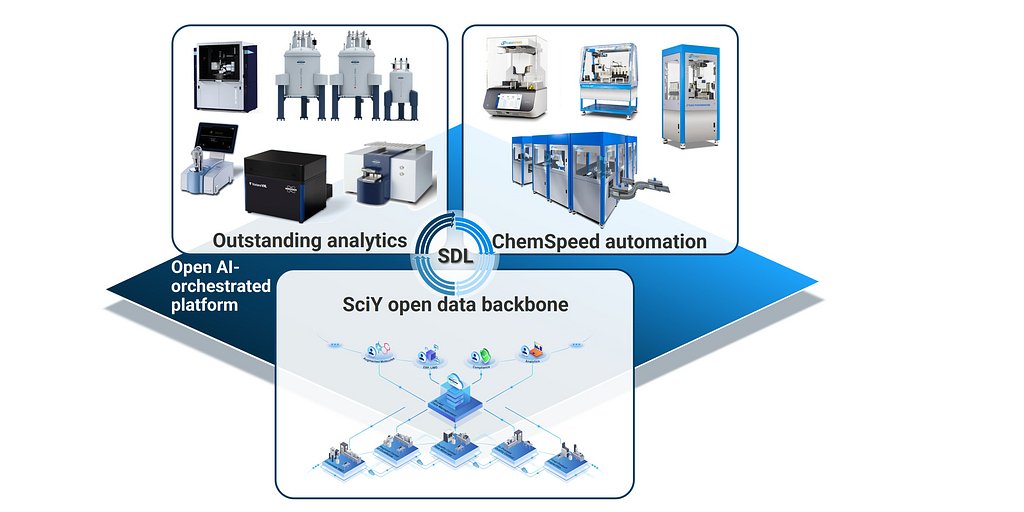
BOSTON, MA – February 09, 2026 – In a significant move to reshape the landscape of scientific research, Chemspeed Technologies and SciY, both vendor-agnostic divisions of Bruker Corporation, today announced the launch of their open Self-Driving Lab (SDL) platform at the SLAS2026 conference. The new platform integrates modular robotics, advanced analytics, and AI-powered orchestration software, aiming to break down long-standing barriers in laboratory efficiency and accelerate discovery from pharmaceuticals to materials science.
This initiative directly confronts a pervasive challenge in modern research and quality control: the fragmented, heterogeneous laboratory environment. For decades, labs have struggled with a collection of siloed instruments from various manufacturers, each operating with proprietary software and generating data in incompatible formats. This digital “Tower of Babel” creates bottlenecks, hinders collaboration, and severely limits the potential for true, end-to-end automation. The Chemspeed and SciY platform proposes a unified solution designed to enable continuous, autonomous experimentation.
The Dawn of the Autonomous Laboratory
The concept of a “Self-Driving Lab” represents a paradigm shift beyond traditional automation, which typically focuses on automating singular, repetitive tasks. An SDL, by contrast, seeks to automate the entire scientific method. It employs a closed-loop system often referred to as the Design-Make-Test-Analyze (DMTA) cycle. In this model, an AI system designs an experiment based on a defined goal, a robotic platform executes the physical steps, integrated analytical instruments test the results in real-time, and the AI analyzes the resulting data to learn and design the next, improved experiment—all with minimal human intervention.
“Vendor‑agnostic orchestration is key,” said Bernd Gleixner, President of Chemspeed, in the official announcement. “With our open SDL, we enable decision‑making in closed‑loop design–make–test–analyze (DMTA) workflows towards continuous 24/7 operations.”
This capability to run experiments around the clock promises to dramatically compress R&D timelines, potentially reducing processes that take months to mere days. By encoding experimental procedures into software and executing them with robotic precision, SDLs also address the critical issue of reproducibility, a persistent challenge in scientific research that can undermine the validity of findings and slow the pace of innovation.
Tackling the Lab's Data Fragmentation
The foundation of the new platform is its dual-pronged approach to solving lab fragmentation. Chemspeed Technologies provides the modular, precision automation hardware—robotics capable of performing complex workflows from synthesis and sample preparation to formulation and testing. These systems are engineered to be vendor-agnostic, allowing them to control and interact with a wide array of third-party laboratory instruments.
Complementing the hardware is the software and data backbone from SciY. This division brings an AI-ready open data platform designed to unify all data streams within the lab. It captures information from instruments and robotics and curates it according to FAIR data principles, ensuring all data is Findable, Accessible, Interoperable, and Reusable. By using ontology-driven semantics, the system ensures that data is not only stored but also understood in context, making it immediately ready for analysis by AI and machine learning algorithms. This structured data environment is the critical fuel required for the AI-driven decision-making at the heart of an SDL.
This open approach stands in contrast to the proprietary ecosystems offered by many competitors, which can lead to vendor lock-in and perpetuate the very silos that researchers are trying to escape. By championing open standards, Bruker’s divisions are positioning their platform as a foundational layer for the digital transformation of any lab, regardless of its existing equipment.
Bruker's Strategic Play for the Lab of the Future
The launch is a clear manifestation of Bruker Corporation's broader corporate strategy. In recent years, Bruker has pursued aggressive growth through strategic acquisitions, including Chemspeed itself in early 2024, to expand its footprint in high-growth areas like lab automation, proteomics, and spatial biology. This SDL platform demonstrates the synergy from these acquisitions, combining Chemspeed's robotics expertise with SciY's software and AI capabilities to create a high-value, integrated solution.
The move places Bruker in direct competition with other life sciences giants like Thermo Fisher Scientific, Agilent, and Danaher, all of whom are vying for dominance in the rapidly expanding lab automation market, which is projected to exceed $8 billion by the early 2030s. Bruker's key differentiator is its emphatic commitment to an open, vendor-agnostic framework, a strategy that could prove highly attractive to pharmaceutical companies and research institutions burdened by decades of investment in diverse instrumentation.
“We are seeing strong market interest by leading pharmaceutical partners,” noted Santi Dominguez, President of SciY. “This confirms that customers are looking for open, readily deployable full stack SDLs, and we are partnering with them to scale autonomous operations across sites and use cases.”
This interest from the pharmaceutical industry is a crucial validator. The immense cost and time required for drug discovery make pharma an ideal early adopter for technologies that promise radical acceleration and efficiency gains. By enabling faster iteration in compound screening, formulation development, and quality control, the SDL platform could deliver a tangible return on investment by helping to bring new therapies to market faster. As AI and automation continue to mature, the ability to seamlessly integrate new tools and technologies into a flexible, intelligent workflow will become a decisive competitive advantage for research organizations worldwide.
Topics & Related
Artificial Intelligence
Machine Learning
Digital Transformation
Sustainability & Climate
Pharmaceuticals
AI & Machine Learning
Software & SaaS
Revenue
Related Company Pulse