
- Global food loss projected to cost $540 billion by 2026
- U.S. wastes $218 billion in food annually
- Inconsistent portioning can cost operations thousands per year
Experts agree that Chef Robotics' AI-powered 'Deposit Assist' represents a significant advancement in reducing food waste and improving efficiency in meal production, offering a cost-effective solution for manufacturers.
Chef Robotics Unveils AI 'Deposit Assist' to Combat Food Waste
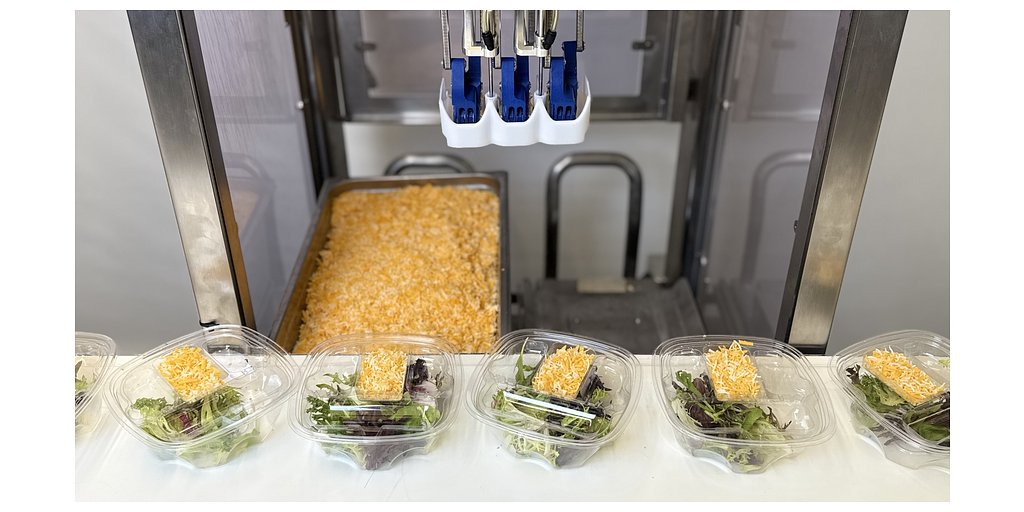
SAN FRANCISCO, CA – May 19, 2026 – Chef Robotics, a San Francisco-based leader in physical AI, today unveiled its "Deposit Assist" capability, a new robotic attachment designed to bring surgical precision to the messy world of food assembly. The innovation targets one of the most persistent and costly challenges in the production of ready-to-eat meals: accurately depositing sticky and scoopable ingredients into small tray compartments.
The new hardware, which integrates with the company's existing robotic systems, aims to drastically reduce spillage, improve product quality, and combat food waste, a problem that costs the industry billions annually. By combining a clever physical funnel with AI-driven controls, Chef Robotics is betting that a small enhancement can deliver a major impact on manufacturers' bottom lines and the quality of meals reaching consumers.
The Multi-Billion Dollar Spillage Problem
The challenge Deposit Assist addresses is far from trivial. In the fast-growing market for multi-compartment, ready-to-heat meals, a stray shred of cheese or a misplaced dollop of sauce is more than a minor cosmetic flaw. It can lead to quality control failures, improper sealing of packaging, and ultimately, rejected products. This contributes to the staggering issue of food waste within the manufacturing sector.
Globally, food loss across the supply chain is projected to cost $540 billion by 2026, with the United States alone wasting an estimated $218 billion in food annually. A significant portion of this waste occurs during processing and manufacturing due to spillage, contamination, and equipment inefficiencies. Inconsistent portioning is a primary culprit, directly eroding profit margins. Industry analysis shows that even a consistent over-portioning of one ounce per dish can cost a single operation thousands of dollars per year.
Beyond the financial toll, this waste has a severe environmental impact, with discarded food contributing 8-10% of global greenhouse gas emissions. For food manufacturers, spillage is a dual cost: they pay for the wasted ingredient and then pay again for its disposal. By ensuring ingredients land precisely where they belong, technologies like Deposit Assist aim to turn this source of loss into a new avenue for savings and sustainability.
Precision Engineering for Complex Ingredients
At its core, Deposit Assist is an elegant engineering solution to a complex physical problem. The system is a hardware attachment, featuring a custom-designed funnel that mounts to the robot's existing utensil or "end effector." This funnel acts as a physical guide, channeling ingredients like shredded cheese, diced vegetables, or sauces directly into the target compartment as the robotic utensil opens.
The true innovation lies in its adaptability and precision. The funnel's geometry is customizable to match the specific tray format, compartment size, and ingredient being handled. This is critical for dealing with the notoriously difficult-to-manage ingredients. Sticky products like shredded cheese often cling to the outside of utensils, leading to spillage into adjacent compartments.
To combat this, Chef Robotics has integrated an NSF-certified air cylinder actuator into the system. After picking an ingredient but before moving to the tray, the robot performs a series of controlled shakes over the supply bin. This motion, powered by the pneumatic actuator, dislodges any excess material stuck to or between the utensils. The result is a cleaner pick-up and a more precise deposit, ensuring that only the correctly portioned amount reaches its destination. Crucially, this entire system can be added to existing Chef robots without requiring costly and disruptive changes to the manufacturer's production line infrastructure.
AI and Vision: The Brains Behind the Brawn
While the physical hardware provides the means for precision, it is the company's AI platform, ChefOS, that provides the intelligence. The Deposit Assist capability is not merely a static funnel; it is an active component of a sophisticated physical AI system.
The robot's actions are guided by an advanced vision system that provides real-time data on ingredient placement and portion size. This visual information is fed into ChefOS, which analyzes it and dynamically adjusts the robot's movements, the speed of the deposit, and the parameters of the shaking motion. This closed-loop feedback system allows the robot to learn and adapt to variations in ingredients—no two clumps of cheese are identical—ensuring consistent performance throughout a production run.
This synergy between hardware, vision, and AI is what allows the system to minimize inconsistent portion weights and reduce spillage simultaneously. It represents a significant step forward from traditional, pre-programmed automation, moving towards intelligent machines that can perceive and react to the highly variable environment of food production.
A New Business Model for Automation
Chef Robotics is making this advanced technology more accessible by including the Deposit Assist capability within its Robotics-as-a-Service (RaaS) pricing model. This approach is pivotal in lowering the barrier to entry for many food manufacturers who are wary of the large capital expenditures traditionally associated with industrial automation.
Instead of a large upfront purchase, customers pay a recurring fee, shifting the cost from a capital expense (CapEx) to a more manageable operational expense (OpEx). This model significantly reduces financial risk and allows companies, including small and medium-sized enterprises (SMEs), to adopt cutting-edge automation. The RaaS model typically includes installation, ongoing maintenance, and software updates, ensuring the robots operate at peak performance and customers always have access to the latest technology.
This service-oriented approach creates a partnership where Chef Robotics is incentivized to deliver tangible results, as its success is directly tied to the customer's operational improvements. For Chef Robotics, it provides a predictable, recurring revenue stream and a wealth of performance data that can be used to further refine its AI and robotic capabilities, driving a cycle of continuous improvement. The availability of the service in the US, Canada, and the UK signals the company's confidence in both the technology and the business model's appeal to a broad international market.