
- 50 Newtons (N) total gripping force: Equivalent to holding a 5kg (11lb) object.
- ±0.1 N force control accuracy: Enables delicate handling of components.
- First commercial system for autonomous left-right reconstruction: Eliminates need for redundant hardware or tool changes.
Experts would likely conclude that Changingtek's X2 Hand represents a significant advancement in robotic dexterity, particularly due to its autonomous left-right reconfiguration capability, which enhances efficiency and adaptability in industrial automation.
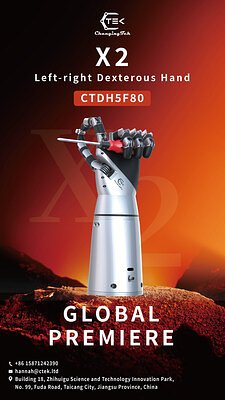
Changingtek's X2 Hand: A New Frontier in Robotic Dexterity
SUZHOU, China – February 26, 2026 – In a move poised to reshape the landscape of industrial automation, Changingtek Robotics Technology today unveiled the "X2," a dexterous robotic hand with a groundbreaking capability: the ability to autonomously reconfigure itself from a left-hand to a right-hand orientation. The company claims this is a world first, offering a level of adaptability that could solve long-standing challenges in manufacturing, logistics, and beyond.
The Ambidextrous Advantage: A Technical Leap Forward
At the heart of the X2 Left-Right Dexterous Hand (LRD Hand) is an innovative tendon-driven transmission system. This design, which mimics the underlying structure of a human hand, allows the actuators and motors to be located away from the joints, resulting in a significantly more lightweight and flexible end-effector. According to Changingtek, this system is the key that unlocks the X2's signature ability to autonomously reconstruct its configuration, effectively serving as both a left and right hand on a single robotic arm.
This mechanical ingenuity is paired with impressive performance specifications. The five-fingered hand features independently controlled digits, allowing it to execute complex manipulation and grasping patterns. While lightweight, it can exert a total gripping force of 50 Newtons (N)—roughly equivalent to the force needed to hold a 5kg (11lb) object—and a fingertip force of up to 10 N per finger.
Perhaps more critical for its target applications is its precision. The X2 boasts a force control accuracy of ±0.1 N, a level of sensitivity that enables it to handle delicate components in a laboratory or assemble intricate electronics without causing damage. This combination of strength and finesse allows it to bridge the gap between heavy-duty material handling and precision-level operations. Further enhancing its capabilities is an integrated, proprietary high-precision vision coordination system, which enables the hand to perform object recognition, positioning, and adaptive grasping in dynamic environments.
Redefining the Robotic Toolkit
The field of advanced robotics is not without its marvels. Companies like the UK's Shadow Robot Company have long produced highly sophisticated, multi-degree-of-freedom hands that closely mimic human dexterity, while firms like Robotiq have cornered the market on robust, adaptive grippers for collaborative robots. NASA's own Robonaut 2 features one of the most advanced robotic hands ever developed.
However, Changingtek's "world's first" claim appears to hold up within its specific context. While many dexterous hands exist, the X2 is the first commercial system explicitly designed for autonomous left-right reconstruction. This seemingly simple feature has profound implications for efficiency. In a typical automated cell, a robot might be equipped with a specific left- or right-handed gripper, or require a tool changer to switch between them for complex assembly tasks.
The X2's ability to reconfigure on the fly eliminates the need for redundant hardware or time-consuming tool changes. A single robotic arm equipped with an X2 hand could potentially perform a sequence of tasks—such as picking a component with a right-hand grip and then inserting it into a fixture that requires a left-hand approach—without interruption. This significantly enhances equipment utilization and streamlines complex workflows, addressing what the company calls key industry challenges of "high application costs, limited flexibility, and complex deployment."
Transforming Industries from Aerospace to Automation
Changingtek is positioning the X2 hand to make a significant impact across a range of high-value sectors. The press release identifies its wide applicability in "aerospace, intelligent manufacturing, laboratory automation, and service robotics." In each of these fields, the X2's unique combination of dexterity, strength, precision, and adaptability addresses critical pain points.
In the aerospace industry, where components are often uniquely shaped, expensive, and require assembly in tight spaces, a highly dexterous and precise robotic hand can automate tasks that were previously too complex for machines. The X2's "rich degrees of freedom" enable it to perform difficult insertion, extraction, and assembly operations in cluttered environments.
For intelligent manufacturing and logistics, flexibility is paramount. Factories and warehouses are moving away from static production lines toward dynamic systems that can handle a high mix of products. The X2's vision-guided adaptive grasping means it can handle a wide variety of parts without reprogramming, while its reconfigurable nature makes the entire robotic cell more versatile.
In laboratory automation, the demand is for gentle, precise, and repeatable manipulation. The X2's fine force control makes it suitable for handling delicate glassware, manipulating sensitive samples, or performing other intricate procedures, thereby reducing the risk of human error and increasing throughput.
Beyond the Factory: The Future of Human-Robot Interaction
The introduction of technologies like the X2 LRD Hand signals a broader shift in robotics, moving beyond simple, repetitive tasks and toward more complex, cognitive work. As robotic end-effectors become more capable, they enable robots to operate in less structured, more human-centric environments. This has significant long-term implications for the future of work and the role of robots in society.
The increasing dexterity of robots will likely accelerate the trend of automating complex manual tasks. This will necessitate a corresponding shift in the human workforce, with a greater emphasis on upskilling and reskilling for roles that involve programming, supervising, and maintaining these advanced automated systems. Instead of performing the delicate manual assembly themselves, human workers will increasingly manage fleets of robots that do.
This evolution also paves the way for more sophisticated human-robot collaboration. A robot that can handle objects with near-human dexterity is a much more useful partner in a shared workspace, whether in a factory, a lab, or even a future home environment. The development of such hardware is a crucial step in the journey toward creating truly embodied intelligent systems—robots that can perceive, understand, and physically interact with the world in a versatile and meaningful way. While still in its early days, the path toward this future is being built, one dexterous finger at a time.