
- Celestron aims to donate 1 Lumina 130mm Tabletop Dobsonian Telescope to a U.S. school for every one sold to consumers.
- The telescope's 130mm aperture allows detailed views of lunar craters, Saturn's rings, and bright deep-sky objects.
- Celestron holds an estimated 50% of the global astronomical telescope market.
Experts in STEM education and astronomy likely view Celestron's Lumina Program as a meaningful step toward improving hands-on science learning, particularly in underfunded schools, though its long-term success will depend on sustained support and effective integration into curricula.
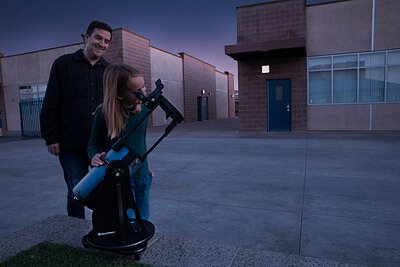
Celestron's Cosmic Gift: A Telescope for Every Classroom?
TORRANCE, CA – February 12, 2026 – Telescope giant Celestron today unveiled an ambitious plan to place the cosmos directly into the hands of K-12 students across the United States. The company, which holds a dominant position in the global telescope market, launched its Lumina Program, a buy-one, give-one initiative that promises to donate a telescope to a school for every special-edition Lumina telescope sold to a consumer.
The program aims to tackle a persistent challenge in science education: a lack of access to hands-on equipment. For every Lumina 130mm Tabletop Dobsonian Telescope purchased, an identical unit will be sent to a U.S. school, empowering educators to move lessons from the textbook to the eyepiece.
"Lumina is built around a simple idea: more students deserve the chance to experience the night sky up close," said Corey Lee, CEO at Celestron, in the company's announcement. "By pairing every purchase with a donated telescope, we're working alongside our customers to help bring astronomy into schools in a meaningful, hands-on way."
A New Star in STEM Education
The announcement comes at a critical time for science education. Many U.S. schools, particularly those in underfunded districts, struggle to afford specialized science equipment. Reports from educational associations consistently highlight budget constraints and competing priorities as major barriers to providing the hands-on experiences that ignite student curiosity. A donated telescope, valued at what would typically be several hundred dollars, represents a significant asset that is often out of reach.
The instrument at the heart of the initiative, the Lumina 130mm Tabletop Dobsonian, has been specifically chosen for this educational mission. Its 130mm (5.1-inch) aperture is widely regarded as an excellent entry point into astronomy, powerful enough to reveal detailed craters on the Moon, the rings of Saturn, and even brighter deep-sky objects like nebulae and star clusters.
The Dobsonian design is celebrated for its simplicity and durability. Unlike more complex models with computerized mounts, these telescopes are intuitive to use—essentially a "point-and-look" system. This makes them ideal for classroom settings, where ease of use and robustness are paramount. Its compact, tabletop form factor further enhances its utility, allowing for easy storage and setup in a classroom, schoolyard, or even for students to take home for family stargazing nights, an option Celestron encourages.
The Business of Giving Back
While the educational benefits are clear, the Lumina Program is also a savvy strategic move for Celestron. The California-based company, part of the Synta Technology group, already commands an estimated 50% of the global astronomical telescope market. This initiative is poised to strengthen its leadership, especially following recent upheavals in the industry. The 2024 collapse of longtime competitors Meade Instruments and Orion Telescopes & Binoculars left a significant vacuum in the market, which Celestron is well-positioned to fill.
The "buy-one, give-one" model, popularized by brands like TOMS Shoes, serves as a powerful tool for blending corporate social responsibility (CSR) with brand building. In an era where consumers increasingly favor companies with strong ethical and social commitments, the Lumina Program creates a compelling narrative. It allows customers to feel they are contributing directly to a social good, transforming a simple purchase into a philanthropic act. This can foster deep brand loyalty and differentiate Celestron in a market driven by both technical specifications and aspirational appeal.
By tying donations directly to sales, the company creates a self-sustaining cycle of goodwill and market growth. Increased sales of Lumina telescopes directly fund the expansion of the donation program, creating a powerful engine for both business and educational outreach.
Promise and Practicality
Despite its promise, the success of a nationwide "buy-one, give-one" program hinges on navigating significant logistical hurdles. Managing a dual supply chain for both retail sales and school donations, vetting thousands of school applications to ensure equitable distribution, and handling the shipment of delicate optical instruments are complex operational challenges. The company has established an online portal for educators at public, private, and charter schools to apply, which is the first step in managing this process.
Beyond the initial donation, the long-term impact will depend on more than just the hardware. The history of similar donation models shows that sustainability requires ongoing support. For the Lumina Program, this means ensuring teachers have the resources and training to integrate the telescopes effectively into their curriculum. While a Dobsonian telescope is user-friendly, basic knowledge of collimation (mirror alignment) and finding celestial objects is necessary for a successful experience.
The Lumina Program enters an ecosystem where organizations like NASA and the Astronomical Society of the Pacific have long provided educational resources, and local astronomy clubs often conduct volunteer outreach. Celestron's initiative is unique in its direct-to-school equipment donation model, addressing a tangible need that these other programs often don't. The ultimate success may lie in how well these donated telescopes are complemented by existing educational resources, creating a holistic support system for teachers who are newly equipped to bring the universe to their students.
The program's reach is inherently tied to the sales of the Lumina telescope. Its ability to make a lasting dent in the educational resource gap will depend on sustained consumer interest and Celestron's long-term commitment to managing the complex philanthropic endeavor it has now launched. For countless students, the view through one of these donated telescopes could be their first step into a larger world, potentially inspiring the next generation of scientists, engineers, and explorers.