
- $20 billion: Annual economic drain of motor vehicle theft in the U.S.
- $58,953: Average financial loss per 1,000 residents nationwide
- $148,071: Highest per-resident loss in Washington, D.C. (2.5x national average)
Experts agree that car theft imposes a far greater financial burden on communities than previously understood, with concentrated economic losses disproportionately affecting certain regions, particularly Washington, D.C., New Mexico, and Colorado.
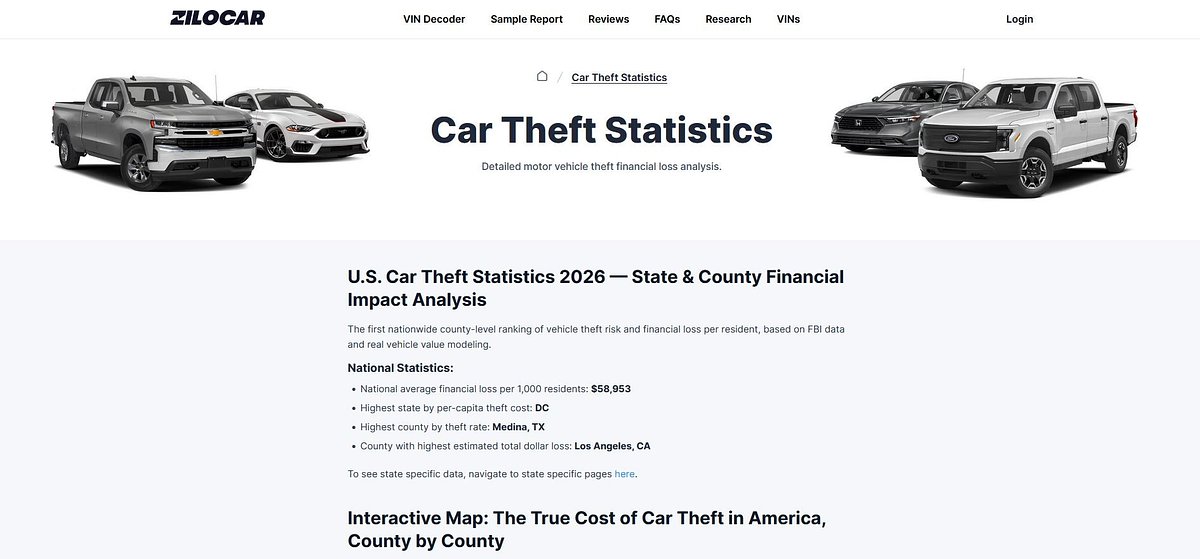
Car Theft's True Cost: Study Reveals $20B Hit on US Communities
WILMINGTON, Del. – March 26, 2026 – A groundbreaking study has pulled back the curtain on the staggering financial toll of motor vehicle theft in the United States, revealing an economic drain of nearly $20 billion annually. The analysis by Zilocar Research, based on the latest FBI data of over 850,000 stolen vehicles, shifts the focus from simple theft counts to the granular, per-person cost, unmasking an economic crisis hitting some communities far harder than national figures suggest.
The U.S. Car Theft Financial Impact Study is one of the first to dissect the issue on a county-by-county basis, examining over 2,500 counties to calculate the financial loss per resident. The findings paint a grim picture: a national average loss of $58,953 for every 1,000 residents. This new metric reveals that the true burden of car theft is not always where the most cars are stolen, but where the economic impact is most concentrated.
The Hidden Economic Burden
While the FBI classifies motor vehicle theft as a major property crime, its financial consequences ripple far beyond the sticker price of a stolen car. The study's nearly $20 billion estimate eclipses more conservative federal figures, which have historically hovered around $6-8 billion, because it accounts for the cascading costs that victims face.
For many American households, a vehicle is their second-largest asset after their home. Its theft triggers a series of financial shocks, including hefty insurance deductibles, the cost of temporary rental cars, and the often-significant gap between an insurance payout and the price of a replacement vehicle in a fluctuating market. Furthermore, victims frequently see their long-term insurance premiums rise, creating a persistent financial strain long after the initial crime.
“Most theft statistics focus only on how many vehicles are stolen,” a spokesperson for Zilocar Research noted in the report. “But when you look at the financial impact per resident, a very different picture emerges. Some communities are experiencing far greater economic losses than statewide averages suggest.” This broader definition of financial impact helps explain why the study's national loss figure is substantially higher than those in other reports, aiming to capture the complete economic disruption to individuals and local economies.
Unmasking America’s Unexpected Theft Hotspots
The study’s most striking revelations come from its geographic analysis. While states with large populations like California (over $3.5 billion) and Texas (approximately $2.68 billion) lead in total financial losses, the per-resident data tells a different story.
Washington, D.C., stands out with the highest financial loss per resident in the nation at a staggering $148,071 per 1,000 residents—roughly two and a half times the national average. This finding is reinforced by data from the National Insurance Crime Bureau (NICB), which consistently ranks the District as having one of the highest theft rates per capita. In 2023, D.C.'s rate was over 1,100 thefts per 100,000 people, a figure that underscores the intense, concentrated impact on its residents.
Following the District are New Mexico ($124,703 per 1,000 residents) and Colorado ($118,447), states with smaller populations but disproportionately high per-capita losses. This pattern challenges the conventional wisdom that theft is purely a big-state problem. The analysis, which allows users to explore an interactive map of county-level data, highlights how specific regions bear an outsized share of the national crisis.
Data-Driven Defense: How Localities Are Fighting Back
In response to these intense financial pressures, communities in the identified hotspots are deploying a range of data-informed strategies. In Washington, D.C., where carjackings have also surged, Mayor Muriel Bowser’s administration launched a pilot program to distribute free Apple AirTags to residents, enabling them to help law enforcement track stolen vehicles. The Metropolitan Police Department has also given away hundreds of steering wheel locks, particularly for Hyundai and Kia models made vulnerable by a viral social media trend.
Colorado and Nevada, despite their high rankings in the study, have recently become models of progress. Colorado has seen three consecutive years of declining auto theft, with a 26% drop from 2023 to 2024. This success is credited to proactive efforts funded by the Colorado Auto Theft Prevention Authority (CATPA), which supports multi-agency task forces and recovery programs. Similarly, Nevada reported a 31% decrease in thefts over the same period, driven by specialized police units in Las Vegas and community initiatives like "Watch Your Car."
In New Mexico, law enforcement in areas like Bernalillo County is leveraging technology, including automated license plate readers and bait car programs, to combat theft rings that often exploit the state's proximity to the international border for trafficking stolen vehicles and parts.
The Tech Arms Race and Insurance Fallout
The fight against car theft has become a technological arms race. While thieves exploit vulnerabilities—as seen with the Kia and Hyundai models lacking engine immobilizers—automakers and owners are fighting back. Hyundai and Kia have rolled out free software upgrades that have significantly reduced theft claims for updated vehicles. However, a rise in vandalism claims for these same models suggests thieves are still attempting to steal them, causing damage even when they fail.
This evolving threat landscape has forced the insurance industry to adapt. Rising claim costs for both stolen vehicles and attempted-theft damages are a direct driver of higher insurance premiums nationwide. In some high-risk areas, insurers are reportedly imposing higher deductibles or even restricting new coverage for the most targeted vehicles.
In response, many insurers are promoting telematics, or usage-based insurance, which uses GPS tracking to monitor driving habits and can aid in vehicle recovery. For consumers, the advice remains a mix of old and new: use physical deterrents like steering wheel locks, protect keyless fobs with signal-blocking Faraday bags, and ensure any available anti-theft software updates are installed. These preventative measures are becoming less of a suggestion and more of a necessity as communities grapple with the deep and persistent financial wound of auto theft.