
- First Canadian to win the Max Born Award
- Over 64,000 citations to Professor Morandotti's work
- Ki3 Photonics, a spin-off from INRS, secured a U.S. Air Force grant
Experts view this award as a validation of Canada's growing leadership in quantum science and technology, highlighting the transformative potential of Morandotti's breakthroughs in quantum photonics and nonlinear optics.
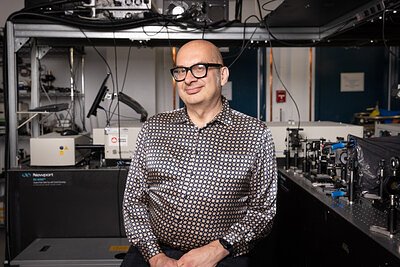
Canadian Physicist Wins Max Born Award, Cementing Quantum Leadership
VARENNES, QC – February 19, 2026 – In a landmark moment for Canadian science, Professor Roberto Morandotti of the Institut national de la recherche scientifique (INRS) has been named the recipient of the prestigious Max Born Award. He becomes the first researcher in Canada to receive the international honor, which recognizes outstanding contributions to physical optics.
Presented by Optica, the leading society in optics and photonics, the award celebrates the legacy of Max Born, a Nobel laureate and foundational figure in quantum mechanics. Morandotti is honored for a body of work that has driven transformative breakthroughs in integrated quantum photonics, nonlinear optics, and terahertz (THz) science, bridging fundamental theory with tangible technological progress.
The recognition places Morandotti among a distinguished group of past recipients that includes several Nobel Prize winners, underscoring the global significance of his research.
"It is a profound honour to receive the Max Born Award, and an even greater one to be the first researcher in Canada to do so," said Professor Morandotti. "Max Born's work laid the foundations for the quantum technologies that are reshaping our world today. Having our contributions recognized as part of this scientific legacy means a great deal to me, and to all the talented people I have had the privilege to work with along the way."
The Architect of Light: Decoding a Legacy of Innovation
Professor Morandotti's career has been defined by his ability to manipulate light in unprecedented ways, pushing the boundaries of physics at the smallest scales. His work provides the building blocks for a new generation of technologies poised to revolutionize computing, communications, and sensing.
One of his most celebrated achievements is the first-ever demonstration of complex quantum light states generated directly on a microchip. This milestone in integrated quantum photonics is crucial for scaling up quantum systems. By encoding more information onto each photon—the fundamental particle of light—his work accelerates the development of quantum communication networks and ultra-secure data transfer, bringing them closer to real-world deployment.
In the field of nonlinear optics, he provided the first experimental proof of optical solitons in engineered waveguide structures. These are unique light waves that remarkably maintain their shape as they travel, a property that is highly valuable for creating stable, high-fidelity optical communication and signal processing systems. Furthermore, he ingeniously recreated fundamental quantum phenomena like Bloch oscillations and quantum walks within photonic systems, creating a powerful link between abstract physics and practical optical devices.
His influence extends into terahertz (THz) science, a slice of the electromagnetic spectrum between microwaves and infrared light. Morandotti developed powerful new THz sources and introduced single-shot THz imaging—a technique capable of capturing ultrafast events that occur in mere trillionths of a second. This technology holds immense promise for applications ranging from non-invasive medical diagnostics and airport security screening to the development of next-generation 6G wireless networks.
A Global Recognition for Canadian Science
The Max Born Award is more than a personal accolade; it is a powerful validation of Canada's growing prominence in the fiercely competitive global quantum landscape. Established in 1982, the award's list of past recipients includes scientific luminaries such as Roy J. Glauber, Alain Aspect, and Anne L'Huillier, all of whom went on to win the Nobel Prize in Physics. Morandotti's inclusion in this esteemed list elevates both his work and the institution that supports it.
INRS, a graduate-level research university, has strategically positioned itself as a key hub within Canada's National Quantum Strategy. This federal initiative, backed by significant investment from agencies like the Natural Sciences and Engineering Research Council of Canada (NSERC), aims to solidify the country's leadership in the quantum domain.
"I would like to congratulate Professor Morandotti on this exceptional distinction," said Isabelle Delisle, Scientific Director at INRS. "A pioneer in quantum photonics both in Quebec and across Canada, he has brought national and international repute to INRS through his scientific leadership and the impact of his discoveries. We are extremely proud to have him among us."
Morandotti holds a Tier I Canada Research Chair, a program designed to attract and retain the world's most accomplished researchers. This award serves as a testament to the success of such national strategies in fostering a world-class research environment capable of producing globally recognized breakthroughs.
Beyond the Lab: A Legacy of Mentorship and Entrepreneurship
With over 64,000 citations to his name, Professor Morandotti is among the most influential physicists of his generation. Yet his impact extends far beyond his own publications. A dedicated mentor, he has guided over 220 researchers from more than 30 countries, many of whom have become leaders in their own right in academia and industry.
This legacy of mentorship is vividly illustrated by the success of Ki3 Photonics, a deep-tech company co-founded by his former mentees. The INRS spin-off is working to make quantum communications more accessible and scalable. Their core mission is to enable multi-user secure networks by leveraging existing telecommunications infrastructure, a critical step toward a future quantum internet.
Ki3 Photonics develops hardware for Quantum Key Distribution (QKD), a communication method that is theoretically un-hackable. The company has already garnered significant attention, earning awards from organizations like SPIE, the international society for optics and photonics, and securing a grant from the U.S. Air Force to explore advanced applications of entangled light. This transition from the university laboratory to a commercial venture with global partners exemplifies the powerful economic and societal ripple effect of foundational scientific research and dedicated mentorship.
As quantum technology transitions from theoretical promise to commercial reality, the groundwork laid by researchers like Morandotti becomes ever more critical. His pioneering experiments and the generation of scientists he has trained are not just solving the puzzles of fundamental physics; they are actively building the tools that will define the 21st century. This award recognizes a lifetime of achievement that continues to illuminate the path toward a quantum future.