
- 50,000 new youth vapers since Health Minister Marjorie Michel took office in May 2025
- 155 high school students start vaping daily
- 25% of grades 10-12 students vaped in the past month (2021/2022 study)
Medical experts and health advocates unanimously agree that flavoured vaping products are the primary driver of youth nicotine addiction and demand a national ban on flavoured e-cigarettes to address the escalating public health crisis.
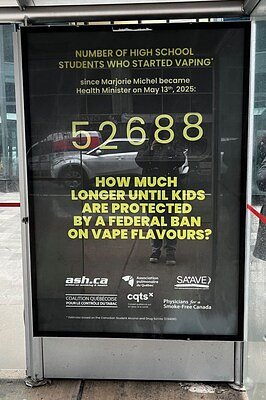
Canada's Youth Vaping Crisis: 50,000 New Vapers on Minister's Watch
OTTAWA, ON – April 17, 2026 – A stark message is greeting commuters and government officials in the nation's capital. Plastered on a bus shelter at the corner of Albert and Metcalfe streets, a new ad claims that over 50,000 high school students have started vaping since Federal Health Minister Marjorie Michel took office last May. The campaign, launched by a coalition of prominent health groups, is a dramatic escalation in their demand for a national ban on flavoured e-cigarettes, an issue they argue the government has allowed to fester while a new generation becomes addicted to nicotine.
Led by the Quebec Coalition for Tobacco Control, Physicians for a Smoke-Free Canada, and Action on Smoking & Health (ASH Canada), the campaign accuses the federal government of perpetuating a public health crisis through inaction. While Minister Michel inherited the issue, advocates say her nearly year-long tenure has been marked by a failure to enact meaningful change, allowing an estimated 155 high school students to fall into what they call the industry's "addiction trap" every single day.
The Science of Addiction
At the heart of the advocates' argument is the role of flavours. Medical experts are unequivocal that fruit, candy, and mint-flavoured products are the primary on-ramp for youth nicotine use. "Flavours are a key factor in attracting young people to nicotine products," stated Dr. Hassan Mir, a cardiologist at the University of Ottawa Heart Institute and a world expert on nicotine addiction. "The government must recognize that by allowing fruit and minty flavours in vaping products, it is helping a predatory industry addict youth to nicotine."
Dr. Mir emphasized that the government's inaction comes at the cost of youth well-being, pointing to mounting evidence linking vaping to increased risks of nicotine addiction, mental health conditions, and cardiovascular and lung injury. This position is supported by recent guidelines from the Canadian Journal of Cardiology and the Canadian Task Force on Preventative Health Care, which do not recommend vaping as a first-line smoking cessation tool.
The real-world consequences are seen daily in clinics across the country. Dr. Nicholas Chadi, Director of the substance use clinic at CHU Ste-Justine, described the severe impact on his young patients. "Legal vaping products are easy to access and incredibly addictive, leading many youths to vape daily, some up to 30 times a day, inhaling doses of nicotine that may surpass several packs of cigarettes," he explained. Dr. Chadi noted that nicotine use during adolescence can disrupt sleep, impair daily functioning, and is associated with an increased risk of initiating tobacco use and trying other psychoactive substances.
A Patchwork of Policies and Promises
The federal government's current predicament is complicated by its own past commitments. During the last election, the Liberal Party promised to "prioritize the health of young Canadians by taking strong action to curb youth vaping" and specifically supported restrictions on flavoured products. Yet, nearly five years after draft regulations to restrict e-cigarette flavours were first proposed, they remain unimplemented.
"While we fully acknowledge that Minister Michel inherited the youth vaping crisis from the previous government, she has now been in office for close to a year," said Cynthia Callard, Spokesperson for Physicians for a Smoke-Free Canada. "At this point, her inaction is perpetuating the crisis."
This federal delay has forced provinces to act independently, creating a confusing and inconsistent regulatory landscape. Quebec, Nova Scotia, and New Brunswick have banned all flavours except tobacco. In contrast, British Columbia and Ontario restrict sales of most flavours to adult-only specialty vape shops, while provinces like Alberta have no provincial flavour ban at all. This patchwork system, advocates argue, is easily exploited.
Flory Doucas, Co-Director of the Quebec Coalition for Tobacco Control, pointed out that federal inaction actively undermines provincial laws. "The vaping industry is notoriously uncompliant, with vape shops openly flouting their willingness to deliver flavoured products to provinces where these are banned," she said. A national flavour ban, she argues, is essential to improve compliance and prevent online retailers from circumventing regional rules.
An Industry Under Fire
Health Canada's own monitoring confirms "ongoing and widespread non-compliance" within the vaping industry. Beyond illegal sales, health groups point to product design and marketing as clear evidence of targeting youth. Modern vaping devices are often sleek, colourful, and packed with gimmicky features like Bluetooth connectivity and even video games, making them trendy accessories rather than smoking cessation aids.
The vaping industry, however, has consistently pushed back against flavour bans. Industry associations argue that flavours are a crucial tool for helping adult smokers switch to a less harmful alternative. They warn that a blanket ban would not only punish adult vapers but also fuel a dangerous, unregulated black market, potentially driving former smokers back to combustible cigarettes. Some data has suggested that provincial flavour restrictions have led to a corresponding increase in traditional cigarette sales, a consequence regulators are wary of.
But for health advocates, the argument that vaping is primarily for harm reduction among adults is undermined by the staggering rates of youth uptake. National surveys show Canada has some of the highest teen vaping rates in the world, with a 2021/2022 study finding that nearly a quarter of students in grades 10 to 12 had vaped in the past month. Furthermore, research indicates a majority of teen vapers have never smoked cigarettes, dismantling the idea that vaping is primarily a gateway away from tobacco for this demographic.
"Over the past eight years, parents, teachers and health professionals have struggled to protect kids from the predatory tactics of the nicotine and tobacco industries," said Les Hagen, Executive Director of Action on Smoking & Health. "It is high time for the federal government to stand up to Big Tobacco and Big Nicotine and protect Canada's youth."
As the Ottawa ad campaign continues to turn heads, the pressure on Minister Michel and Health Canada mounts. For critics, the issue has become a symbol of regulatory failure and broken promises. "All of today's high school students who vape are victims of the lack of action and the collateral damage of Health Canada's failed harm reduction strategy," concluded Ms. Callard, framing the debate in stark terms. The unresolved crisis leaves the health of a generation hanging in the balance.