
- 3.7% annual increase in colorectal cancer cases among Canadians aged 35-39 (2001-2021)
- 73% of diagnosed individuals aged 45-50 found at Stage III or IV (2022 survey)
- $719 million in net savings projected over 40 years with earlier screening
Medical experts and advocacy groups widely agree that lowering the colorectal cancer screening age to 45 is crucial to address the rising cases among younger adults and improve early detection rates.
Canada Pushed to Lower Cancer Screening Age Amid Rise in Younger Patients
TORONTO, ON – March 13, 2026 – A growing chorus of medical experts and patient advocates is intensifying pressure on Canadian provinces and territories to lower the recommended screening age for colorectal cancer from 50 to 45. The push comes as new data reveals an alarming increase in the disease among younger adults, transforming it into the deadliest cancer for Canadians under 50.
The Colorectal Cancer Resource & Action Network (CCRAN), a national patient advocacy group, is at the forefront of this movement. The organization this week welcomed a supportive statement from the Canadian Cancer Society, viewing it as a critical step in a campaign CCRAN has spearheaded since 2020. This alignment of major health organizations signals a potential turning point in Canada's fight against a preventable yet increasingly fatal disease.
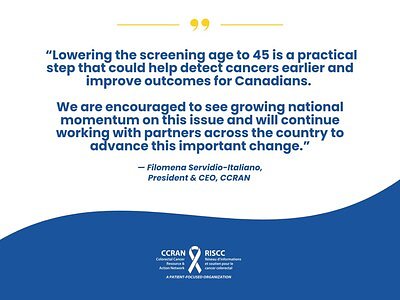
"For too many Canadians, colorectal cancer is still being diagnosed at later stages when treatment is more complex, and outcomes are less favourable," said Filomena Servidio-Italiano, President and CEO of CCRAN. "Lowering the screening age to 45 is a practical step that could help detect cancers earlier and improve outcomes for Canadians."
The Alarming Rise of Early-Onset Cancer
For decades, colorectal cancer was predominantly viewed as a disease affecting older populations. Current screening guidelines in most provinces, based on federal recommendations from 2016, reflect this, targeting average-risk individuals between the ages of 50 and 74. However, the epidemiological landscape is shifting dramatically.
Statistics show a steady, concerning climb in diagnoses among younger Canadians. Between 2001 and 2021, new cases per 100,000 people rose by 3.7% annually for those aged 35-39 and 2.6% for those 40-44. The risk for an average 45-year-old today is now comparable to that of a 50-year-old in the late 1970s, when many original screening policies were established.
The primary danger for this younger cohort is delayed diagnosis. Without routine screening and often with symptoms being dismissed as other ailments, many are not diagnosed until the cancer has reached an advanced stage. A 2022 survey found that a staggering 73% of diagnosed individuals between 45 and 50 were already at Stage III or IV, when the disease is far more difficult to treat and survival rates plummet from 90% to less than 15%.
This reality is deeply personal for patients like Yvonne Shaw, who was diagnosed with Stage 4 colorectal cancer at age 50. "Lowering the screening age could help detect cancers earlier for many Canadians and prevent others from facing the aggressive treatment I am now experiencing," she stated, her story underscoring the life-and-death stakes of the policy debate.
A Growing Consensus for Change
The call to lower the screening age is not new, but the momentum has never been stronger. CCRAN has been a persistent advocate, convening national symposia on early-onset colorectal cancer and taking the issue directly to policymakers. In 2022, the organization established a Young Adult Colorectal Cancer Patient Advisory Council to ensure the voices of those most affected are central to its efforts.
The recent endorsement from the Canadian Cancer Society adds significant weight to the cause, creating a unified front that provincial health ministries will find harder to ignore. This advocacy is backed by a strong medical consensus.
"We are seeing a troubling rise in colorectal cancer among younger adults, and many patients are diagnosed before they would traditionally be eligible for screening at age 50," explained Dr. Sharlene Gill, a medical oncologist at BC Cancer and co-chair of CCRAN's Medical and Scientific Advisory Board. "Lowering our screening age to 45 is a recognized strategy that can help advance prevention and early detection."
Dr. Ian Bookman, head of gastroenterology at St. Joseph's Health Centre in Toronto, echoed this sentiment. "As a practicing gastroenterologist, I have unfortunately seen a growing pattern of colorectal cancer being diagnosed in patients in their 50s, 40s and even younger," he said. "These new guidelines will help younger Canadians advocate for themselves and their loved ones while taking a more proactive approach to their health."
Following the International Lead
Canada is not alone in confronting this issue, but it risks falling behind international peers who have already taken action. In May 2021, the U.S. Preventive Services Task Force (USPSTF) officially recommended lowering the screening age to 45 for average-risk adults, a move the American Cancer Society also supports. This change has begun to reshape preventative care in the United States.
Similarly, Australia is adapting its policies. While its national program mails free test kits to those aged 50-74, as of July 2024, it began allowing individuals aged 45-49 to request a free screening kit, effectively opening the door to earlier detection. These moves provide a clear precedent for Canadian health authorities, demonstrating that lowering the screening age is a viable and necessary public health intervention.
Can the System Handle the Shift?
The most significant hurdle to implementing a new screening age is logistical and financial. Expanding eligibility to include millions of Canadians aged 45-49 will inevitably increase demand on the healthcare system. The primary screening method, the Fecal Immunochemical Test (FIT), is a simple at-home kit, but positive results require a follow-up colonoscopy, a more invasive and resource-intensive procedure.
Concerns about system capacity—specifically, the availability of endoscopy suites and trained gastroenterologists—are paramount. One analysis projected that lowering the age to 45 and using FIT screening would increase colonoscopy demand by a manageable 3.9% over a lifetime. However, a widespread shift to colonoscopy as a primary screening tool, as is common in some parts of the U.S., could overwhelm the system with an 89% to 116% increase in demand.
Economically, the change presents a classic case of short-term investment for long-term gain. One 2023 modeling study projected that lowering the screening age would incur an additional $298 million in screening and treatment costs. However, these costs were dwarfed by an estimated $719 million in net savings over 40 years, realized through the avoidance of expensive and complex treatments for advanced-stage cancer.
Advocates argue that the focus should be on the immense human and societal benefits, including an estimated gain of over 92,000 Quality-Adjusted Life Years (QALYs). As CCRAN and its partners continue their work, the debate is moving from if the screening age should be lowered to how Canada can prepare its healthcare system to make this life-saving change a reality for all.