
- $600 billion: The estimated size of the global copyright trading market that BookAI aims to disrupt.
- 230 publishers: The number of publishers from 15 countries that adopted BookAI's platform at the Frankfurt Book Fair.
- 62%: The percentage of traction from Western markets at the Frankfurt Book Fair.
Experts would likely conclude that BookAI's AIoT-integrated platform represents a significant advancement in the intellectual property market, offering a scalable solution to streamline cross-border content evaluation and licensing, with strong validation from both publishers and hardware partners.
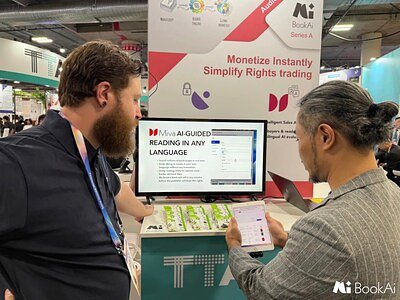
BookAI Unlocks Global IP Market with AIoT, Opens Seed Round
LAS VEGAS, NV – January 13, 2026 – In a move signaling a significant shift from conceptual technology to commercial reality, AI knowledge computing firm BookAI has announced the opening of its Seed Round financing. The announcement, made today, comes directly on the heels of a breakthrough showcase at the Consumer Electronics Show (CES) 2026, where the company demonstrated a scalable, hardware-integrated solution for the global intellectual property market.
The Taiwan Tech Arena (TTA) backed startup is now raising capital via SAFE (Simple Agreement for Future Equity) notes, a strategic decision designed to rapidly onboard partners and capitalize on momentum gained from both the tech and publishing industries. By bridging the gap between static content and interactive AIoT devices, BookAI is positioning itself as a critical infrastructure layer for a borderless knowledge economy.
From Concept to Commercial Reality at CES
While CES 2026 was awash with artificial intelligence applications, BookAI distinguished itself by demonstrating a tangible, market-ready product that solves a complex, real-world problem. The company validated its B2B2C business model through a strategic partnership with Korean smart lamp manufacturer CN Inc. The centerpiece of their exhibit was the DAL:BIT smart lamp, a device that seamlessly integrated BookAI's core technology.
Attendees witnessed English-speaking users interacting in real-time with Traditional Chinese content projected by the lamp. This wasn't simple translation; users could converse with the text, ask for summaries, and analyze concepts, all facilitated by BookAI's platform. This transformation of a static book into an interactive "IntelliBook" captured the attention of investors and potential partners, generating immediate inquiries from Japanese venture capital firms focused on IP expansion and Silicon Valley investors targeting scalable AI infrastructure.
"We proved at CES that BookAI is not just a tool, but the 'Intel Inside' for the global knowledge economy," said Kun-Lin Hsieh, Founder and CEO of BookAI, in a statement. "By embedding our Nabu and Miva engines into third-party devices—like our new partnership with Korean smart lamp maker CN Inc.—we have unlocked a scalable path to transform static content into IntelliBooks and monetize them across borders instantly."
This "Knowledge-as-a-Service" model, demonstrated through a consumer-facing hardware product, provides a clear pathway to commercial scalability, a milestone that many early-stage generative AI companies are still striving to achieve.
The Engine for a Borderless Knowledge Economy
At the heart of BookAI's innovation is its dual-engine platform designed to liquefy intellectual property. The system works by converting traditional text into "IntelliBooks"—dynamic, interactive, and, most importantly, tradable digital assets. This is powered by the company's proprietary "Sovereign Knowledge Map" technology within its Miva app, which acts as an "AI Reading Ally."
The platform's potential extends far beyond a novel reading experience. It directly addresses a major friction point in the estimated $600 billion global copyright trading market. Currently, publishers and rights agents face a costly and time-consuming process to evaluate foreign-language content for potential licensing. Translation costs are prohibitive, and the evaluation process can take months, creating a significant barrier to the international flow of knowledge and culture.
BookAI's Nabu platform, a self-publishing system for IntelliBooks, allows rights holders to list their content. Prospective buyers or licensees can then use the Miva app to instantly interact with and evaluate the work in their native language, drastically reducing both the time and cost associated with cross-border IP trading. The effectiveness of this solution was previously validated at the Frankfurt Book Fair, where the platform was adopted by over 230 publishers from 15 different countries. Notably, 62% of this traction came from Western markets, underscoring the universal nature of the problem BookAI aims to solve.
Building a Moat with Copyright and Scalability
In an era where generative AI has raised complex questions about copyright and intellectual property ownership, BookAI has built its strategy around compliance. The company asserts that its market-ready infrastructure is designed to handle complex copyright management, a feature that provides a significant "commercial moat" and appeals directly to global IP holders who are often wary of new AI technologies. While the precise technical underpinnings of its compliance system are proprietary, the focus itself is a key differentiator.
The company's "dual-engine growth validation" strategy provides a comprehensive proof of concept. The "Content Engine," validated at the Frankfurt Book Fair, demonstrated strong B2B demand from publishers who are eager to find new ways to monetize their backlists and expand into new markets. The "Hardware Engine," validated at CES 2026, confirmed the B2B2C traction by showing how this content can be delivered to end-users through a growing ecosystem of AIoT devices.
This two-pronged approach de-risks the business model by proving out both sides of the marketplace: the supply of content from publishers and the demand from consumers via hardware partners. It creates a virtuous cycle where more content attracts more hardware partners, and a wider device network makes the platform more valuable for publishers.
A Strategic Seed Round to Fuel Expansion
To harness this momentum, BookAI has opened a Seed Round structured with SAFE notes. This financing instrument is popular with early-stage startups as it allows for faster capital injection without the lengthy negotiations of a priced equity round. For BookAI, the choice reflects a desire for speed and flexibility, enabling them to quickly bring on strategic investors who can provide more than just capital.
The company is seeking partners who align with its vision of a global, frictionless knowledge ecosystem. The interest from distinct investor profiles—Japanese VCs with a focus on IP and Silicon Valley funds centered on AI infrastructure—highlights the multifaceted appeal of BookAI's model. It is simultaneously an IP play, a SaaS platform, and an infrastructure solution for the AIoT landscape.
The funds raised will be used to scale operations, further develop the Nabu and Miva engines, and expand its network of publishing and hardware partners worldwide. By building out this ecosystem, BookAI aims to become the definitive platform for accessing, interacting with, and trading knowledge-based assets, effectively creating a new asset class and transforming how the world consumes information.