
- Auction Date: May 13, 2026
- Assets for Sale: 20 Bollinger B4 electric trucks and manufacturing equipment
- Company Debt: $6.2 million owed to supplier Dana Inc.
Experts view Bollinger Motors' collapse as a cautionary tale for EV startups, highlighting the immense capital and operational challenges of scaling production in a highly competitive market.
Bollinger's End of the Road: EV Truck Maker's Assets Hit Auction Block
OAK PARK, Mich. – April 27, 2026 – The ambitious journey of electric vehicle manufacturer Bollinger Motors has reached its final, unceremonious stop. In a stark reminder of the brutal realities of the EV market, the company's complete manufacturing operations and a fleet of newly built electric trucks will be sold to the highest bidder in a court-ordered auction on May 13.
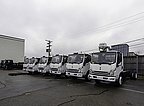
The online webcast auction, conducted by industrial liquidation specialist Maynards Industries, will see the piecemeal sale of Bollinger's assets from its facilities in Oak Park, Michigan, and Tunica, Mississippi. The inventory includes not only sophisticated, late-model EV production equipment but also twenty 2025 Bollinger B4 Class 4 all-electric trucks, vehicles that represent the final output of a company that once promised to revolutionize the commercial vehicle space.
A Trail of Debt and Broken Promises
Bollinger Motors' collapse was not a sudden event but a slow, painful decline marked by financial turmoil and strategic missteps. Founded in 2014 by Robert Bollinger, the company initially captured the industry's imagination with rugged, boxy designs for an all-electric SUV (the B1) and pickup truck (the B2). However, in a pivotal and ultimately fateful decision in January 2022, the company abruptly canceled its consumer vehicle plans, refunding deposits to focus exclusively on the commercial truck market.
The pivot was intended to target what founder Robert Bollinger called a "bigger market with less competition." This new direction culminated in the acquisition of a 60% controlling interest by Mullen Automotive in September 2022 for $148.2 million, a deal meant to provide the capital and scale needed for production. But the cash infusion was not enough to overcome deep-seated operational and financial woes.
By late 2025, the company was in a death spiral. It missed payroll for multiple pay periods and faced a barrage of lawsuits from unpaid suppliers. Production of the B4 chassis cab, which had begun at a facility run by contract manufacturer Roush Enterprises, was halted in January 2025 after Bollinger failed to pay over $1.8 million in invoices. The final blow came from a lawsuit filed by key supplier Dana Inc., which claimed it was owed $6.2 million, pushing the company into receivership in December 2025. This was, troublingly, the company's second receivership in less than a year. The parent company, which rebranded from Mullen Automotive to Bollinger Innovations in July 2025, faced its own crisis, having been delisted from the Nasdaq stock exchange in October 2025.
A Cautionary Tale for the EV Gold Rush
The liquidation of Bollinger Motors serves as a potent cautionary tale for the dozens of startups that have entered the electric vehicle "gold rush" over the past decade. The path from a compelling prototype to profitable, high-volume production is fraught with peril, a reality often referred to as "production hell." Bollinger's story is a textbook example of these challenges, highlighting the immense capital required to scale manufacturing, navigate complex supply chains, and compete against both legacy automotive giants and other well-funded startups.
While government incentives and a growing demand for zero-emission commercial vehicles create a fertile market, the execution risk remains extraordinarily high. The commercial electric truck sector, in particular, has seen several high-profile flameouts. Recent failures of European electric truck makers like Volta Trucks, Tevva, and Quantron echo the struggles seen in North America, demonstrating a global pattern of consolidation and failure. Even larger, publicly traded EV companies like Rivian and Lordstown Motors have faced significant struggles with cash burn, production delays, and stock market volatility, underscoring that no startup is immune to the sector's immense pressures.
Bollinger's failure illustrates that a good idea and a promising product are not enough. Without a nearly bottomless well of capital and flawless operational execution, even the most innovative ventures can be crushed by the sheer weight of manufacturing reality.
Opportunity Knocks for Rivals and Fleet Operators
While the auction marks a somber end for Bollinger, it presents a significant strategic opportunity for other players in the automotive and logistics industries. The sale allows potential buyers to acquire critical EV manufacturing infrastructure and vehicles without the multi-year lead times and high costs associated with purchasing new.
"This is a unique opportunity to acquire exceptionally high-quality and lightly used EV manufacturing equipment and electric trucks without the long lead times associated with new production," said Robert Levy, President of Maynards Industries, in the press release announcing the sale. "These assets offer immediate value to manufacturers, integrators, and fleet operators looking to expand their capabilities."
Potential bidders could range from established automakers looking to quickly bolster their own commercial EV programs to rival startups seeking to leapfrog development stages by acquiring a turnkey production line. Contract manufacturers could purchase the equipment to expand their service offerings to other EV brands, while large fleet operators have the chance to acquire ready-to-deploy electric trucks at a potential discount, accelerating their own fleet electrification goals. The auction essentially offers a shortcut to market entry or expansion in the highly competitive commercial EV space.
On the Auction Block: The Remnants of an EV Dream
The assets up for sale provide a tangible look at what Bollinger built and what it hoped to achieve. The centerpiece of the vehicle auction is the fleet of twenty 2025 Bollinger B4 trucks. These Class 4 chassis cabs, which carried an MSRP of $158,758 upon their launch in September 2024, feature a 158-kWh battery pack, a projected range of 185 miles, and a payload capacity of nearly 7,400 pounds. Designed for customization, they were intended to serve a variety of commercial uses, from last-mile delivery vans to dump trucks.
Beyond the vehicles, the auction catalog details a comprehensive suite of manufacturing and testing equipment acquired mostly between 2021 and 2025. This includes specialized battery testing and validation systems, EV charging and diagnostic infrastructure, vehicle lifts, wheel alignment systems, and a host of other toolroom and plant support machinery. The "lightly used" condition of these assets makes them particularly valuable.
Inspections for the assets in Oak Park, Michigan, are scheduled for May 11–12, with the items in Tunica, Mississippi, available for viewing by appointment. As bidders prepare to pick over the bones of the defunct automaker, the sale will serve as the final chapter in Bollinger's history and, perhaps, the first chapter for a competitor who seizes the opportunity.