
- $800,000: Bishop's University's funding to join the international effort to observe black hole collisions.
- $2B: Total cost of the European Space Agency's Laser Interferometer Space Antenna (LISA) mission.
- 2035: Planned launch year of the LISA mission.
Experts agree that the LISA mission will revolutionize astrophysics by enabling the first-ever detection of supermassive black hole mergers, providing unprecedented insights into galaxy formation and the nature of gravity.
Bishop's University Joins $2B Mission to Hunt Colliding Black Holes
SHERBROOKE, QC – April 01, 2026 – In a move that places it at the forefront of modern astrophysics, Bishop's University has secured $800,000 to join a monumental international effort to observe the universe's most violent events: the collision of supermassive black holes. The funding positions the small Quebec-based institution as a key player in a $12-million pan-Canadian network preparing for the European Space Agency's $2-billion Laser Interferometer Space Antenna (LISA) mission, a project poised to revolutionize our understanding of the cosmos.
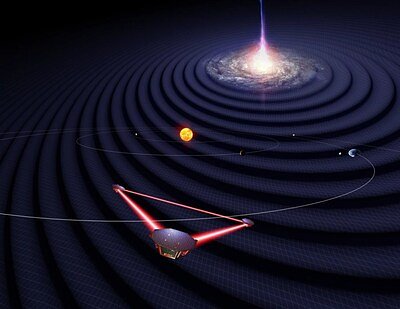
When gargantuan black holes, millions of times the mass of our sun, spiral into each other at the hearts of distant galaxies, they unleash ripples in the very fabric of spacetime. These gravitational waves, predicted by Einstein a century ago, carry secrets about the formation of galaxies, the nature of gravity, and the dawn of the universe itself. Now, a team at Bishop's will help build the tools to finally capture them.
Canada's National Network for Cosmic Ripples
The investment in Bishop's is part of a larger national strategy. The university is one of six institutions forming the Gravitational Wave Astrophysics Infrastructure Network (GRAIN), a $12-million collaboration designed to ensure Canada plays a leading role in the next generation of gravitational wave astronomy. Alongside researchers from UBC, McGill, Université de Montréal, the University of Lethbridge, and the University of Manitoba, Bishop's will contribute to building the essential hardware, software, and computing power needed to detect and analyze these faint cosmic signals.
This funding, provided by the Canada Foundation for Innovation (CFI), the Government of Québec, and other partners, is a strategic investment. It unlocks Canadian participation in the ambitious LISA mission, a space-based observatory set to launch in 2035. By pooling expertise and resources, the GRAIN network aims to create a national data center and software ecosystem, guaranteeing Canadian scientists access to the mission's groundbreaking data and a seat at the table for its discoveries.
A New Window on the Low-Frequency Universe
The LISA mission represents a monumental leap beyond current capabilities. While ground-based observatories like LIGO and Virgo have successfully detected high-frequency gravitational waves from the mergers of smaller, stellar-mass black holes, they are deaf to the low-frequency rumbles of their supermassive cousins. Terrestrial seismic noise and the sheer scale required make it impossible to detect these long-wavelength signals from Earth.
LISA solves this problem by going to space. The mission will consist of a constellation of three spacecraft flying in a precise triangular formation, trailing Earth in its orbit around the sun. The spacecraft will be separated by an astonishing 2.5 million kilometers, forming a gigantic detector. By shooting lasers between them, LISA will measure minuscule changes in this distance—down to the picometer, a scale smaller than a single atom—caused by a passing gravitational wave.
This unprecedented sensitivity will open a new observational window, allowing scientists to:
- Witness Supermassive Black Hole Mergers: For the first time, astronomers will observe the collisions of black holes weighing millions to billions of solar masses, tracing the history of galaxy formation back to the early universe.
- Map Spacetime: LISA will detect Extreme Mass Ratio Inspirals (EMRIs), where a stellar-mass black hole or neutron star spirals into a supermassive one. These events will provide exquisitely detailed maps of the warped spacetime around black holes, offering stringent new tests of Einstein's theory of General Relativity.
- Survey Our Galaxy: The observatory is expected to detect thousands of compact binary star systems within our own Milky Way, creating a detailed census that will illuminate stellar evolution.
With a planned launch aboard an Ariane 6 rocket in 2035, the mission is expected to begin its scientific operations around 2037, promising a new era of cosmic exploration.
Bishop's University at the Forefront
At Bishop's, the funding directly supports the work of Dr. John Ruan, the Canada Research Chair in Multi-Messenger Astrophysics. His team is tasked with developing what the press release calls "critical software infrastructure" for the LISA mission. This involves creating the sophisticated algorithms and data-processing pipelines required to sift through the immense volume of data from the spacecraft, distinguish faint gravitational wave signals from noise, and translate them into meaningful astrophysical information.
Dr. Ruan's expertise in multi-messenger astronomy—which combines gravitational wave data with traditional observations using light—is central to this effort. The software developed at Bishop's will be essential for interpreting LISA's findings and connecting them to the broader cosmic picture.
"LISA will detect gravitational waves from black hole collision at the centres of galaxies for the first time, which will be a landmark discovery worthy of a Nobel Prize," said Dr. Ruan in the university's announcement. "The GRAIN project ensures that Canadian researchers—including our team at Bishop's—will lead parts of this effort, by delivering critical software infrastructure to the mission."
This role places the university's researchers not just at the heart of a national collaboration, but at the digital core of a mission that will define astrophysics for decades.
From Small Campus to Cosmic Stage
For an institution of approximately 2,600 students, this level of participation in a multi-billion-dollar international project is a significant achievement. It highlights a strategic focus on cultivating world-class research in specialized fields, allowing a smaller university to make an outsized impact on the global scientific stage.
"Bishop's is a small university asking very big questions," noted Dr. Matthew Peros, the university's Interim Associate Vice-Principal (Research). "Being part of a national collaboration of this scale speaks to the strength of our researchers, and also the impact that small institutions can have on cutting-edge research on a national and international level."
This involvement not only elevates the university's research profile but also provides unparalleled opportunities for its students to engage with a frontier-pushing scientific endeavor. As Bishop's University helps build the tools to listen to the cosmos, it solidifies its place as a small but mighty force in the quest to understand the universe's deepest secrets.