
- Legal Victory: Biocytogen's RenNano® platform cleared of patent infringement by Shanghai Intellectual Property Court.
- Market Impact: Over 350 partners and collaborators de-risked following the ruling.
- Strategic Shift: Court recognized independent innovation, validating China’s biotech capabilities.
Experts would likely conclude that this ruling underscores a growing confidence in China's domestic biotech innovation and its ability to compete globally on intellectual property grounds.
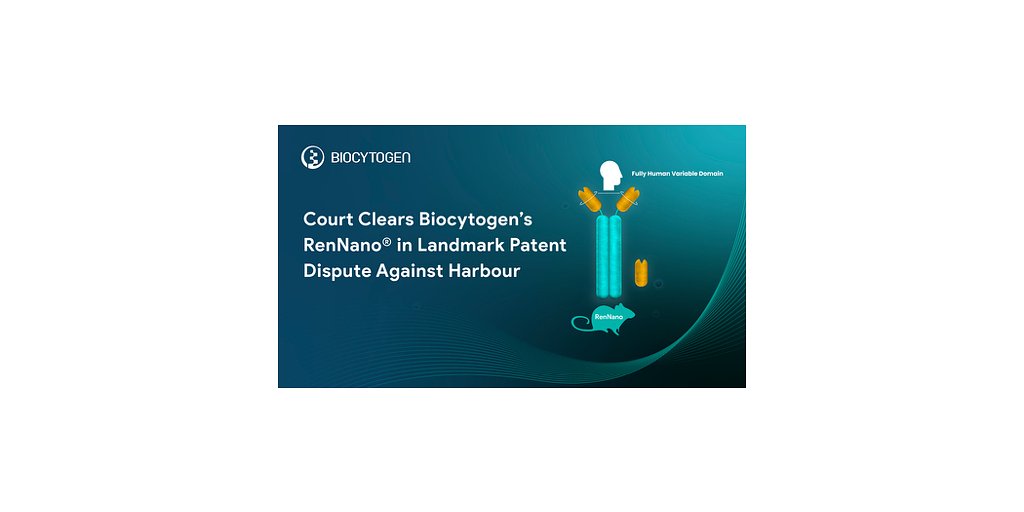
Beyond the Verdict: Biocytogen’s Patent Win Signals a Power Shift
BEIJING – June 29, 2026 – In the world of high-stakes biopharmaceuticals, court judgments are often read as simple wins or losses. But the recent ruling from the Shanghai Intellectual Property Court in favor of Biocytogen is a document that demands a deeper reading. On the surface, the court found that the company’s RenNano® antibody discovery platform did not infringe on a patent held by rival Harbour Antibodies BV. Dig deeper, however, and the verdict signals a profound shift in the landscape of global biotech: a validation of China's domestic innovation and a clear signal of confidence for one of its most ambitious players.
This wasn't merely a legal victory; it was a strategic exorcism. For nearly two years, a legal cloud has hung over Biocytogen's core technology, a platform critical to its business model of forging global partnerships. The lawsuit, filed by Harbour Antibodies’ parent company Harbour BioMed in September 2024, created an element of risk for the more than 350 partners and potential collaborators relying on Biocytogen’s platforms. The Shanghai court’s first-instance judgment, which also ordered Harbour to bear the litigation costs, has effectively lifted that uncertainty, allowing the market to re-evaluate Biocytogen not on its legal liabilities, but on its scientific and commercial merit.
The Anatomy of a High-Stakes Dispute
The conflict centered on one of the most valuable technologies in modern drug discovery: transgenic mice engineered to produce fully human, heavy chain-only antibodies (HCAbs or nanobodies). These smaller antibodies are a holy grail for drug developers, capable of reaching therapeutic targets inaccessible to conventional antibodies. Both Biocytogen, with its RenNano® platform, and Harbour BioMed, with its Harbour Mice® platform, are major competitors in this lucrative space.
Harbour BioMed, which acquired the Dutch firm Harbour Antibodies and its technology in 2016, alleged that RenNano® infringed on its Chinese patent (ZL201210057668.0). The legal battle that ensued was a testament to the tenacity on both sides. Biocytogen fought the case on multiple fronts, first unsuccessfully challenging the Shanghai court's jurisdiction all the way to the Supreme People's Court of the People's Republic of China. It also filed a request to invalidate the patent itself with the China National Intellectual Property Administration (CNIPA).
In a fascinating turn that speaks to the growing sophistication of China's IP ecosystem, the CNIPA upheld the validity of Harbour’s patent in June 2025. Yet, a year later, the Shanghai court determined that Biocytogen’s independently developed technology did not infringe upon it. This nuanced outcome—recognizing the patent holder's rights while simultaneously protecting a separate innovator—is a powerful statement. It demonstrates a legal system capable of making fine distinctions, a crucial development for both domestic and international firms that rely on IP protection to justify massive R&D investments.
A Signal of Sovereign Innovation
For Biocytogen, the ruling is an emphatic affirmation of a narrative it has carefully cultivated: that of a company built on genuine, independent innovation. In a statement last year, the company asserted that the “technical principles, design strategy, and intellectual property scope of RenNano® are fundamentally different” from the patent in question. The court’s decision now lends the full weight of judicial authority to that claim.
This validation is the currency of confidence in the biotech sector. With the legal overhang removed, Biocytogen’s value proposition to its global partners is significantly de-risked. The company’s entire model is built on a “dual-engine” platform, combining its vast portfolio of humanized mouse models with a massive library of antibody sequences ready for partnership. This model has already secured landmark deals with major multinational pharmaceutical companies. The clarity provided by the court’s ruling will undoubtedly accelerate the pace and scale of future collaborations for its RenNano® platform, which is central to discovering next-generation VHH therapeutics.
“This favorable first-instance judgment further underscores the originality and independence of Biocytogen’s proprietary technologies,” the company stated, reinforcing the message that its platforms are not just powerful, but secure. This is the signal that will be heard loudest in the boardrooms of potential partners worldwide.
The Global Chessboard of Antibody IP
This dispute cannot be viewed in isolation. It is a single, pivotal battle in a larger, global “patent war” being waged over foundational antibody technologies. What makes this case particularly compelling is that Harbour BioMed is itself a formidable and aggressive defender of its intellectual property. In a parallel drama playing out in the United States, Harbour recently won a major victory of its own. A federal jury in Delaware found that biotech giant Amgen had willfully infringed a Harbour patent, awarding it over $20 million in damages with the potential for that sum to be tripled.
Harbour’s proactive IP strategy in the U.S. makes its setback against Biocytogen in China all the more significant. It demonstrates that even the most litigious and well-resourced players cannot assume dominance. The ruling highlights a competitive landscape where innovation, backed by a robust legal defense, can successfully carve out its own territory. It is a clash of two Chinese-based titans, each leveraging international subsidiaries and global legal systems to protect their most valuable assets.
The verdict sends a clear message: the field of advanced antibody discovery is no longer the exclusive domain of a handful of Western firms or a single patent holder. A new class of innovators, particularly from China, has not only mastered the science but also the complex legal strategy required to compete and win on the world stage. As Biocytogen moves forward, it does so with a court-affirmed freedom to operate. While the possibility of an appeal by Harbour remains—this is, after all, a first-instance judgment—the immediate momentum is undeniably with Biocytogen. The ruling has moved a critical piece on the global biotech chessboard, signaling a company, and a country, that is confident in its power to innovate and its ability to defend that innovation.