
- 526 teams from 27 countries competed in the AGIBOT WORLD CHALLENGE 2026.
- Over 100 teams surpassed the official baseline performance.
- AGIBOT rolled its 10,000th robot off the production line in March 2026.
Experts agree that the shift from simulation-based to real-world testing is a critical milestone for embodied AI, ensuring commercial viability and reliability in dynamic environments.
Beyond the Simulation: Reality is the New Benchmark for Embodied AI
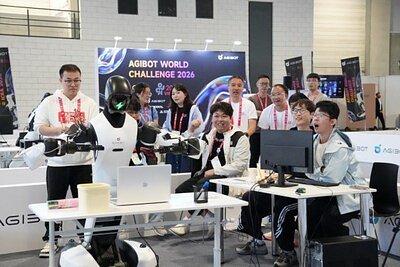
VIENNA, Austria – June 05, 2026 – In the polished halls of the ICRA 2026 conference, the future of artificial intelligence wasn't just being discussed; it was being tested, dropped, and debugged in the physical world. The AGIBOT WORLD CHALLENGE 2026, a global competition that drew 526 teams from 27 countries, marked a pivotal moment for the industry. While headlines often fixate on the latest AI language models, this event signaled a far more tangible shift: the move away from evaluating AI in pristine, predictable simulations and toward the messy, unforgiving reality of real-world robotics.
This isn't just a technical upgrade. It’s a fundamental change in philosophy that could determine how quickly intelligent robots move from research labs into our warehouses, hospitals, and homes. For years, the industry has relied on digital sandboxes to train and score AI models. But as AGIBOT’s challenge demonstrated, true progress is now measured by how well a machine navigates the unscripted chaos of the physical world.
The Great Sim-to-Real Divide
The world of embodied AI has long been haunted by the "sim-to-real gap"—the frustrating chasm between a robot's flawless performance in a simulation and its often clumsy, unreliable behavior when deployed on hardware. Simulations are invaluable for running millions of trials at low cost, but they are inherently simplified approximations of reality. They struggle to replicate the subtle physics of friction, the infinite variations in lighting, or the unpredictable ways objects might fall or react to a grasp.
"There's a growing recognition that for embodied AI to be commercially viable, it must demonstrate consistent reliability in dynamic environments," noted one industry analyst. This sentiment was a recurring theme at ICRA 2026, where workshops focused on building "Reliable and Trustworthy Embodied AI." The challenge lies in creating systems that can generalize from their training and adapt on the fly, a feat that has proven difficult for models confined to digital worlds.
The AGIBOT competition confronted this problem head-on. By making the offline finals a series of closed-loop tests on its G2 humanoid robot, the organizers forced teams to prioritize physical stability, adaptability, and the ability to complete long, multi-step tasks. A high score in the simulation was just the entry ticket; the real test was whether a team’s code could successfully pilot a physical robot through complex scenarios, a process that places a premium on robustness over brute-force optimization for a narrow digital benchmark.
A Global Gauntlet for the Brightest Minds
The scale and diversity of the challenge underscored the global race to crack embodied intelligence. Teams from world-renowned institutions like the Chinese Academy of Sciences, Tsinghua University, and the University of California San Diego competed alongside corporate R&D powerhouses including Russia's Sber Robotics Center, Alibaba, and vivo. The fact that over 100 teams surpassed the official baseline performance indicates a remarkably high level of talent and maturity in the field.
The competition was split into two key tracks, reflecting the core pillars of modern robotics. The "Reasoning to Action" (R2A) track, won by team PrismBot from vivo, evaluated the entire chain of command: from understanding a complex instruction to planning a sequence of movements and executing them precisely. This goes far beyond simple manipulation, requiring a deep integration of language, spatial reasoning, and physical control.
The second track, "World Model" (WM), focused on a more predictive form of intelligence. Won by NeoVerse-ABot, a joint team from the Chinese Academy of Sciences and Amap CV Lab, this track tested an AI's ability to anticipate the physical consequences of its actions. Crucially, the tests included non-ideal interactions like dropping objects or failing to grasp them, forcing models to understand and recover from failure—a critical skill for any robot operating in the real world.
Building the Bedrock: AGIBOT's Ecosystem Strategy
While the competition captured the spotlight, AGIBOT’s larger strategy is arguably more significant. The Shanghai-based company, which rolled its 10,000th robot off the production line in March, isn't just building robots; it's building the foundational infrastructure for the entire industry. The challenge was a showcase for its full-stack toolchain, which it has now opened to the public.
This ecosystem includes the AGIBOT WORLD open-source dataset for training models, the Genie Sim 3.0 simulator for initial testing, and the AGIBOT G2 humanoid robot as the physical validation platform. By providing standardized tools and benchmarks like EWMBench, the company is tackling one of the biggest hurdles to progress: inconsistent evaluation criteria. This allows researchers and developers worldwide to test their models against a common, reproducible standard, accelerating the feedback loop from concept to deployment.
This strategy positions AGIBOT as more than just a hardware manufacturer. It is aiming to become a central pillar in the development of embodied AI, providing the picks and shovels for the coming robotics gold rush. By fostering an open-source community around its platform, it hopes to drive a virtuous cycle of innovation that benefits both the company and the broader field.
From Aisle 5 to Your Front Door: The Commercial Frontier
Perhaps the most telling sign of the industry's direction was a specialized track focused on a "real-supermarket benchmark." Developed in collaboration with Dexmal, this challenge required robots to perform end-to-end mobile manipulation in a mock retail environment. Algorithms controlled real robots remotely, tasked with navigating aisles, picking items from shelves with varying heights and randomized placements, and transporting them.
This moves beyond abstract tasks to address a concrete, high-value commercial problem. The retail and logistics sectors are poised for massive automation, but the dynamic and cluttered nature of a store or warehouse remains a formidable challenge for today's robots. Benchmarks like this are essential for pushing developers to create solutions that are not just technically clever but commercially practical.
As AGIBOT integrates the learnings from Vienna into its public leaderboards and open-source tools, it is helping to chart a course for the entire field. The shift from simulation scores to real-world reliability is creating a new set of winners and losers, rewarding those who can build robust, adaptable systems. This move toward standardized, reality-based testing is laying a more stable and scalable foundation, ensuring that the next generation of embodied intelligence is built for the world we actually live in.