
- 20 years: Atlantis Blue Project Foundation has been active in marine conservation.
- 2,700-mile rescue: The resort executed a long-distance rescue of a critically endangered Kemp's ridley sea turtle.
- 7,500+ sea turtles: Assisted by the resort and ABPF over the past two decades.
Experts would likely conclude that Atlantis Paradise Island has successfully integrated luxury tourism with cutting-edge marine conservation, demonstrating a model where scientific research and corporate responsibility can drive tangible environmental impact.
Beyond the Resort: Atlantis's Two-Decade Mission to Save the Seas
PARADISE ISLAND, Bahamas – May 26, 2026 – While guests splash in its famed water parks, a deeper, more urgent mission is unfolding across Atlantis Paradise Island. As the world observes World Ocean Month, the iconic resort is marking two decades of its Atlantis Blue Project Foundation (ABPF), a non-profit that has transformed the tourism giant into a formidable force for marine conservation. Far from a simple corporate responsibility initiative, the foundation's work—from establishing genetic arks for coral to executing 2,700-mile animal rescues—is having a tangible impact on the biodiversity of The Bahamas and beyond.
For years, the resort has balanced its identity as a premier vacation destination with its role as a steward of the vibrant marine ecosystems that draw visitors to its shores. Now, with a series of milestone achievements, Atlantis is showcasing a model where luxury tourism and cutting-edge science are not just compatible, but deeply intertwined. "Marine conservation is in our DNA," said Audrey Oswell, President and Managing Director of Atlantis Paradise Island, in a recent statement. "Our efforts not only protect marine species and their habitats, but our work helps us inspire guests to be as passionate as we are."
A Genetic Ark for Ailing Reefs
Beneath the surface of its conservation efforts lies a critical fight to save the very foundation of ocean life: coral reefs. One year into its operation, The Bahamas Coral Gene Bank at Atlantis stands as a last line of defense against threats like warming seas and the devastating Stony Coral Tissue Loss Disease (SCTLD) sweeping the Caribbean. In partnership with the Perry Institute for Marine Science (PIMS) and the University of The Bahamas, this biosecure facility is the first of its kind in the nation.
More than a simple aquarium, the gene bank is a Noah's Ark for coral, safeguarding the genetic diversity of 15 species, including the critically threatened Pillar and Grooved Brain Corals. The facility can house up to 600 mature colonies, using advanced techniques to propagate them and produce thousands of juvenile corals annually for replanting on decimated reefs. It represents a crucial shift from merely studying the decline of reefs to actively engineering their recovery.
Complementing this effort is another Bahamian first funded by ABPF: a Sea Urchin Nursery. Recognizing the vital role of long-spined sea urchins as reef 'gardeners,' the project raises juvenile urchins to graze on the algae that otherwise smothers young coral. By reintroducing these key herbivores, the initiative aims to create healthier conditions for the coral fragments grown in the gene bank to thrive once they are outplanted, creating a holistic strategy for reef revival.
From Rescue to Release: A Haven for Marine Life
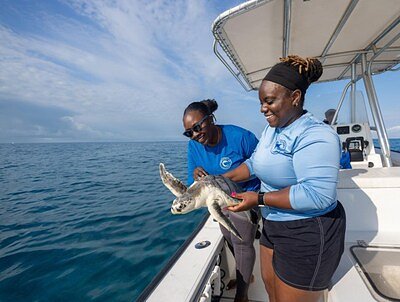
Nowhere is the resort's impact more poignant than in the stories of the animals it saves. Atlantis operates the only Marine Mammal Stranding Response Facility in The Bahamas, a critical resource for the entire region. The recent story of 'Lucky,' a critically endangered Kemp's ridley sea turtle, underscores the facility's importance. Rescued after being 'cold-stunned' in the frigid waters off Nova Scotia, the turtle was flown 2,700 miles to Atlantis for specialized veterinary care and rehabilitation before its successful release.
This is just one of over 7,500 sea turtles the resort and ABPF have assisted over the past two decades. The work extends to other magnificent species as well. The recent arrival of 'Kronos,' a young Atlantic manta ray with a six-foot wingspan, marks the continuation of a long-standing research program. Atlantis, which was the first facility in the Western Hemisphere to care for and study manta rays, collaborates with institutions like Mote Marine Laboratory to tag and track these enigmatic giants upon their release, contributing vital data on a species about which much remains unknown.
These high-profile cases are backed by a consistent record of success. In one remarkable instance, a spotted dolphin named 'M&M,' rescued and rehabilitated at the resort's Dolphin Cay habitat in 2018, was photographed four years later thriving with its original pod off the coast of Bimini—a rare and powerful validation of the rehabilitation program's long-term effectiveness.
Weaving Conservation into the National Fabric
The work being done at Atlantis does not exist in a vacuum. It is a significant contribution to The Bahamas' national identity as a leader in environmental stewardship. The nation has long been at the forefront of conservation, establishing one ofthe world's first marine protected areas in 1959 and continuing to work toward ambitious protection goals. Atlantis's initiatives directly support this national agenda.
Since 2010, the resort has donated over 8,000 young mangrove trees to partners like The Bahamas National Trust (BNT). These mangroves are essential for coastal resilience, protecting shorelines from storm surge, filtering water, and providing critical nursery habitat for countless marine species. By propagating and distributing these vital trees, Atlantis helps restore and expand one of the most important ecosystems in the country.
The ABPF's financial and logistical support has also been instrumental in expanding marine park boundaries, directly contributing to the more than 1.4 million acres of marine habitat the foundation has helped protect. By partnering with government agencies and established non-profits, the resort ensures its efforts are aligned with and amplify the country's broader conservation strategy.
Redefining the Tourist Experience
Ultimately, the long-term success of conservation may depend on its ability to capture the public's imagination. Atlantis is leveraging its unique position to bridge the gap between scientific work and public awareness. A portion of the proceeds from all guest marine interactions—from swimming with dolphins at the AZA-accredited and Global Humane Certified™ Dolphin Cay to other marine adventures—directly funds the ABPF's non-profit work.
New programs like 'Flippers, Fins and Feathers' go a step further, offering guests behind-the-scenes access to the resort's veterinary hospital and animal care operations. The goal is to transform a vacation experience into an educational one, fostering a deeper connection to the marine world and the complex efforts required to protect it.
While the true measure of such programs—their ability to inspire lasting behavioral change in tourists—can be difficult to quantify, the model itself is pioneering. By embedding conservation into its core business, funding research through guest experiences, and turning its 171-acre property into a living laboratory, Atlantis is challenging the traditional boundaries of a resort. It is building a legacy that extends far beyond its hotel towers, one that is measured in rescued turtles, restored reefs, and a new generation of visitors inspired to protect the ocean's wonders.