
- 7,808 improvements: Certified producers made nearly 8,000 documented operational improvements in 2025.
- 3.2 million metric tons: Total certified seafood production under GSA standards.
- 86% retention rate: High producer participation in the BAP program, reflecting its perceived value.
Experts agree that third-party seafood certification is driving measurable improvements in sustainability, food safety, and social accountability, with market demand reinforcing its critical role in the industry's transformation.
Beyond the Label: How Seafood Certification Drives Thousands of Real Changes
PORTSMOUTH, N.H. – February 26, 2026 – The global seafood industry, a critical source of protein for billions, is undergoing a quiet but profound transformation driven not by regulation alone, but by the rigorous demands of third-party certification. The Global Seafood Alliance (GSA) announced this week that producers certified under its standards made nearly 8,000 documented operational improvements in 2025, signaling a significant shift toward greater accountability in the journey from water to plate.
The data, detailed in GSA's annual report, reveals that its Best Aquaculture Practices (BAP) and Best Seafood Practices (BSP) programs are acting as powerful catalysts for tangible change. Certified producers, spanning 45 countries, collectively implemented 7,808 corrective actions last year, contributing to a total certified production of over 3.2 million metric tons.
The Anatomy of Improvement
While the figure of 7,808 improvements is impressive, its true significance lies in the process behind it. These are not voluntary upgrades or marketing claims; they are mandatory corrections of non-conformities discovered during intensive, independent audits. To earn or maintain GSA certification, facilities must address every identified issue, turning the audit process into a mechanism for continuous improvement.
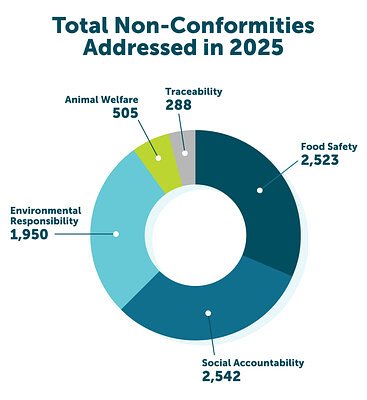
The improvements in 2025 were spread across the most critical areas of seafood production:
* Social Accountability (2,542 improvements): This was the area with the most significant number of corrections, reflecting a growing focus on worker welfare. These changes address everything from fair wages and workplace safety to ensuring equitable treatment. The GSA recently reinforced this focus by introducing a new Enhanced Social Module (ESM) for its processing plant standards, providing a more comprehensive framework for evaluating labor practices.
* Food Safety (2,523 improvements): Ensuring the safety of the final product remains paramount, with thousands of adjustments made to handling, processing, and storage protocols.
* Environmental Responsibility (1,950 improvements): Certified farms, hatcheries, and feed mills implemented changes to minimize their ecological footprint, from water quality management to responsible feed sourcing.
* Animal Welfare (505 improvements): A foundational pillar of the BAP standards, this category saw hundreds of enhancements to animal health and husbandry practices.
* Traceability (288 improvements): These corrections strengthened the ability to track seafood throughout the entire supply chain, a key factor in preventing fraud and ensuring authenticity.
"The nearly 8,000 improvements made across BAP- and BSP- certified facilities in 2025 are a powerful reflection of our industry's commitment to continuous improvement," said GSA CEO Mike Kocsis in a statement. He credited the producers and partners who "embrace third-party certification as a pathway to progress."
The Business Case for Responsibility
The push for certification is not purely altruistic. For the 4,308 producers in the GSA program—a figure that grew by 3% in 2025—adherence to these standards is increasingly a strategic business imperative. With a strong retention rate of 86%, the BAP program demonstrates that producers see tangible value in participation, from enhanced market access to fortified brand reputation.
A primary driver is the powerful demand from the marketplace. More than 200 retail and foodservice giants globally, including household names like ALDI, Publix, Lidl, and H-E-B, have committed to sourcing BAP-certified seafood. This commitment goes beyond a simple procurement policy; many of these partners actively collaborate with GSA on consumer-facing marketing campaigns. By featuring the BAP label in stores, on websites, and across social media, they leverage the certification to build shopper trust and loyalty.
This retail demand is a direct response to a more conscious consumer. Recent global research by GlobeScan, commissioned by GSA, found that two-thirds of consumers trust the BAP label, and over half said it would positively influence their purchasing decision. In a crowded market, a trusted third-party seal serves as a clear signal of quality and responsibility. While price remains a factor, studies show a growing willingness among shoppers to pay a premium for products they believe are sourced sustainably and ethically.
Setting a New Ethical Standard
Perhaps the most significant development in 2025 was GSA's bold move to address a long-standing ethical issue in shrimp farming: eyestalk ablation. The organization announced it will require all BAP-certified shrimp hatcheries to phase out the practice by the end of 2030.
For decades, the practice of surgically removing a female shrimp's eyestalk to induce egg maturation has been standard industry procedure. However, a growing body of scientific evidence and advocacy from animal welfare groups has highlighted the practice as a source of significant pain, stress, and trauma for the animals. Research has shown that ablated shrimp suffer from higher mortality rates, weakened immune systems, and behavioral signs of distress.
GSA's decision marks a pivotal moment, positioning it as a leader in setting new ethical benchmarks for the entire industry. The 2030 deadline acknowledges the complexities of transitioning away from a long-entrenched practice, giving producers time to adapt. GSA has backed its policy with funding for research into commercially viable alternatives, such as improved broodstock nutrition, environmental controls, and genetic selection. Progressive hatcheries in Asia and Latin America have already demonstrated that ablation-free production is not only possible but can lead to healthier broodstock and more robust offspring.
This move aligns GSA with the policies of several major European retailers that have already set their own deadlines for eliminating ablation from their supply chains, anticipating a market where higher animal welfare is no longer a niche demand but a baseline expectation.
A Ripple Effect in a Global Ocean
While GSA is a major force, it operates within a larger ecosystem of sustainability programs, including the Aquaculture Stewardship Council (ASC) for farmed seafood and the Marine Stewardship Council (MSC) for wild-caught fisheries. GSA's BAP program distinguishes itself by offering a comprehensive certification that can cover the entire aquaculture production chain—from feed mill and hatchery to farm and processing plant—a unique proposition that provides assurance from end to end.
The alliance's global reach was further solidified in 2025 with several key milestones, including the first BSP-certified fishing vessels in Argentina and the world's first BAP-certified oyster producers in both Japan and Australia. These achievements demonstrate the expanding influence of responsible practices across different species and geographies.
As global demand for seafood continues to rise, the role of programs like BAP and BSP becomes ever more critical. By linking rigorous, science-based standards with powerful market incentives, GSA is building a framework where environmental stewardship, social accountability, and ethical treatment are not just ideals, but integral components of a successful and sustainable modern seafood industry.