
- $14.6 billion: Annual cost of migraine-related lost productivity in Canada.
- 7 million workdays: Lost to absenteeism each year due to migraine.
- $9,200–$42,000: Estimated annual cost per employee with migraine to employers.
Experts agree that migraine imposes a significant economic and workplace productivity burden, requiring proactive accommodations to support affected employees and mitigate financial losses.
Beyond the Headache: The Real Cost of Migraine in the Workplace
KIRKLAND, QC – June 08, 2026 – As Canadian companies solidify their return-to-office (RTO) strategies, they are colliding with a significant, often invisible, public health reality: the five million Canadians living with migraine. A new awareness campaign highlights a growing disconnect between modern workplace design and the needs of a substantial portion of the workforce, creating a hidden drag on productivity that costs the Canadian economy billions.
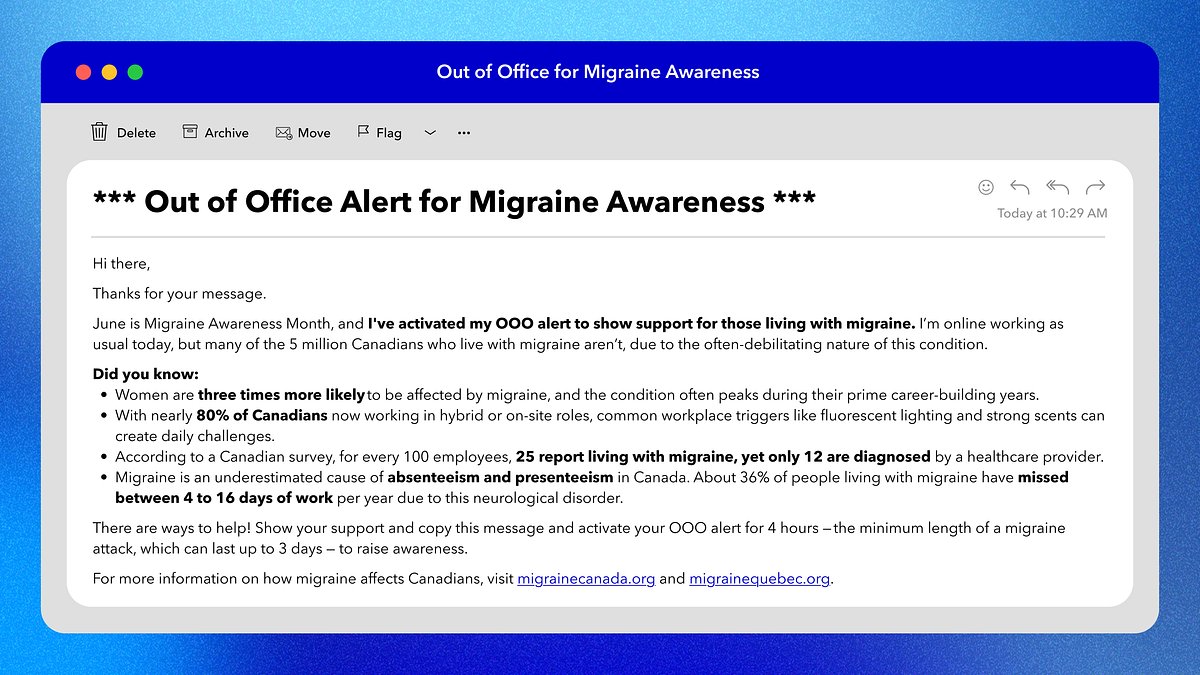
For the third consecutive year, Pfizer Canada, in partnership with Migraine Canada and Migraine Québec, is promoting its 'Out of Office for Migraine Awareness' campaign. The initiative encourages Canadians to set an OOO email alert for four hours—the minimum duration of an attack—to foster empathy and understanding. But as new survey data reveals persistent support gaps, the campaign's relevance has shifted from a simple awareness tool to a critical signal of a mounting business challenge.
A Collision Course: The Return-to-Office and Invisible Illness
The widespread shift back to in-person and hybrid work, now encompassing nearly 80% of Canadian workers, has inadvertently reversed the benefits many employees with migraine experienced during the pandemic. Remote work provided an invaluable sanctuary—a controlled environment free from the sensory triggers that define many modern offices.
"The return to shared workspaces means renewed exposure to common triggers," shares Dr. William Kingston, a neurologist at Toronto's Sunnybrook Hospital. "For someone living with migraine, this isn't a matter of preference – it's a clinical issue." He points to environmental factors like fluorescent lighting and strong scents, which can significantly lower the threshold for a debilitating attack. The imperceptible flicker of standard office lights and the prevalence of perfumes and air fresheners can turn a productive workday into a battle against nausea, light sensitivity, and severe pain.
This is not a niche problem. Migraine disproportionately affects women—who are three times more likely to experience it—and often peaks during their prime working years. The consequences can be career-altering. "I had to leave my career as a nurse because the demanding environment became impossible to manage with chronic migraine," comments Tiffany Eichhorst, a patient advocate from British Columbia. "This isn't just about debilitating pain... it's about careers being impacted and people having to make difficult choices between their health and their profession."
Her story is a stark reminder that a failure to accommodate is a failure to retain talent. As companies compete for skilled workers, creating environments that force employees to choose between their health and their job is a losing strategy.
The High Cost of Presenteeism
For business leaders, the issue extends far beyond employee well-being; it strikes at the bottom line. The economic impact of migraine in Canada is staggering, with lost productivity costing the economy an estimated $14.6 billion annually. This includes approximately 7 million workdays lost to absenteeism each year.
However, the more insidious cost is presenteeism—when employees are physically at work but not fully functional due to illness. Research consistently shows that presenteeism accounts for the majority of productivity loss related to migraine, with some studies suggesting it comprises up to 80% of the total economic cost. Recent Canadian studies estimate the annual cost to an employer per employee with migraine ranges from $9,200 to over $42,000, depending on the frequency of attacks and the methodology used.
These numbers paint a clear picture: employees are pushing through debilitating symptoms out of fear of stigma or a lack of support, operating at a fraction of their capacity. They are at their desks, but their focus, creativity, and output are severely compromised. This is a quiet but massive drain on operational efficiency that many organizations fail to track or even acknowledge.
From Awareness to Actionable Accommodation
The 'Out of Office' campaign serves as a vital conversation starter, but its ultimate value lies in catalyzing a shift from passive awareness to proactive accommodation. "The OOO Alert remains a simple but powerful tool to spark dialogue," says Wendy Gerhart, Executive Director of Migraine Canada. "Our collective goal is to turn that dialogue into meaningful action."
Meaningful action, in this context, is neither complex nor prohibitively expensive. Under the Canadian Human Rights Act, employers have a legal 'Duty to Accommodate' chronic conditions like migraine up to the point of undue hardship. Yet, many effective accommodations are simple, low-cost adjustments:
- Environmental Controls: Implementing a scent-free policy, installing anti-glare screen filters, using fluorescent light covers, or providing access to a quiet, dimly lit room for breaks.
- Flexibility: Offering flexible work hours, modified break schedules, and hybrid or remote work options to allow employees to manage their energy and avoid triggers.
- Supportive Policies: Educating managers and teams about migraine, ensuring benefits plans cover modern treatments, and removing the requirement for a doctor's note for every attack.
These are not perks; they are essential tools for talent retention and productivity. As patient advocate Susan Cape notes, the simple act of a manager or colleague asking, "I sense you're struggling, and do you need some support," can make an incredible difference. It transforms a silent struggle into a supported one, fostering loyalty and enabling an employee to contribute their best work.
The Leadership Imperative: Beyond the OOO Alert
Ultimately, creating a migraine-supportive workplace is a test of leadership and execution. It requires moving beyond rhetoric and implementing tangible policies. Pfizer Canada, a sponsor of the campaign, is modeling this by conducting its own internal survey to better understand the needs of its colleagues. "Our commitment extends beyond medicine to fostering communities of support for patients," said Frédéric Lavoie, a business lead at the company. This internal focus demonstrates a commitment to walking the talk.
For other Canadian organizations, the call to action is clear. The data is unequivocal, the legal duty is established, and the solutions are readily available. The question is no longer whether to act, but how quickly and effectively leaders can translate this understanding into an executable strategy that protects both their people and their productivity.