
- Event Date: February 11, 2026
- Book Praise: Could Should Might Don't has been praised by figures like Stephen Fry and Oliver Burkeman
- Podcast Success: Unlikely Collaborators' podcast reached #1 in the Science category on Apple Podcasts
Experts in futures design and perception studies would likely conclude that understanding and deconstructing our internal narratives is crucial for navigating the future more effectively.
Beyond the Crystal Ball: Rethinking How We Imagine the Future
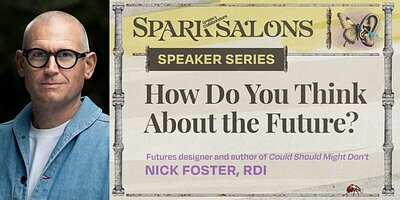
SANTA MONICA, CA – February 04, 2026 – In a world saturated with forecasts and predictions, one prominent futures designer is asking a more fundamental question: How do we think about the future? On February 11, Unlikely Collaborators will host Nick Foster, RDI, for a Spark Salon conversation that aims to shift the focus from predicting what’s next to understanding the internal narratives that shape our vision of it. The event, titled “How Do You Think About the Future,” promises a provocative look at the assumptions and mental shortcuts that define what we believe is possible, uncertain, or inevitable.
The discussion finds a natural home with Unlikely Collaborators, the nonprofit founded by Elizabeth R. Koch. The organization’s work is centered on its Perception Box™ framework, a concept that explores the unconscious collection of beliefs, fears, and experiences that quietly filter our reality. Foster's mission to deconstruct our visions of the future aligns seamlessly with the nonprofit's goal of helping people see themselves and the world more clearly, suggesting that our greatest barrier to navigating the future may be our own unexamined minds.
The Designer Who Rejects Predictions
Nick Foster is not a typical futurist. His career has been spent at the bleeding edge of technology, shaping future-focused projects for giants like Nokia, Sony, Dyson, and Apple. As the former Head of Design at Google X, the company’s celebrated “moonshot factory,” he led teams exploring everything from brain-controlled computers to neighborhood-scale nuclear fusion. Yet, despite this deep immersion in next-generation technology, Foster is known for his decidedly down-to-earth, even irreverent, approach.
He actively rejects the allure of grand predictions and corporate jargon. Instead, his work is designed to challenge assumptions and empower people to become more discerning critics of the endless future propositions we are sold. In 2013, he coined the term “future mundane,” a concept that seeks to ground speculative design in the relatable, everyday human moments of emerging futures, stripping away the escapist fantasy. This perspective earned him recognition from Fortune magazine as “one of the world's foremost leaders in speculative design” and, in 2021, the prestigious title of Royal Designer for Industry (RDI), the highest honor for a British designer.
Foster’s talks are intentionally provocative, designed to dismantle formulaic frameworks and inspire audiences to reconsider their relationship with what’s to come. He argues that the future is not a distant, alien territory to be discovered, but an extension of the present—a world continuously shaped by human hands, values, and choices.
Deconstructing the 'Perception Box'
At the heart of the upcoming salon is the synergy between Foster’s philosophy and the core work of Unlikely Collaborators. Founded by Elizabeth R. Koch, the organization is built on the Perception Box™ framework—a metaphor for the invisible mental structure that dictates how we interpret everything. This “box” is constructed from our unique mix of experiences, beliefs, biases, and fears, creating an unseen lens that can both clarify and distort our view of reality.
The nonprofit argues that becoming aware of this internal framework is the first step toward meaningful change and resolving conflict. By understanding the contours of our own Perception Box, we can gain distance from overpowering emotions and begin to see beyond our own limited perspective. This concept has found a significant audience, evidenced by the success of the organization's podcast, “Science of Perception Box.” Hosted by neuroscientists Dr. Heather Berlin and Dr. Christof Koch, the show explores how our minds construct reality and reached #1 in the Science category on Apple Podcasts in its first week, signaling a broad public appetite for understanding the intersection of neuroscience and self-awareness.
Unlikely Collaborators works with a wide range of thinkers, from neuroscientists to artists, to explore the practical applications of this idea. The collaboration with Nick Foster extends this mission, applying the principles of self-examination to the collective act of imagining the future.
A New Framework for Navigating Uncertainty
The event also serves as a platform for the ideas in Foster’s new book, Could Should Might Don't: How We Think About the Future. The book, which has already garnered praise from figures like Stephen Fry and author Oliver Burkeman, provides a guide for replacing lazy certainties with a more rigorous and empowering stance toward what’s next. Foster posits that humanity has developed predictable, and often limiting, patterns for envisioning the future.
He outlines four primary mindsets people adopt:
- Could: The excitable, science-fiction utopianism often frustrated by pragmatism.
- Should: The dogmatic certainty driven by data and dogma, common in corporate and political spheres.
- Might: The nuanced scenario planning of strategists and analysts.
- Don't: The risk-averse mindset rooted in fear and distrust of power.
Foster’s argument is not to favor one over the others, but to encourage a conscious understanding of which lens we are using at any given time. In a world where, as Kirkus Reviews notes, we need a “perspective on how to build a future that benefits our species’ survival,” this kind of mental toolkit becomes a crucial instrument for navigating complexity. The book reframes the future not as something to be controlled, but as a space for more tenacious, imaginative, and compassionate engagement.
More Than a Talk: A Salon for Challenging Ideas
The Spark Salons are a signature program for Unlikely Collaborators, designed specifically to create spaces for the kind of challenging conversations that Foster champions. These events are not passive lectures but active gatherings meant to foster connection and deepen understanding among a diverse community of artists, researchers, and collaborators.
The roster of past speakers—including illusionist Harris III, Harvard professor Michael Norton, PhD, and renowned neuroscientists Dr. Lisa Feldman Barrett and Dr. Wendy Suzuki—highlights the organization’s commitment to interdisciplinary dialogue. By bringing together varied voices, the salons aim to illuminate new paths by challenging the assumptions that hold communities and individuals back.
The upcoming event with Nick Foster will be held in person at the organization’s Santa Monica headquarters and livestreamed online, with free registration for both. In-person attendees will receive a complimentary copy of Foster’s book, providing a tangible guide to continue the exploration long after the conversation has ended. It is an invitation not just to hear about the future, but to actively participate in reimagining it.
Topics & Related
Generative AI
Digital Transformation
Machine Learning
Software & SaaS
AI & Machine Learning
Revenue
EBITDA
Related Company Pulse