
- 127% reduction in cost-per-lead for trucking recruitment
- 348% sales growth for ecommerce brands
- 10-15% enrollment growth for educational institutions
Experts would likely conclude that Colling Media's BDPN Framework offers a strategic, full-funnel approach that delivers measurable business outcomes, challenging the industry's reliance on fragmented, single-channel campaigns.
Beyond the Click: An Agency's Full-Funnel Framework Redefines ROI
PHOENIX, AZ – March 26, 2026 – In an advertising landscape often criticized for fragmented strategies and opaque results, one Arizona-based agency is making a compelling case for a return to integrated, full-funnel thinking. Colling Media, a top-ranked Google Premier Partner, recently announced significant performance breakthroughs driven by its proprietary BDPN Framework—a four-stage system designed to unify Brand, Demand, Performance, and Nurturing efforts. The agency claims its methodology is delivering dramatic, measurable business outcomes that siloed, single-channel campaigns simply cannot match.
With a track record built over 17 years and more than $50 million in managed ad spend, Colling Media's announcement isn't just marketing rhetoric; it's a direct challenge to the status quo. The firm is reporting impressive metrics across high-stakes industries, including a 127% reduction in cost-per-lead for trucking recruitment, sales growth of up to 348% for ecommerce brands, and double-digit enrollment growth for educational institutions. These figures suggest a potential paradigm shift, moving the conversation from isolated metrics like clicks and impressions to the business outcomes that matter most: revenue, hires, and growth.
A Systemic Answer to Industry 'Panic Moves'
The development of the BDPN Framework was born from observing a persistent and costly pattern: brands pouring money into bottom-of-the-funnel performance tactics while systematically starving the awareness and consideration stages that feed them. The result is a self-defeating cycle of rising acquisition costs and diminishing returns.
Brian Colling, CEO of Colling Media, frames the issue in stark terms. "CMOs are spending $40 CPMs on OTT and CTV to replace what used to cost $5 to $10 on traditional television, and they are calling that a programmatic strategy. It is not. It is a panic move," he stated in the company's announcement. Colling's critique taps into a broader industry anxiety. As marketers chase audiences from linear TV to streaming services, many have adopted expensive digital tactics without a cohesive strategy, leading to inefficient spending. The BDPN Framework, he asserts, is designed to "stop the panic" by creating a unified growth engine.
This critique resonates with wider industry trends. While programmatic advertising offers powerful targeting, it has been plagued by concerns over transparency, ad fraud, and a myopic focus on low-cost impressions over tangible business impact. Colling's argument suggests that simply buying ads programmatically on new platforms like Connected TV (CTV) without integrating them into a full-funnel strategy is a reactive measure, not a sustainable growth plan.
Deconstructing the BDPN Framework
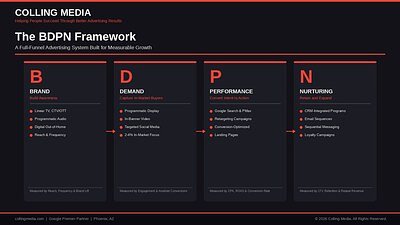
At its core, the BDPN Framework organizes every channel and creative asset around a clear understanding of the customer journey. It solves a common industry failing by assigning specific roles, channels, and metrics to each stage, ensuring that an upper-funnel brand campaign isn't judged by the same conversion metrics as a bottom-funnel search ad.
Brand: This is the top of the funnel, focused on building "mental real estate." Using channels like linear TV, CTV/OTT, and programmatic audio, the goal is to ensure a brand is already in a consumer's consideration set before they even begin an active search. Success here is measured by reach, frequency, and brand lift.
Demand: This middle stage targets the small fraction—typically 2-4%—of a market actively looking for a solution at any given time. With programmatic display, targeted social media, and in-banner video, these campaigns engage in-market consumers, driving them toward the brand. Measurement focuses on engagement, site visits, and assisted conversions.
Performance: This is the bottom of the funnel, where intent is converted into action. Google Search, retargeting, and optimized landing pages are used to capture high-intent buyers, generating phone calls, form fills, and purchases. The key metrics are direct and clear: Cost Per Acquisition (CPA), Return on Ad Spend (ROAS), and conversion rate.
Nurturing: Perhaps the most overlooked stage, Nurturing focuses on post-conversion engagement. Using CRM-integrated programmatic, email sequences, and sequential messaging, this stage aims to turn one-time buyers into repeat customers and brand advocates, maximizing their long-term value. Success is measured by retention rate, lifetime value (LTV), and repeat purchase rate.
"Most agencies start and stop at the Performance layer, fishing in a shrinking pond," Colling added. "If nobody knows you exist, your performance campaigns are going to be expensive and limited. BDPN ensures that the top and middle of the funnel are constantly feeding the bottom."
The Proof is in the Performance
While many agencies promote proprietary methodologies, Colling Media backs its framework with specific, cross-industry results. For its education clients, the integrated system has driven enrollment growth of 10-15% while improving media efficiency by 20%. In real estate, it delivered a 42% reduction in Cost Per Lead (CPL) and a 20% lift in lead-to-appointment rates by building local brand equity while capturing active buyers.
The most dramatic results were reported for a national trucking client, where the BDPN system drove a 127% reduction in CPL and a 3X improvement in lead quality—a critical achievement in a tight labor market. This was accomplished by targeting drivers across the media they consume daily, moving them from passive awareness to active application.
These outcomes are underpinned by a sophisticated approach to multi-touch attribution, which connects upper-funnel investment to lower-funnel sales. This stands in stark contrast to last-click models that undervalue the crucial brand-building and demand-generating activities that make performance campaigns effective. The agency's credentials, including its status as a top 3% Google Premier Partner and recognition on the Inc. 5000 list of fastest-growing companies, lend credibility to its ability to execute such complex, data-driven strategies.
By moving beyond vanity metrics and tying every dollar spent to tangible business outcomes like enrollments, leases, and hires, the framework provides the clarity and accountability that modern CMOs demand. It represents a disciplined, strategic alternative to the fragmented and often chaotic world of digital advertising, promising not just campaigns, but a predictable system for growth.