
- 210,000+ registered members in Midea Club across 21 countries
- Over 400 million installations supported by Midea Club
- 170+ assistance centers in Italy, including 8 specialized 'Blue Service' hubs
Experts would likely conclude that Midea's strategic shift towards a comprehensive service ecosystem represents a necessary and forward-thinking move to strengthen its competitive position in the HVAC industry, particularly in supporting the energy transition and installer expertise.
Beyond the Box: Midea's Plan to Reshape the HVAC Industry with Service
MILAN, Italy – March 30, 2026 – At the bustling MCE 2026 exposition, a major player in the global appliance market signaled a fundamental shift in its strategy that could send ripples through the HVAC industry. Midea, under the banner of "Green Vision, Blue Future," moved beyond simply showcasing new hardware. Instead, it debuted a transformative evolution of its professional service ecosystem, a clear declaration that the future is not just about the products sold, but the support and partnerships built around them.
With a formidable lineup of its top leadership present—including Alex Zhu of Residential Air Conditioning, Dennis Lee of Building Technologies, Meteor Liu of Kitchen & Water Heater Appliances, and Midea Italia's own Alberto Di Luzio—the company underscored its commitment to this new direction. The focus was squarely on the Midea HVAC Professional Service System, a holistic framework designed to support installers, partners, and customers throughout a product's entire lifecycle.
A Strategic Pivot from Products to Partnerships
For years, the HVAC industry has operated on a largely product-centric model. Midea's latest initiative represents a significant pivot towards "servitization"—an integrated approach where the product is intrinsically bundled with a suite of services. This strategy aims to build deeper relationships and create a more resilient business model, a necessary evolution in a market where competitors like Daikin and Carrier are also heavily investing in installer support and sustainability programs.
The Midea HVAC Professional Service System is built on three core pillars:
Midea Club: This global installer incentive program is the cornerstone of the company's outreach to trade professionals. Already active in 21 countries with what Midea reports as over 210,000 registered members, the platform offers rewards, free training, AI-assisted tools, and new business leads. The company claims the program has already been instrumental in over 400 million installations, demonstrating its scale.
Midea Solutions Hub: Moving beyond the digital realm, these are physical, collaborative spaces set up with local partners. They function as showrooms for product display and customization while also serving as streamlined pickup points for installers, helping to optimize their daily operations.
Blue Service & Midea Academy: Forming the backbone of Midea's technical support, this pillar is about ensuring quality and building trust on the ground. In Italy alone, the company operates over 170 assistance centers, including eight specialized "Blue Service" hubs that act as micro-logistics centers for spare parts. This network is designed to provide rapid, high-quality service and technical training, strengthening the brand's local presence.
This shift addresses what has been a mixed aspect of the company's reputation. While known for its innovative and competitively priced products, Midea's service and support network has faced criticism. This new, comprehensive ecosystem appears to be a direct and ambitious attempt to turn a potential weakness into a core competitive strength.
Empowering Installers for the Energy Transition
A key theme emerging from Midea's announcement is the central role of the professional installer. As heating and cooling technologies become more complex and integrated with sustainable energy sources, the expertise of the technician on the ground becomes paramount. Midea is positioning itself as a key partner for these professionals.
This philosophy was highlighted in a panel discussion hosted with the Italian HVAC association, Assoclima, titled "Installers Driving the Energy Transition." The dialogue focused on the global shift away from a product-only focus, emphasizing the need for installation standardization and enhanced technician expertise to build deeper trust with customers.
By providing robust training through the Midea Academy and tangible business benefits through the Midea Club, the company is investing in the workforce that will ultimately be responsible for implementing its "Green Vision." This is particularly crucial with the rise of advanced refrigerants like R290, which offer significant environmental benefits but require specialized handling due to their flammability, making certified training essential.
The Engine of Change: A Fleet of Green Technology
This service-oriented strategy is backed by a powerhouse lineup of new and updated products heavily focused on sustainability and efficiency. Midea's showcase made it clear that its service ecosystem is designed to support a new generation of green technology, driven largely by tightening regulations like the EU's F-Gas Regulation.
In the residential space, Midea highlighted the successful rollout of its R290 split AC units in Malta, presenting it as a blueprint for the rest of Europe. The company also debuted the PortaSplit Cool, a new addition to the range that TIME magazine recognized as one of the "Best Inventions of 2025" for its innovative, installer-free design. Other notable products included the H-Pack indoor heat pump, which secured an MCE Excellence Award, and the AI-powered Solstice system, which promises to reduce energy consumption by over 30%.
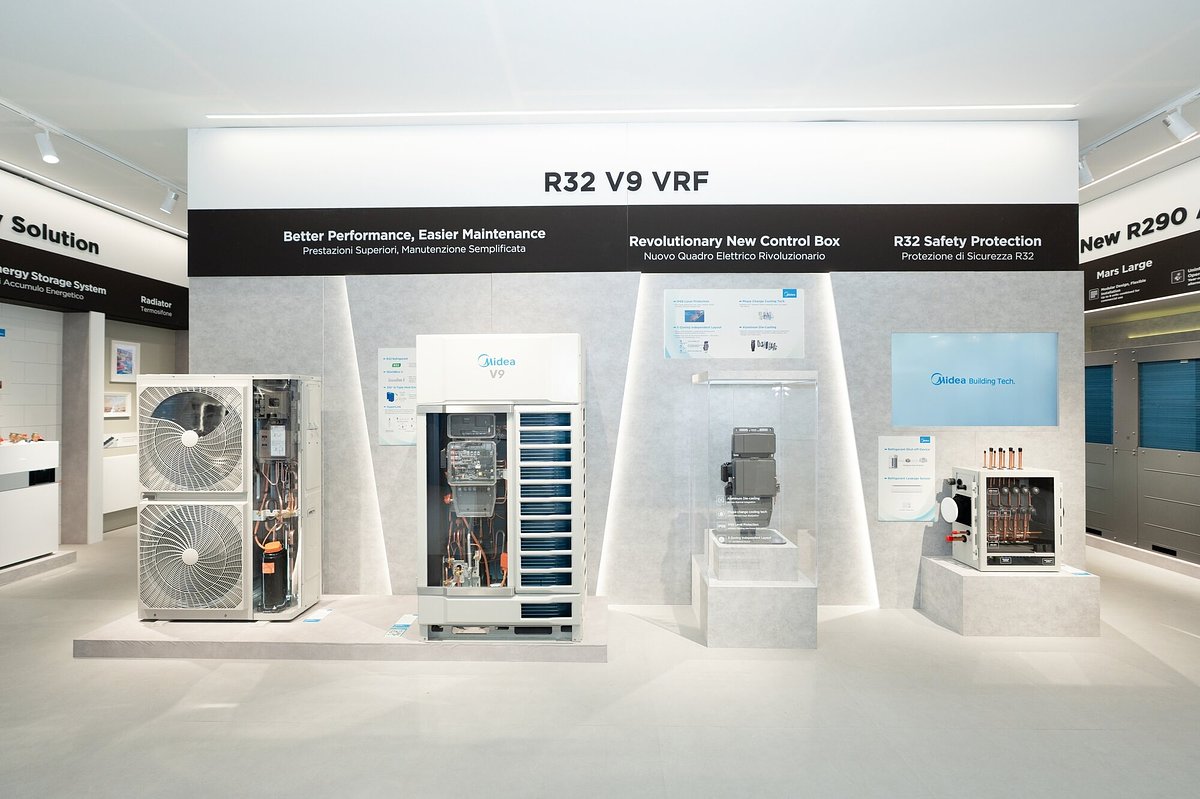
For commercial applications, Midea Building Technologies (MBT) introduced the new V9 VRF system and a full range of R290 heat pumps. It also showcased data center cooling systems with impressive Power Usage Effectiveness (PUE) ratings as low as 1.2, targeting a critical sector for energy consumption.
This focus on sustainable technology, particularly low-GWP refrigerants and high-efficiency heat pumps, positions Midea to capitalize on Europe's aggressive energy transition goals. By creating an ecosystem that not only provides the hardware but also trains the professionals needed to install and maintain it, the company is building an end-to-end solution. As the industry watches, the success of this integrated 'product + service' model will depend not just on innovative technology, but on Midea's ability to deliver on its ambitious promise to empower the professionals on the front lines of Europe's green energy transition.
Topics & Related
Decarbonization
Net Zero
Trade Wars & Tariffs
Automation
Revenue
EBITDA
Related Company Pulse